The afforestation project around Inner Mongolia's Malan Lake has grown into a fine example of how ecological engineering, economic incentives and institutional cooperation can reinforce one another
4-MIN READ4-MINAdvertising partnerPublished: 12:00am, 31 Aug 2026[The content of this article has been produced by our advertising partner.]
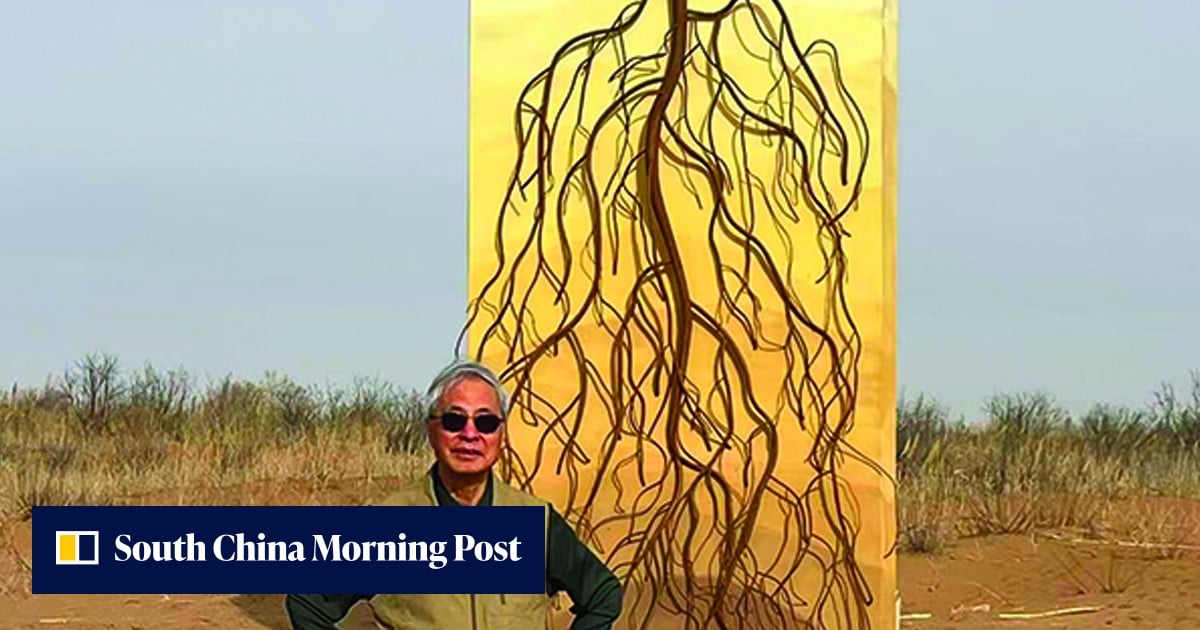
On the southeastern rim of the Tengger Desert, where dunes can rise 30 metres high and advance significant metres a year, a private afforestation effort is attempting something larger than tree planting. At Malan Lake in Alxa, Inner Mongolia, founder Mr YUEN Shu Wah is testing whether desert restoration can succeed by redesigning not only landscapes, but also livelihoods and governance.
Battling Moving Sand
“Countries, cities and villages have been annihilated by the desertification,” Yuen says, describing the stakes in stark historical terms and adding the spread of desert conditions affects communities “very, very much” and must be stopped.
Malan Lake lies along an ecological corridor where unchecked expansion can intensify sandstorms and push degradation outward. Greening this frontier, Yuen argues, helps “hold the desert expansion” at a critical point. His aim is afforestation, which is the process of planting trees where there have not been any for a long period of time, as opposed to reforestation where new trees are planted to replace old or missing ones in existing forests.
Yuen began exploring desert restoration in the late 2000s and formally established Alxa League Springfield Forest Limited in 2011 to scale the Malan Lake initiative. When he first surveyed the site around 2010, he encountered moving dunes up to 30 metres high, advancing roughly 12 metres a year.
Early planting efforts revealed how technically complex the terrain was: seedlings on the windward side could be uprooted, while those on the leeward side risked burial. After more than two years of experimentation and hesitation, Yuen committed significant capital in and around 2013–2014, shifting from small-scale trials to systematic afforestation.
The project has since expanded dramatically. At its most intensive recently, it reported planting up to 150,000 mu—approximately 100 square kilometres—of desert in a single year. Planting density is intentionally low, at about 50 plants per mu (roughly 750 per hectare), reflecting dryland forestry practices designed to maximise survival under limited rainfall.
Yet Yuen is quick to temper any sense of triumph. Against the vastness of the Tengger Desert, he says, even these gains remain “a drop in the bucket”. Nevertheless, what began as a cautious pilot has evolved into a structured operation involving partnership between full-time staff, seasonal workers, university, research organisations and government, demonstrating both scale and organisational maturity.
What distinguishes the Malan Lake model is not only its scale but its structure. It is largely privately funded, operating with the discipline of a business while pursuing public ecological objectives.
“The unique point is, firstly, it comes from a private source of funding,” Yuen explains. In addition, the emphasis is very much on keeping costs down and maintenance needs low. The team focuses on planting indigenous, drought-resistant species capable of surviving harsh conditions with little or no irrigation. “The plant needs to survive on its own,” Yuen says, adding that the aim is to tackle “the most harsh conditions” at minimal cost.
This technical discipline is matched by a social one. For Yuen, desertification cannot be separated from human behaviour. Overgrazing has long contributed to land degradation, but simply restricting herds without offering alternatives risks undermining livelihoods. “We try to green the desert and keep the people happy,” he says. “We need people to look after the land.”
That philosophy has led to the development of what he calls a “sand industry” - economic activities adapted to arid conditions. Cultivating Tremella mushrooms, using local shrubs as a growing medium, has become one example of an alternative income stream. The initiative also promotes indigenous plant propagation and cultivating medicinal species suited to desert environments. These ventures are designed to reduce dependence on expanding herds while giving residents a stake in ecological recovery.
“In order to let people stay there without relying only on overgrazing, we developed a sand industry,” Yuen says. “Since we're able to develop the Tremella industry, this is an innovative sort of livelihood for the local people.”
He acknowledges that policy efforts to curb overgrazing face limits if livelihoods are not addressed, pointing out that without viable alternatives, behavioural change is difficult to sustain. Yuen has called on enterprises and educational institutions to help develop more desert-based industries that align economic incentives with conservation.
“The government also knows that they need to change the herdsmen’s habit of overgrazing. But if they cannot find a good livelihood for the herdsmen… their achievement is limited,” he says.
Participation extends beyond local communities. Universities have reserved plots of land where students can take part in greening efforts over several years. Corporate partners contribute not only funding but also procurement support, for example by purchasing desert-grown products as gifts. In this way, ecological restoration is woven into supply chains and ESG strategies.
Technology is increasingly central to the project’s governance model. In its early years, operations relied heavily on field experience and practical experimentation. Now, in collaboration with City University of Hong Kong (CityUHK), the team is introducing environmental sensors and exploring satellite assessment to monitor larger areas. The goal, Yuen says, is to improve predictive capability, to understand better what can and cannot be done under volatile desert conditions, and to make the project more productive.
“We always wish to make better predictions of what we can do, what we cannot do. I think it helps to make the project more productive,” he explains.
He situates the work within a broader ESG and SDG framework. Environmental gains include biodiversity restoration and carbon sequestration; social benefits include employment and education about sustainable land use; governance innovation lies in cross-sector collaboration between private funders, public institutions and research partners.
“To find out ways and means to do this is by itself an achievement,” he reflects.
A Model for All
The project has made considerable progress, but Yuen acknowledges its limitations and emphasises that the ambition is not to conquer the desert single-handedly, but to demonstrate that restoration is possible—and replicable.
“We want more companies, enterprises, foundations, individuals to realise it is possible to forest the desert land,” he says, “and hopefully they can chip in and do the same.”
After more than a decade of work, Yuen believes the team has gradually found its way. Malan Lake now stands as more than a green patch against a shifting horizon: it is a test case for how ecological engineering, economic incentives and institutional cooperation can reinforce one another.
In a landscape defined by wind and sand, the project suggests that the more durable force may be governance—the careful alignment of people, capital and purpose towards a common environmental goal.