Video USS George Washington arrives for new Middle East mission Operations and scenes on the mess deck on the aircraft carrier, USS George Washington, filmed in the Arabian Sea, August 2026. (Video US Navy via DVIDS.)
FIRST ON FOX: Morale is said to be high as the aircraft carrier the USS George Washington has arrived in the Arabian Sea near the vital Strait of Hormuz and close to Iran.
The carrier, CVN 73, has replaced the USS Abraham Lincoln. Fresh from a visit to Vietnam three weeks ago, the 5,000 sailors aboard this mobile airfield, base to approximately nine operational squadrons of advanced strike fighters, electronic attack planes and helicopter assets are, according to senior officers, ready and willing to carry out their new mission.
"Morale aboard USS George Washington remains high among our sailors," Capt. Nicholas DeLeo, the ship’s Commanding Officer, told Fox News Digital. He added "I see this as I walk the deck plates, seeing them take pride in their work — whether conducting flight operations, maintaining our systems or supporting one another on the ship. The dedication and teamwork I see across the ship is outstanding, and that spirit keeps us ready and resilient."
CENTCOM COMMANDER TOUTS USS ABRAHAM LINCOLN MENTAL HEALTH RECORD AFTER MORE THAN 260 DAYS WITHOUT PORT CALL
Nimitz-class aircraft carrier USS George Washington (CVN 73) conducts routine operations while underway in the Arabian Sea, Aug. 22, 2026. George Washington is deployed to the U.S. 5th Fleet area of operations to support maritime security and stability in the Middle East. (U.S. Navy photo)
The George Washington, a Nimitz-class carrier, is the flagship of Carrier Strike Group (CSG) 5, and is reported to be accompanied by several warships, including the guided missile cruiser USS Robert Smalls (CG 62) and the guided missile destroyer USS Shoup (DDG 86).
Commander of Carrier Strike Group Five, Rear Adm. Jeff Heames, told Fox News Digital "The teams aboard USS George Washington and Carrier Strike Group Five are ready, determined, and resourced for sustained operations. Our Sailors understand the importance of the mission and continue to execute with precision and professionalism every day."
With the carrier group now operating in the Middle East, it falls under US Central Command (CENTCOM). The command’s former Commander, Gen. Joseph Votel, (Ret.), recently told Fox News’ America Reports about the George Washington’s expected mission, saying "Being able to continue to have credible military capability in the Middle East is really important, so the arrival of the George Washington is I think a good example of that."
Votel continued, "We’re going to have to be prepared, because this is probably going to take some time, to continue to bring forces into the region, we want them to be at a high level of readiness."
IRAN WAR THRUSTS DIEGO GARCIA INTO SPOTLIGHT AS OFFICIAL CALLS US MILITARY BASE ‘INTEGRAL’
Image 1 of 2 next An EA-18 Growler, attached to Electronic Attack Squadron (VAQ) 141, launches off the flight deck of Nimitz-class aircraft carrier USS George Washington (CVN 73) while operating in the Indian Ocean, Aug. 18, 2026. (U.S. Navy photo by Chief Mass Communication Specialist Joshua Karsten)
Image 2 of 2 prev A U.S. Navy Sailor launches an F/A-18 Super Hornet attached to Strike Fighter Squadron (VFA)195, off the flight deck of Nimitz-class aircraft carrier USS George Washington (CVN 73) while underway in the Arabian Sea, Aug. 21, 2026. The USS George Washington is deployed to the U.S. 5th Fleet area of operations to support maritime security and stability in the Middle East. (U.S. Navy photo)
Flight operations continue, both day and night. Launching into the skies off Iran from the George Washington, aircraft based on board are reported to be F/A-18E/F Super Hornet multirole strike fighters, F-35C Lightning II fifth-generation stealth multirole fighters, EA-18G Growler electronic warfare aircraft and E-2D Advanced Hawkeye airborne early warning and control.
Also onboard are said to be MH-60S Seahawk & MH-60R Seahawk multi-mission helicopters for anti-submarine warfare and search-and-rescue.
This past week, a historic landing on the George Washington. Navy Lt. Steven Frazier, a pilot from Strike Fighter Squadron 147, the Argonauts, made the 200,000th trap - landing on the ship in an F-35C Lightning II fighter jet, with his stealth fighter caught by a thick, steel arresting gear cable with the jet’s tail hook.
In a laid-back understatement that could have come straight out of the movie ‘Top Gun’, Lt. Frazier said, "It's a good feeling for me to know that once I leave, I can come back to the aircraft carrier and trap". The carrier can land one aircraft on deck per minute, and typically lands 70 aircraft a day.
IRAN WAR FORCES AMERICA TO CONFRONT THE STRATEGIC COST OF DETERRING CHINA
An F/A-18 Super Hornet, attached to Strike Fighter Squadron (VFA) 27, prepares for takeoff aboard Nimitz-class aircraft carrier the USS George Washington in the Arabian Sea Aug. 21 2026. (NAVCENT Public Affairs)
Attention to mission is evident throughout the ship. On the bridge, Assistant Navigator Elizabeth Wayne told the ship’s communication team, "all of the time when we are navigating, we are focused outside of the ship on anything that could pose a hazard or a threat to the ship."
Wayne continued, "When we are in special evolution, when we are conducting flight operations, the most important thing is to ensure we are lock step with (the) airboss, the captain, the command duty officer underway, everybody needs to be on the same page to execute that safely."
As it arrived in the Middle East, Russia tried to suggest the food on the carrier was not good. Russia Today (RT) posted what are believed to be AI-generated photos of poor rations on board. However, from the videos seen by Fox News Digital of great food and even a café below decks, the truth appears to be very different. Victoria Marc, Culinary Specialist 2nd Class, talked to the communications team on the carrier, noting that "throughout the day and into the night, our sailors have all sorts of food and drink options available to them."
Image 1 of 2 next One hundred and fifty cooks onboard provide 15,000 meals a day onboard the USS George Washington on Aug 17, 2026. (Screenshot from US Navy video)
Image 2 of 2 prev A sailor tucks into his breakfast with fresh bread on board the USS George Washington in this Aug. 17, 2026 photo, 150 cooks onboard provide 15,000 meals a day. (Screenshot from US Navy video)
Marc added, "Sailors have the opportunity to eat three meals a day, plus the night rations. Our 150 cooks work 24 hours to prepare and serve 15,000 meals a day to ensure our sailors are well-fed. From the mess deck throughout the day, there’s always something there where people feel fueled and ready for the fight."
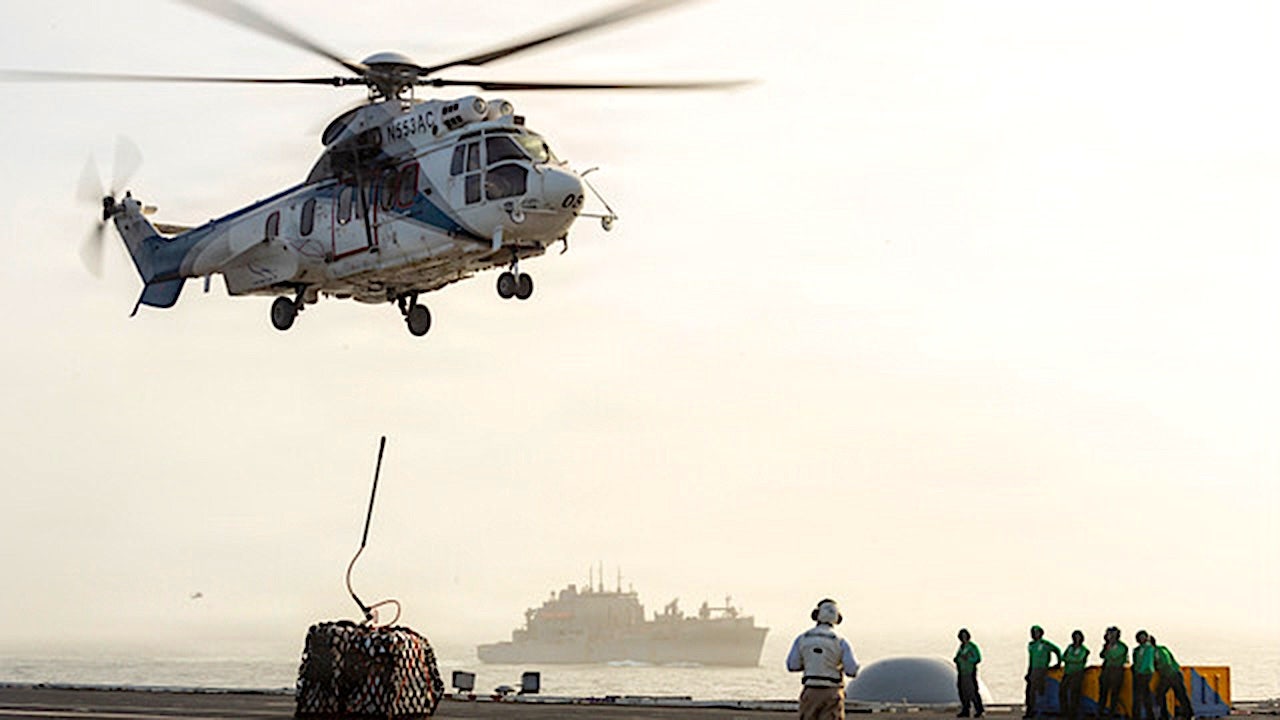
And the Navy intends keeping it this way. Earlier this week, CENTCOM published images of the George Washington being replenished at sea. Navy images show the ship being resupplied twice in four days this past week, an average of 2,000 pallets of supplies including fresh food and ammunition winched by helicopter from a nearby supply ship.
Fuel for the carrier’s aircraft is also transferred ship-to-ship. The carrier is nuclear-powered, so the ship itself will not need refueling at sea.
WHO CONTROLS THE STRAIT OF HORMUZ RIGHT NOW? HERE'S WHAT THE SHIP TRAFFIC ACTUALLY SHOWS
A Eurocopter AS-332 Super Puma, attached to fleet replenishment oiler USNS Henry J. Kaiser (T-AO-187), delivers supplies to Nimitz-class aircraft carrier USS George Washington (CVN 73) during a replenishment-at-sea evolution in the Arabian Sea, Aug. 22, 2026. George Washington is deployed to the U.S. 5th Fleet area of operations to support maritime security and stability in the Middle East. (U.S. Navy photo) (US Navy photo)
More history this week – under the headline "Shoutout to our Shipbuilders!!", the ship’s communications team posted "40 years ago on August 25, 1986, the keel for USS George Washington was laid."
CLICK HERE TO DOWNLOAD THE FOX NEWS APP
Today in the Arabian Sea, that keel supports the 5,000 men and women and their array of air firepower, as they stand at the coalface of the Middle East conflict, ready – and willing – to carry out their mission.
Paul Tilsley is a veteran correspondent who has reported from four continents for more than three decades. Based in Johannesburg, South Africa, he can be followed on X @paultilsley.