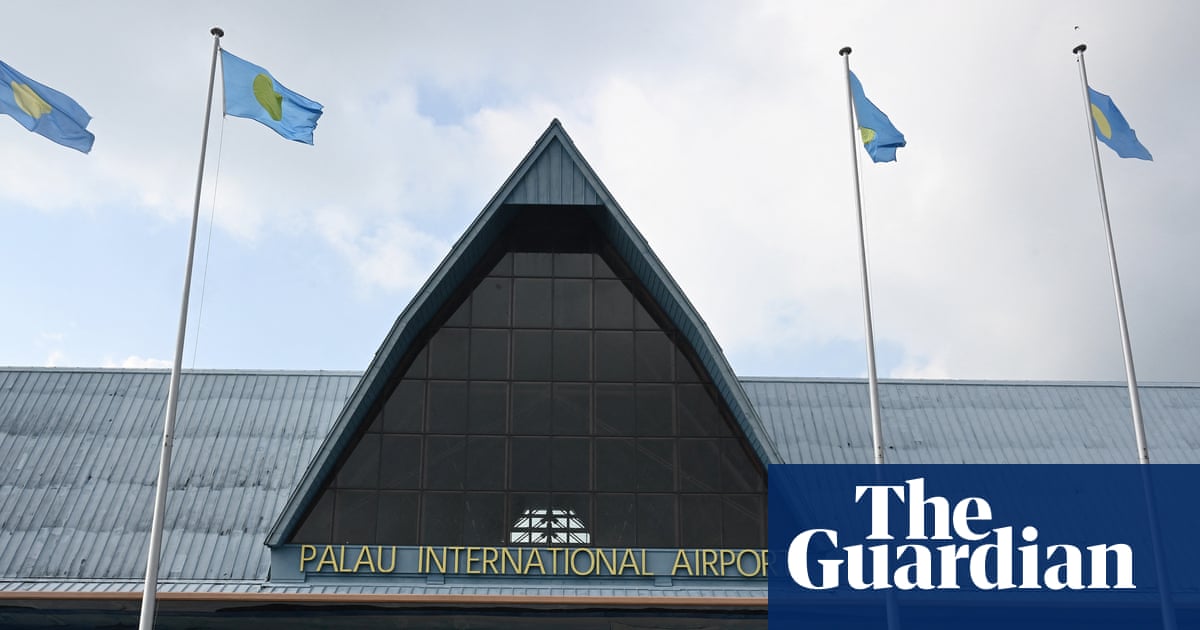
Pacific Islands leaders and delegates arrive at Palau International Airport ahead of the 55th Pacific Islands Forum leaders meeting. Photograph: Saeed Khan/AFP/Getty ImagesView image in fullscreenPacific Islands leaders and delegates arrive at Palau International Airport ahead of the 55th Pacific Islands Forum leaders meeting. Photograph: Saeed Khan/AFP/Getty ImagesPacific Islands Forum meeting in turmoil after several leaders pull out of Palau summit Solomon Islands prime minister cancels his appearance, along with leaders from Fiji, Vanuatu and Samoa
Several leaders have pulled out of a the Pacific Islands Forum leaders’ meeting in Palau at the eleventh hour.
Solomon Islands prime minister, Matthew Wale, has cancelled his appearance after a no-confidence motion was lodged against him at home by the Solomon Islands home affairs minister, Manasseh Maelanga.
Maelanga accused Wale of “repeatedly making decisions of matters of national importance without proper consultation with, or the approval of, cabinet, thereby undermining the principles of collective cabinet responsibility, representative democracy and good governance”, according to the ABC.
Australia has been in negotiations with the Solomons on a security treaty, with the hope that further negotiations could have taken place on the sidelines of the summit.
Fiji’s prime minister, Sitiveni Rabuka, and his Vanuatu counterpart, Jotham Napat, will also not be attending, with the Samoan leader, La’auli Leuatea Schmidt, another notable absence.
The Australian prime minister, Anthony Albanese, has confirmed he will still be attending.
Oliver Nobetau, the Lowy Institute’s Pacific Islands program director, said the pulling out by key leaders “dulls the flame” of the meeting.
“This has been shaping up to be quite a significant PIF … it’s really unfortunate that this is the case,” he told Guardian Australia.
“With the pulling out of this many key prime ministers within the region, it dilutes the potential of what could come out of this leaders’ meeting.”
Nobetau said there were high expectations that this leaders’ meeting could progress pilot projects around Pacific climate resilience, and was important ahead of the COP31 climate summit, where a pre-leaders summit will be held in Tuvalu in October.
He added the leaders not showing up could be read as those nations prioritising bilateral agreements with nations including Australia above region-wide commitments.
“PIF has to demonstrate its usefulness as well. While it is a useful forum for a lot of our Pacific members, maybe the bigger countries feel there are more pressing issues or they can achieve more benefits for their countries by engaging bilaterally or directly with other partners.”
Speaking at Queensland Labor conference on Sunday in Brisbane, Albanese said Australia had a duty to help Pacific nations thrive.
Albanese said allowing Pacific nations to succeed would also benefit Australia.
“The big challenges facing the Pacific require solutions designed and delivered for the Pacific, by the Pacific,” he told the
“Australia has a key role to play, as a partner and leader.
“In a time of strategic competition in our region, our engagement in the Pacific Islands Forum and our contributions to the infrastructure, regional security and climate action of the region matter more than ever before.”
The visit follows the prime minister signing a security deal with Fiji, elevating the bilateral relationship to a formal alliance as Australia seeks to curb Chinese influence in the region.
Pacific leaders are set to discuss security and climate concerns during the summit.
Albanese said Australia would also seek to reiterate support for Pacific workers coming to the country.
Debate has recently raged over how the Pacific Australia Labour Mobility Scheme cohort would factor into immigration cuts flagged by various parties.
Representatives of the resurgent One Nation have been pressed to clarify that PALM workers, many of whom provide much-needed labour in regional areas, would not be included in a significant reduction to net overseas migration.
Albanese said the migration discussion had been fuelling division and the Pacific worker scheme would continue because of its critical economic benefit.
“People from the Pacific make an enormous contribution to Australia’s prosperity through their vital work in regional industries like agriculture and meat processing,” he said.
“So many of our farmers and food producers rely on them.
“We know also the wages they remit home help boost the economies of their families and communities, contributing to the prosperity and stability of the whole region.”