Add The New York Post on Google President Trump’s “economic D-Day” against Iran has been greeted with understandable skepticism. Trump has spent a decade spectacularly undermining his own credibility — and America’s — and Treasury Secretary Scott Bessent’s opening sanctions package against roughly 60 Iran-linked individuals, companies and vessels hardly resembled Normandy.
Yet behind the theatrics lies a potentially powerful strategy in pursuit of a just cause, if the West shows some staying power. Iran’s vile regime actually can be choked economically. But it will take months of pain. The contest comes down to something simpler than sanctions architecture: Who can tolerate the pain longest?
Iran is betting that Western political patience expires before Iran’s economic oxygen does. Jihadists have long viewed the West as decadent and incapable of sustained resolve, and dictatorships can impose hardships that democratic governments struggle to sustain politically.
China buys more than 80% of Iran’s shipped oil, with some estimates approaching 90%. Almost all of what Iran is selling was stashed offshore before the war, and has escaped the blockade — and it is running low and will run out. Already, Iranian shipments to China have fallen to roughly 534,000 barrels a day this month from about 1.4 million barrels daily last year, while Chinese refiners are already seeking replacement barrels from Iraq and Brazil.
Iran has spent decades becoming remarkably adept at circumventing financial sanctions. Tankers change identities, vessels go dark, cargoes move ship-to-ship, shell companies proliferate and payments migrate into yuan. China can buy Iranian oil outside the conventional dollar system, while Iran can spend yuan on Chinese goods.
All that helps Iran disguise and monetize a barrel that reaches the world market. It does not solve the problem of getting the next barrel out. Jask, Iran’s alternative terminal on the Gulf of Oman, offers limited relief; sustained loadings remain far below the volumes Tehran needs.
The crucial figure, however, is the oil Iran managed to position beyond the blockade before exports were constricted. Reuters reported that Iranian floating storage outside the blockade had fallen from roughly 105 million barrels to around 80 million, with about 30 million barrels in Asian waters. Those stocks allow deliveries to continue even as fresh exports plunge, creating an illusion of resilience.
But the stockpile is shrinking, and Iran’s bravado is a charade.
It entered the war suffering from chronic electricity shortages, deteriorating infrastructure and a severe water crisis after years of drought and groundwater depletion. The rial has lost roughly 80% of its dollar value since late 2022. Inflation has ravaged purchasing power. Last winter’s riots, followed by the massacre of tens of thousands, were driven partly by economic despair.
Once the external stockpile runs sufficiently low, the dynamics become unbearable. Lower exports mean less foreign currency, greater pressure on the rial and fewer resources for imports, subsidies, government salaries, the security apparatus and the war itself.
Iran’s floating oil resembles a family living from savings after losing most of its income. Spending can continue for months, preserving an appearance of normality while the bank balance races toward zero. Oil outside the blockade is savings; new exports are income. Push the regime far enough and it approaches a cliff — including the point at which it may lack the resources to pay the forces required to suppress a furious population.
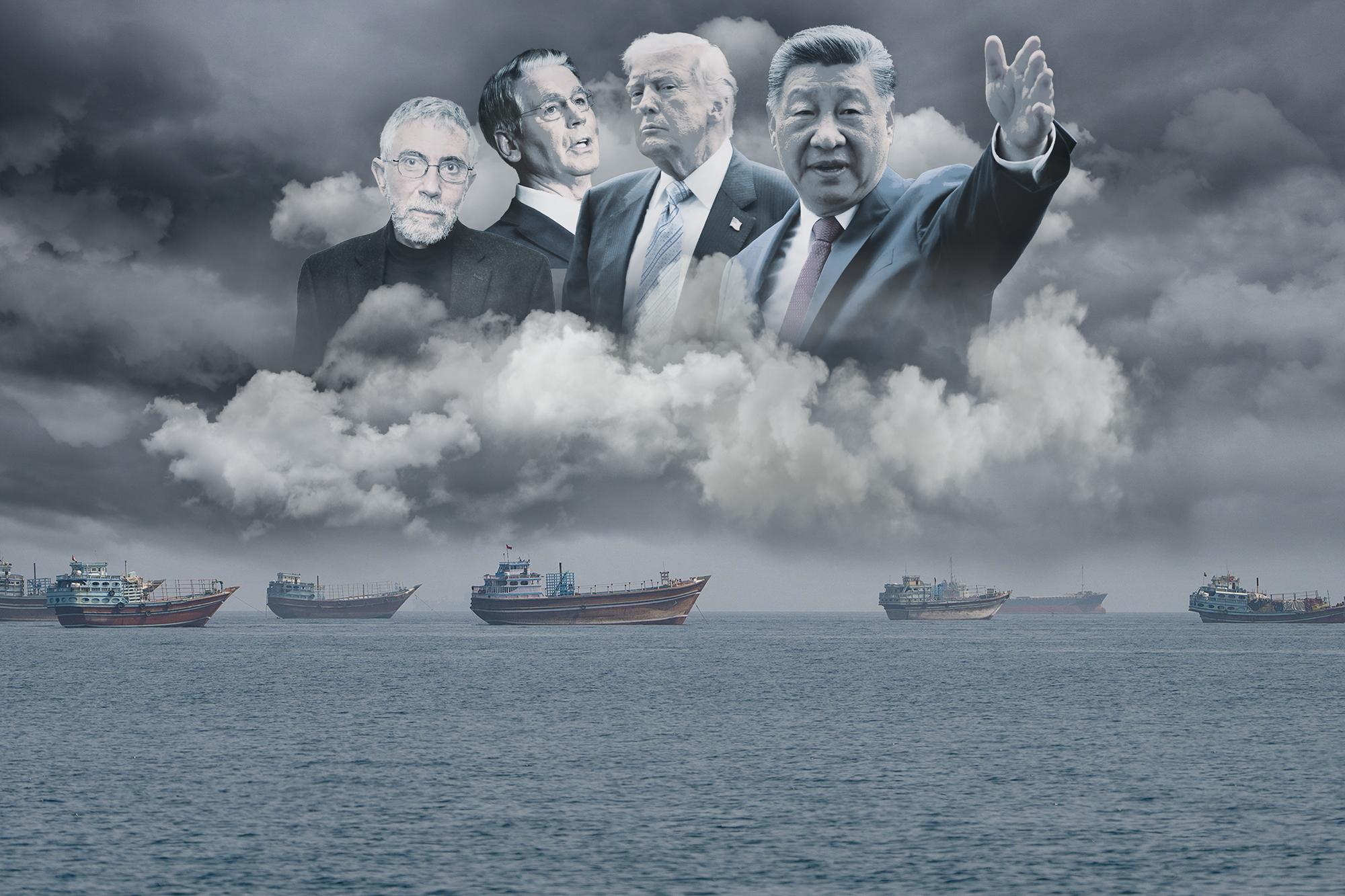
Economist Paul Krugman sees the confrontation differently. He greeted Bessent’s announcement by saying the “D” in “D-Day” stands for “Dud,” arguing that China has given Iran ways around American financial coercion and that Washington risks enormous collateral damage if it sanctions institutions important enough to force Beijing’s hand.
His strongest point concerns timing. Americans experience higher gasoline prices immediately. Businesses feel higher energy and transportation costs immediately. Voters judge Trump immediately. Iran’s storage crisis unfolds over months.
Krugman’s argument underweights the distinction between Iran’s ability to get paid for oil and its ability to produce and export enough oil to get paid for. Yuan settlement solves the first problem. China provides buyers and intermediaries. Neither replenishes a declining offshore stockpile.
China is the wild card. Iranian commerce is tiny beside Beijing’s economic relationship with the United States and Europe, giving Chinese companies powerful incentives to comply with sanctions. Xi Jinping also has a geopolitical interest in resisting Washington’s ability to dictate Chinese foreign policy through financial pressure. Much may therefore depend on whether the West appears determined enough to make Iran look like a lost cause.
Trump’s task is to persuade Americans that several months of pain could produce an extraordinary strategic return: a severely weakened Islamic Republic, a diminished network of terrorist proxies, reduced threats to Gulf states and energy infrastructure, damage to the Tehran-Moscow-Beijing alignment, and perhaps an opportunity for Iranians to escape the murderous theocracy imposed on them since 1979.
Trump has been shockingly effective at selling millions of Americans on the deeply flawed product that is himself. Now he must sell them on endurance. He needs to find his inner Winston Churchill, however preposterous that may seem.
Dan Perry is the former London-based Europe-Africa editor and Cairo-based Middle East editor of the Associated Press.