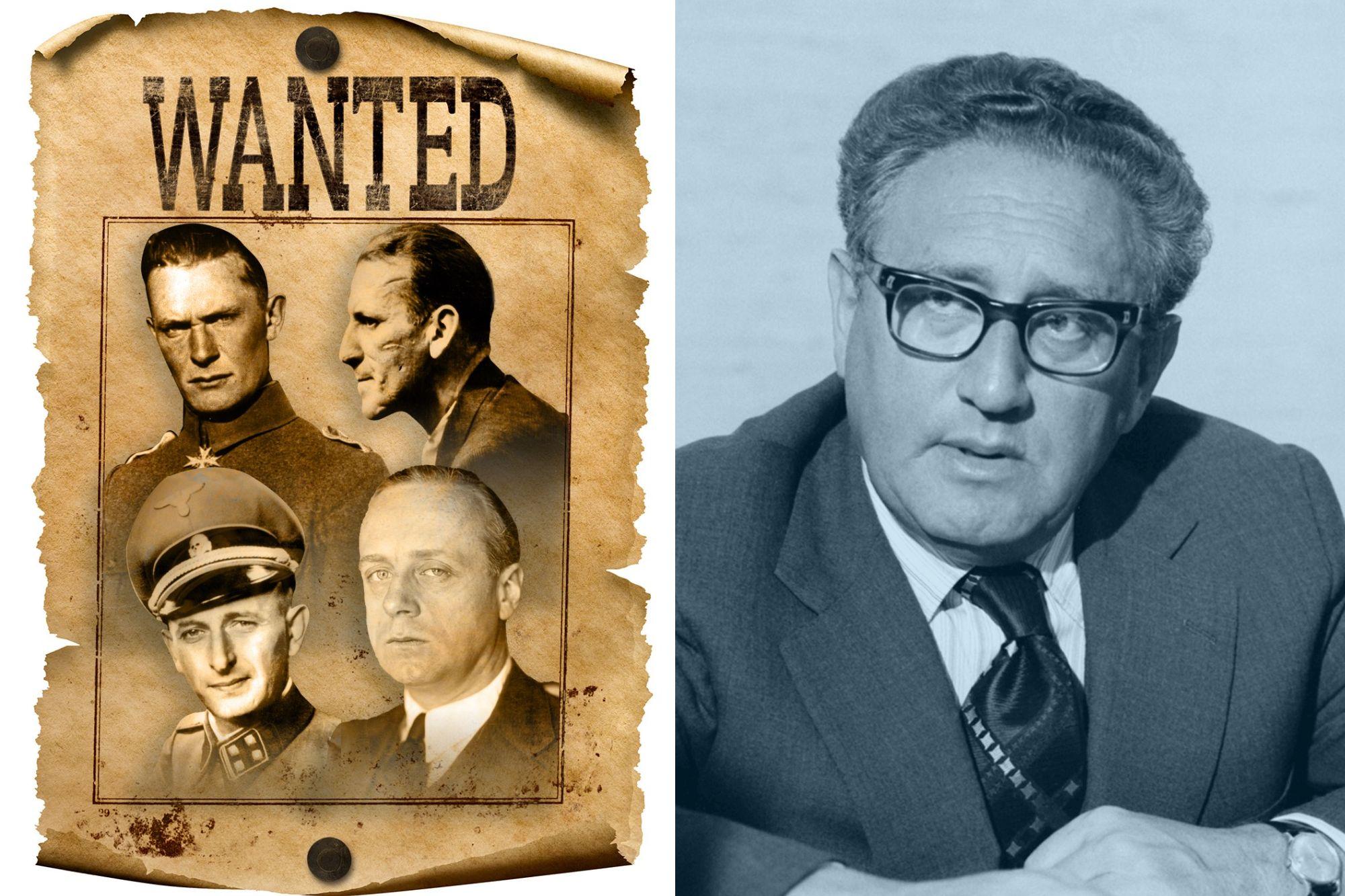
Add The New York Post on Google Adolf Hitler’s war on the world ended with him blowing his brains out as Russia’s Red Army closed in on his bunker. But what happened to his accomplices in the Nazi terror after the apocalypse in Berlin?
Charles Lachman’s latest, “They Shall Not See the Dawn: The Manhunt for the Third Reich’s Most Wanted” (Diversion Books, Sept. 1) is the gripping story of the morning after.
The guns fell silent in Europe on May 8, 1945. But the war didn’t stop there. And not just because American forces were fighting a bloody battle for Okinawa that day, with another three months’ hard fighting still to come in the Pacific theater.
Tens of thousands of Germans wanted to keep fighting for the Fatherland.
On the wall of Gen. Eisenhower’s headquarters was a map of the “mountainous, impregnable terrain” of Bavaria, the Nazi heartland, and Austria. This was the diehards’ “National Redoubt.”
On May 3, 1945, three days after Hitler’s cronies torched his corpse in the garden of the Führerbunker, a group of senior Nazis met secretly at a lakeside villa in the Austrian mountains.
They included Ernst Kaltenbrunner, SS general and chief of the Reich Security Main Office, which ran the Gestapo; and Otto Skorzeny, the scarfaced commando leader who was, Lachman writes, a “one-man Nazi war machine.”
Not forgetting Kaltenbrunner’s old friend Adolf Eichmann, the bespectacled bureaucrat who planned the genocide of Europe’s Jews and made sure the trains ran on time.
Their plan: to undermine the Allied occupation by unleashing the Werewolves, a guerilla force of as many as 200,000 Nazi loyalists. They were prepared to unleash “a fanatical fight to the end. Hitler’s Gotterdammerung — the twilight of the Gods.”
They weren’t the only eminent Nazis to escape the Allies’ advance.
The American and British conquerors were in a race against time.
Hermann Goering, commander of the Luftwaffe, was running for Austria with a convoy of flunkies and loot.
Hitler’s chief “Jew-baiter” and propaganda minister Julius Streicher, and his foreign minister, the dapper social climber Joachim von Ribbentrop, had dropped off the map.
Robert Ley, who ran the Reich’s slave-labor empire and tried to sell Hitler on a war-winning “death ray,” had vanished. So had Arthur Seyss-Inquart, the ruler of the occupied Netherlands whose men deported Anne Frank to her death.
Hans Frank, the “Butcher of Poland,” had dodged the Soviet advance, shipped two warehouses-worth of loot plundered from Jewish households — furs, chocolates, booze, a da Vinci painting and a Rembrandt — back to his wife in Bavaria. He set up a temporary headquarters in a Prussian castle with a staff of 20 officers and three mistresses.
Enno Lolling, the camp physician at Dachau who collected human skin, and Rudolf Hess, the commandant of Auschwitz, tried to link up with the SS leader Heinrich Himmler at Flensburg, the last pocket of Nazi-controlled territory near the border with Denmark.
There were rumors that Hitler had escaped from Berlin. The Führer was hiding as a hermit in the Italian mountains, a shepherd in the Swiss Alps, or a casino croupier in Geneva. Or did he have plastic surgery aboard a ship to South America?
To track down the enemy, the US Army’s Counter Intelligence Corps and British military intelligence recruited fluent German speakers from the ranks. Many of their specialists were German- or Austrian-born Jews who had fled the Nazis and donned American and British uniforms.
They included German-born Sgt. Henry Kissinger, a veteran of the Battle of the Bulge and the liberation of the Hannover-Ahlem concentration camp.
The CIC’s Bob Matteson and Syd Bruskin tracked Ernst Kaltenbrunner’s mistress, a 22-year-old “Teutonic temptress” named Countess Gisela von Westarp, to Altaussee, a village in the Austrian Alps. Tipped off that Kaltenbrunner was hiding in a remote cabin, Matteson and his men donned leather shorts, Alpine jackets and feathered caps to look like hikers.
They nabbed Kaltenbrunner at daybreak, along with a company of soldiers, an arsenal of weapons, wads of counterfeit cash and piles of French bonbons and American cigarettes.
Hermann Goering surrendered himself, his family, his convoy, his retinue and, he believed, the Third Reich, to Lt. Jerome Shapiro, the commander of a four-man Jeep patrol. The obese, grandiloquent Goering then had a hot bath and a big dinner.
Maj. Henry Plitt, a New York City-born Jew who had jumped with the 101st Airborne on D-Day, traced Robert Ley to a mountaineering village in southern Bavaria. Ley was living as “Dr. Distelmeyer, a research chemist,” but Peter Rodgers, a German-born GI, identified him from his Hitler-style toothbrush moustache.
A week later, Plitt’s squad received a tip-off about a “Joseph Seiler,” who was in a chalet just over the Austrian border.
Seiler was painting at his easel when the Americans arrived. He insisted he was an artist who didn’t follow politics.
Plitt realized that Seiler’s initials were also those of Hitler’s depraved propagandist Julius Streicher. After arresting Streicher, Plitt searched the home and found “the largest collection of porn books, photos and lewd cartoons in the world.”
Plenty of Nazis killed themselves rather than face the music. The Reichskommissar of Oslo blew himself to bits with fifty kilos of dynamite.
Leonardo Conti, Germany’s chief medical doctor and advocate of mass sterilization, hanged himself in a prison cell with his shirt sleeve.
Ernst-Robert Grawitz, an SS doctor who “presided over torture and perverted medical experiments” on prisoners, surprised his wife and children at dinner by pulling the pins on two fragmentation grenades, killing them all.
Heinrich Himmler was caught at a checkpoint by Arthur Britton, a Belgian-born British sentry. The British stripped Himmler in search of a cyanide pill, but found nothing, so they served him tea and sandwiches in his shorts and socks.
Himmler had a dose sufficient “to kill an elephant” wedged between one of his teeth and his gum. He ate it in his cell.
But Rudolf Hess, who was working under the identity of a farm laborer named Franz Lang in British-occupied Denmark, accidentally broke his capsule. Two days later, a German-born British soldier named Hanns Alexander knocked at the door of Hess’s barn.
Hess had removed his SS officer’s tattoo, probably with sandpaper. But he kept his wedding ring, with his name and that of his wife. The soldiers, all of them German-born Jews, beat him to a pulp with axe handles. They would have killed him if an army doctor hadn’t intervened.
Transferred to “Camp Tomato,” a temporary British facility, Hess confessed to the murder of 2 million people. In its March 17, 1946, edition, The New York Times reported his arrest and called him “probably the greatest individual killer in the history of the world” — in a two-paragraph report buried on page 31.
The top Nazis went to Allied Supreme Headquarters Center for Axis Nationals, known from its acronym as “Camp Ashcan.”
Goering kept to his bunk as he fought his opiate addiction. Ribbentrop protested Eisenhower’s order that the prisoners be addressed as “Mr.,” and demanded the return of his “von.”
The prisoners shunned Streicher as a “raving lunatic” in the dining hall. Streicher retaliated on their daily walk around the grounds by clicking his heels and bellowing, “Sieg Heil!”
If you’ve seen the movie “Nuremberg,” with Russell Crowe as Goering, you know what happened next. The Nazi villains were tried before the world and hanged in disgrace. Without the bravery and teamwork of individual soldiers to track them down, these butchers would have cheated the gallows.
Charles Lachman’s narrative thunders along like a Sherman tank on a stretch of unbombed autobahn. It’s a thrilling, often brutal ride, but Lachman never misses the human stories behind the heroism of the Nazi-hunters.
After the war, these heroes returned to civilian life. They didn’t talk about it much. But Arthur Britton, the man who bagged Himmler, padded around the house for the rest of his 87 years in Himmler’s slippers.
Dominic Green is a Wall Street Journal contributor and a Fellow of the Royal Historical Society. Find him on Twitter @drdominicgreen.