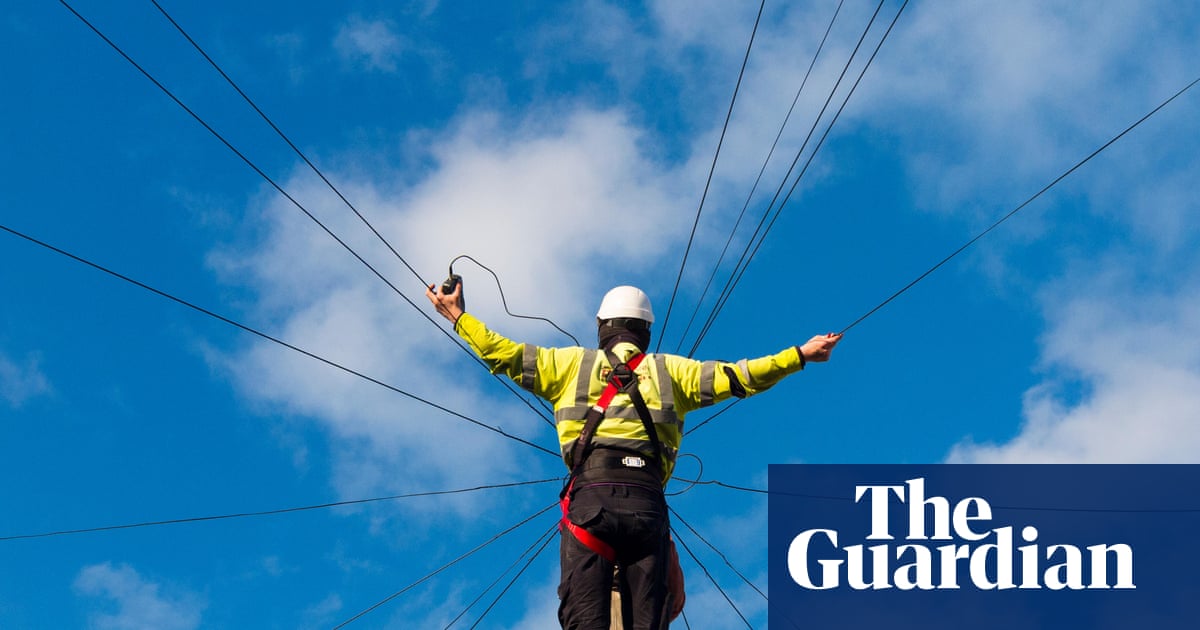
‘Things are going to change massively in two or three years when AI is integrated into everything,’ said one senior executive. Photograph: David Gee 4/AlamyView image in fullscreen‘Things are going to change massively in two or three years when AI is integrated into everything,’ said one senior executive. Photograph: David Gee 4/AlamyUK risks falling behind in AI race without faster telecoms upgrades, say executivesPlanning delays and slow 5G upgrades could leave the UK unable to cope with a surge in AI-related traffic
The UK risks becoming a laggard in the global AI race as crucial telecoms upgrades to harness the technology fall behind rival nations, according to senior industry executives.
The infrastructure AI race has centred on the need to build datacentres, and to ensure they have access to the huge water and energy supplies required to cool and supply the computational power to train and run AI models.
However, as adoption spreads, the UK’s broadband and mobile networks will be expected to carry an immense volume of AI-related traffic produced by consumers and businesses.
While the UK has addressed its previously embarrassing status of having one of the slowest broadband speeds in Europe, as BT’s Openreach and other service providers cover the country with full-fibre connections, efforts to upgrade the nation’s 5G mobile networks are not keeping pace.
Mobile coverage in the UK is worse than any of the 27 EU member states, and every other member of the G7, according to a recent report by the consumer group Which? based on data from Opensignal.
According to the analysis, the UK ranks 57th globally for network performance, 70th for download speeds and 55th for the reliable quality needed for activities such as video calls, streaming and gaming.
“If with the technology and services we use today [networks] are sub-optimal, imagine when you add mass AI usage and other associated activities,” said Andrea Donà, networks director at VodafoneThree, the UK’s largest mobile operator. “I would go further. I am embarrassed today at the level of quality of our network[s]. The UK is worthy of what EE, O2 and VodafoneThree can offer, but we need reform.”
View image in fullscreenThe UK’s main mobile operators are investing heavily in 5G standalone tech such as upgrading masts. However, they say planning rules are delaying even simple upgrades. Photograph: Ben Birchall/PAHighlighting the risks of an AI-traffic crunch, Donà likened the situation to consumers suffering signal loss at a big public event – such as a gig at Wembley, the British grand prix at Silverstone, or a rugby international at Twickenham.
“What we see now only with a mass aggregation of people is a proxy, an indication of the things that will come. That [one-off] experience will be constant because of the additional capacity [consumers] will need in an AI world.”
Another senior telecoms executive said that while the issue of AI and connectivity is now “nascent”, it is going to become a “national competitiveness issue” in the way the slow rollout of full-fibre broadband did.
“Things are going to change massively with the next wave of devices, in two or three years when AI is integrated into everything,” he said. “AI companies, and governments, don’t think about networks, but they will when they hold them back.”
The UK’s main mobile operators are investing heavily in important 5G stand-alone technology – VodafoneThree has committed £11bn to upgrade masts – but the industry says it is being held back by issues including planning delays.
Donà said that it is not about needing to build more sites, in VodafoneThree’s case it is actually reducing its nationwide network of masts by 30%, but the restrictive regulations to simply upgrade existing sites.
About 96% of the upgrades VodafoneThree need to make are on existing sites, but more than half of those will require some form of planning permission, which companies say can be a lengthy and bureaucratic process.
“Andy Burnham has his agenda on growth,” said Donà. “Our infrastructure is here to help the government and UK economy. Planning reform is the lowest possible cost growth policy – it doesn’t require any government money. It could be a great first 100 days-win for the new prime minister.”
Mobile operators also argue that despite their networks being classified as critical national infrastructure – such as datacentres and energy and water systems – they do not receive the reliefs that the government has offered those sectors in areas such as business rates and energy.