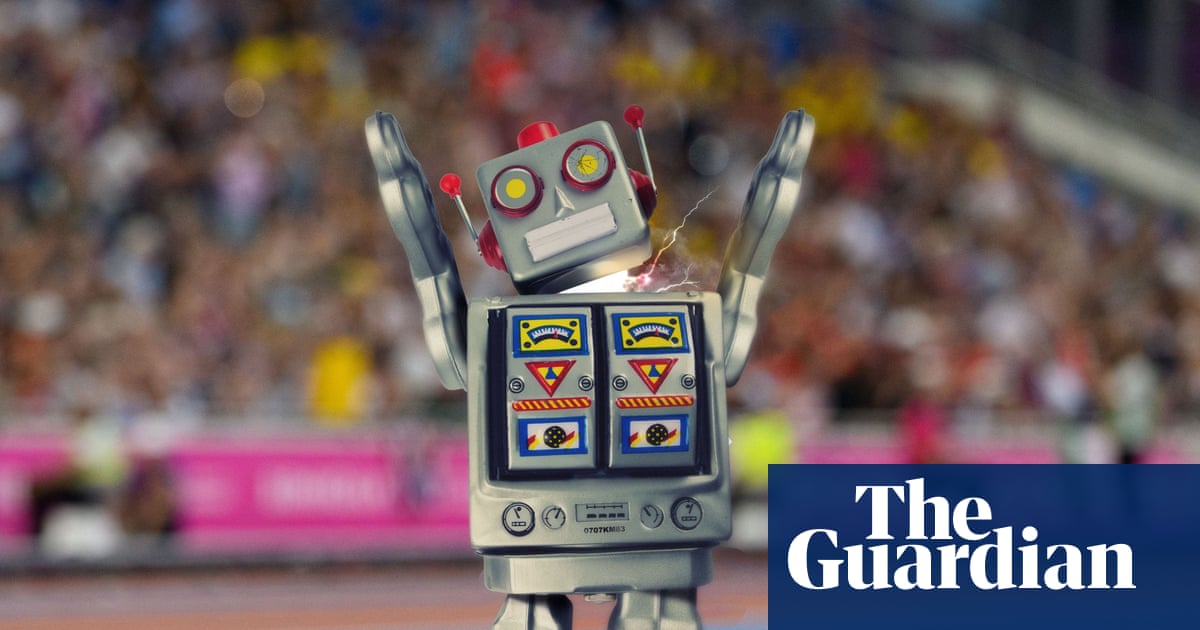
The five-day robot Olympics staked out China’s claim as the undisputed leader in humanoid robotics. Composite: Alex Mellon for the Guardian : Getty ImagesView image in fullscreenThe five-day robot Olympics staked out China’s claim as the undisputed leader in humanoid robotics. Composite: Alex Mellon for the Guardian : Getty ImagesHilarity, unease and relief: games show China is not over the finish line in humanoid robot raceWorld Humanoid Robot Games showcased leaps Beijing has made in the tech, but also highlighted limitations as US rivals prepare their own launches
With exploding pelvises, enough comic pratfalls for a Buster Keaton show reel and the odd moment of ruthless violence, the World Humanoid Robot Games in Beijing gripped the world this week with an unsettling mixture of hilarity, trepidation and relief.
The five-day showcase staked out China’s claim to undisputed leadership in humanoid robotics as android martial artists landed knockout roundhouse kicks and robot teams marched into the arena heralded by flag-waving captains astride giant robotic dogs. The games’ blue-riband event, the 100m, did not disappoint when the robot-sprinters ran quicker than Usain Bolt before slamming mindlessly into a padded wall in a blaze of sparks, flames and flying mechanical limbs.
0:48Robots run, punch and score at World Humanoid Robot Games in China – videoThere, in a 10-second clip perfect for the games’ global online audience, was proof of what onlooking international experts described as the superpower’s “staggering” engineering progress, combined with comfort that the disintegrating robots might not yet be ready to become humanity’s overlords.
“Ready for another big day of fail,” read a typically schadenfreude-laced comment from one of millions who tuned into viral social media clips and livestreams of events from boxing to breakdancing in which the humanoids displayed a jerky mix of ruthless effectiveness and pathetic failure.
Others caught themselves experiencing unexpected empathy. One captioned a robot struggling through the 400m obstacle race: “after drinking 4 bottles of wine at 2 a.m”. Another found a weightlifting contest “way more emotional than I expected” as the bots strained to achieve their sporting goals.
If the games had a slogan it might be: faster, higher, funnier. The obstacle course involving humanoids scrambling under nets, down stairs and over stepping stones reminded the comedian Charlie Higson of Monty Python’s Upper Class Twit of the Year sketch: “It’s only lacking ‘taking the bra off the debs’ and ‘shooting themselves’.” He came back the next day for more. “They get better and better,” he tweeted as a cheerleader robot wielding glittery pom-poms flailed around like it was having a fit.
But the games were not intended to only entertain. Involving over 2,000 humanoids built by more than 660 mostly domestic tech companies, it was a propaganda flex of China’s robotics muscle just weeks before its president, Xi Jinping, lands in Washington DC for a summit with Donald Trump, where the superpowers’ race to tech supremacy will be high on the agenda. Only last month Trump banned imports of Chinese humanoids and four-legged robot dogs, citing cyber and national security concerns. The event was also a billboard to boost global sales of Chinese robots as US rivals prepare their own launches, notably Elon Musk’s long-hyped Optimus humanoid which is reported to have finally gone into production this month. Last year China produced 12,800 humanoids, about 90% of the global total, according to the Mercator Institute for Chinese Studies, a dominance which perhaps gave China the confidence to candidly broadcast so many comic failures, which surprised some onlookers.
View image in fullscreenRobots can run fast or box, but they can’t do both. Photograph: Achmad Ibrahim/APThe event reflected the fact that, for the Chinese Communist party, humanoids are a high priority, offering solutions to a looming demographic crunch in the labour market, rising military ambitions and, as they walk more widely among the people, the state’s desire to tighten its surveillance web. Beijing is fuelling an intensely competitive robot industry by seeding hundreds of companies to create an evolutionary survival of the fittest dynamic, with the games creating a hard deadline for competitors to deliver measurable progress. Xi’s latest five-year plan, approved in March, was studded with pledges to boost robotics industries; accelerate the “practical application of … humanoid robots” and explore “embodied AI in roles experiencing labour shortages or high-risk environments” which likely include war. The military potential of the humanoids on display worried some onlookers.
“Fascinating, and honestly, a little scary,” said Arun Bothra, a senior police officer in India, which shares a tense border with China. “Watching robots run, play football and compete like humans is one thing. Seeing them on borders someday, carrying guns and making decisions, will be something else entirely.” Or as another viewer concluded while watching a humanoid hoist a loaded barbell in the weightlifting contest: “Humanity is preparing its own end”.
Of course China is not alone in pursuing robotic warfare. As the Beijing games progressed on Monday, Ukraine was staging a novel military parade in Kyiv made up entirely of robotic weaponry and defence equipment.
View image in fullscreenTiangong Ultra beats Usain Bolt’s record in the 100m sprint. Photograph: Tingshu Wang/ReutersBut how to explain the numerous crashes and fits in the Olympic speed skating arena where the competition took place? Experts said the games revealed how China was making the most rapid strides in developing humanoids’ bodies rather than their minds.
“The progress they have made from last year is staggering,” said Thrishantha Nanayakkara, a professor of robotics at the Dyson school of design engineering at Imperial College London. “Everything seems to be coming together …. by 2030, it will be a very different world.”
The fastest sprinter, Tiangong Ultra, completed the 100m more than twice as fast as last year, while the peak standing jump rose from 0.96 m to 3.40m. Liquid cooling has allowed Chinese engineers to increase the torque of the motors that drive their limbs creating more twitchy and powerful force.
“This execution is incredible,” said Ingo Keller, head of robotics at the National Robotarium, based at Heriot-Watt University in Edinburgh. “You would not have expected the speed of development. [But] does it move the goalpost in utilising humanoids? Not necessarily.”
View image in fullscreenAn Honor Lightning humanoid robot caught fire following the 100m final race. Photograph: Tingshu Wang/ReutersExperts stress the games revealed progress in specialist, not generalist, humanoids: the robots were fast runners or good boxers, not both, partly because the AI models that govern their decisions are yet to be able to process the physical world’s full complexity. The industry talks about reaching a ChatGPT moment – a tipping point when humanoid technology becomes generally useful and explodes into the mainstream. By one definition, that comes when a robot can succeed at 80% of tasks in an unfamiliar home, instructed by voice or text. The event coincided with a sobering speech from Wang Xingxing, founder of Unitree, one of China’s leading robotics companies, who said it could be a decade before that ChatGPT moment.
“Humanoids are not yet capable enough for mass deployment,” he said. “The limitations in the AI models that power robots’ decision-making and interactions remain the industry’s biggest bottleneck.” Amid uncertainty about the impact of robotics and bubble fears, his company’s share price has been oscillating wildly since it listed in Shanghai earlier this month.
Georg Stieler, a consultant who advises multinational companies on robots, said he did not see much progress on robots’ autonomy when he was in Beijing this week. He reported that some Chinese robotics companies were also privately cynical about the five-day showcase, complaining about a lack of funding for commercial long-term pilot projects “to do something useful in a factory”.
“It’s not so difficult to make a stunt, which people will share on LinkedIn or X,” Stieler said. “The major challenge is to do something that’s really useful.”
Humanoid robot dexterity requires much more work and there was little focus on the events testing it. There was little obvious coverage of a Monty Pythonesque category that included power tool assembly, powder weighing, bottle opening, cap prying, box unpacking and tweezer bean-picking. One such challenge was briefly featured on Wednesday when the race track was occupied by the unspectacular sight of a humanoid struggling to pick up a small object from a table and spilling water in a pouring challenge. The cameras panned away to find a humanoid martial artist carving the air with kicks.