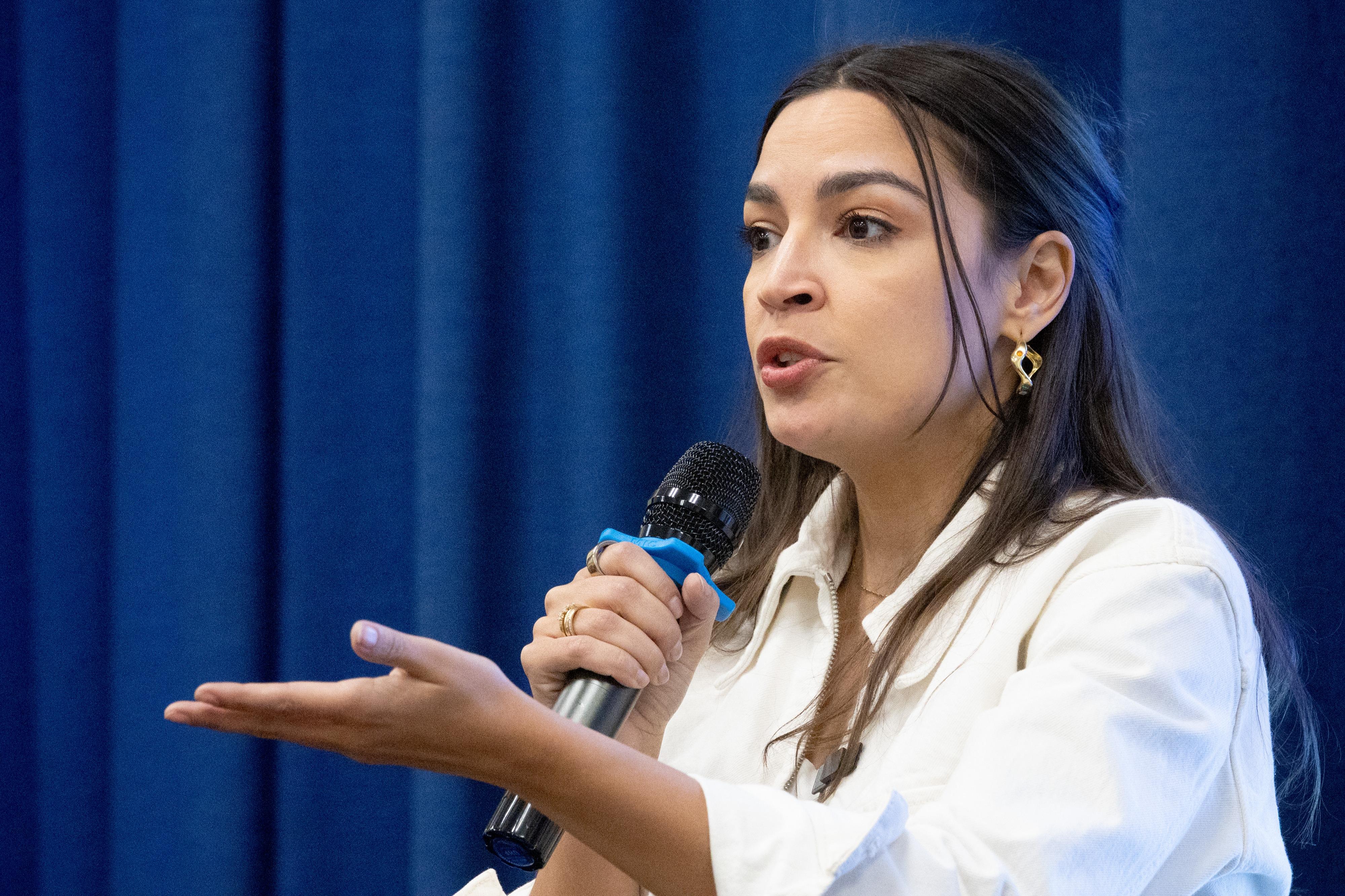
Rep. Alexandria Ocasio-Cortez hosts an in-person town hall in Queens, on February 5, 2026. Aristide Economopoulos for NY Post See more of our coverage in your search results.
Add The New York Post on Google Iconoclast: Did AOC Ever Mean It? “With a laugh and a smile,” Rep. Alexandria Ocasio-Cortez said “Woke 1 was crazy,” notes Carlos Lozada at The New York Times: She was “distancing herself, whether subtly or overtly, from what is known as wokeism” — but how much of it did she “truly believe at the time?” If she “did believe it, jettisoning it now should take something more than a sheepish grin.” If she didn’t, “yet declared it with such passion, with such pretensions to moral clarity,” she should “acknowledge the dissonance” and “explain the shift, not just explain it away.” What ideas about police abolition, trans ideology and white guilt does she “now regard as crazy or cringey or silly?” AOC has a right to change her mind, but let her “explain how and why she’s moving on.”
“Following the Supreme Court’s landmark decision on birthright citizenship,” the United States should restrict all forms of reproductive tourism,” Emma Waters argues at The Hill. This biz sells human embryos, eggs and sperm, and — “thanks to birthright citizenship” — potentially US passports. “Non-U.S. residents accounted for 59,246 assisted reproductive technology cycles between 2014 and 2022”; “China alone generated 19,718 cycles.” “The international clientele is buying the specific services the rest of the world restricts or bans” — while “reproductive tourism in the U.S. relies on these ethically fraught” practices. “A nation can take seriously its own infertility crisis without operating an open-borders bazaar in embryos, eggs, and passports for the clientele of the entire world.”
While Target has “often loudly expressed its progressive values,” new CEO Michael Fiddelke “is leading a turnaround effort that has pushed shares upward,” cheers The Washington Post editorial board. Burned in culture-war battles over post-George Floyd controversies, trans-bathroom policies and Pride Month merchandise, the Minneapolis-based retailer has learned that “there’s no pleasing everyone” — as now progressives fume, with the American Federation of Teachers urging “members not to buy school supplies from Target because it has “stayed silent on ICE’s occupation of its own hometown.” Fiddelke should stand firm: “Resisting union bullying would set a promising new precedent of selling goods based on the needs of customers, not the demands of whoever yells at the company the loudest.”
Jason Arday’s story “saddens” Roland Fryer at The Wall Street Journal, as do those of Claudine Gay and Jayson Blair, as all “raise the same question”: Why “elite institutions,” so “eager for diversity,” are willing to “take chances on people whose credentials wouldn’t otherwise get them in the door.” His “quarrel with DEI” isn’t about the “initial opportunity,” which he favors, as “what happens after”: The problem is when “potential is confused with accomplishment,” as opposed to a colorblind approach to assessment. The “obligation” to “invest” in raw potential must be matched by “telling people the truth about their work.” Professors who think they’re “being kind” by giving “gentle comments” to minority students in fact “are withholding the one thing the writer needs.”
Canada and America were “on the cusp” of a “long awaited trade deal” when “defeat was snatched from the jaws of victory,” laments Jane Stannus at The Spectator. Hmm: Did Prime Minister Mark Carney “ever want a deal?” Just “four relatively small points of contention” emerged, and none seem a reason to end talks. To keep power, “Carney has cynically stoked fear of America” and President Trump; maybe Trump should “launch a charm offensive.” He “wants fair treatment for the US” but also for “Canada to free itself from the toils of China.” The answer may be to start “differentiating between the Davos darling who holds the reins” and “the many common-sense Canadians who see the urgent necessity” of a deal.