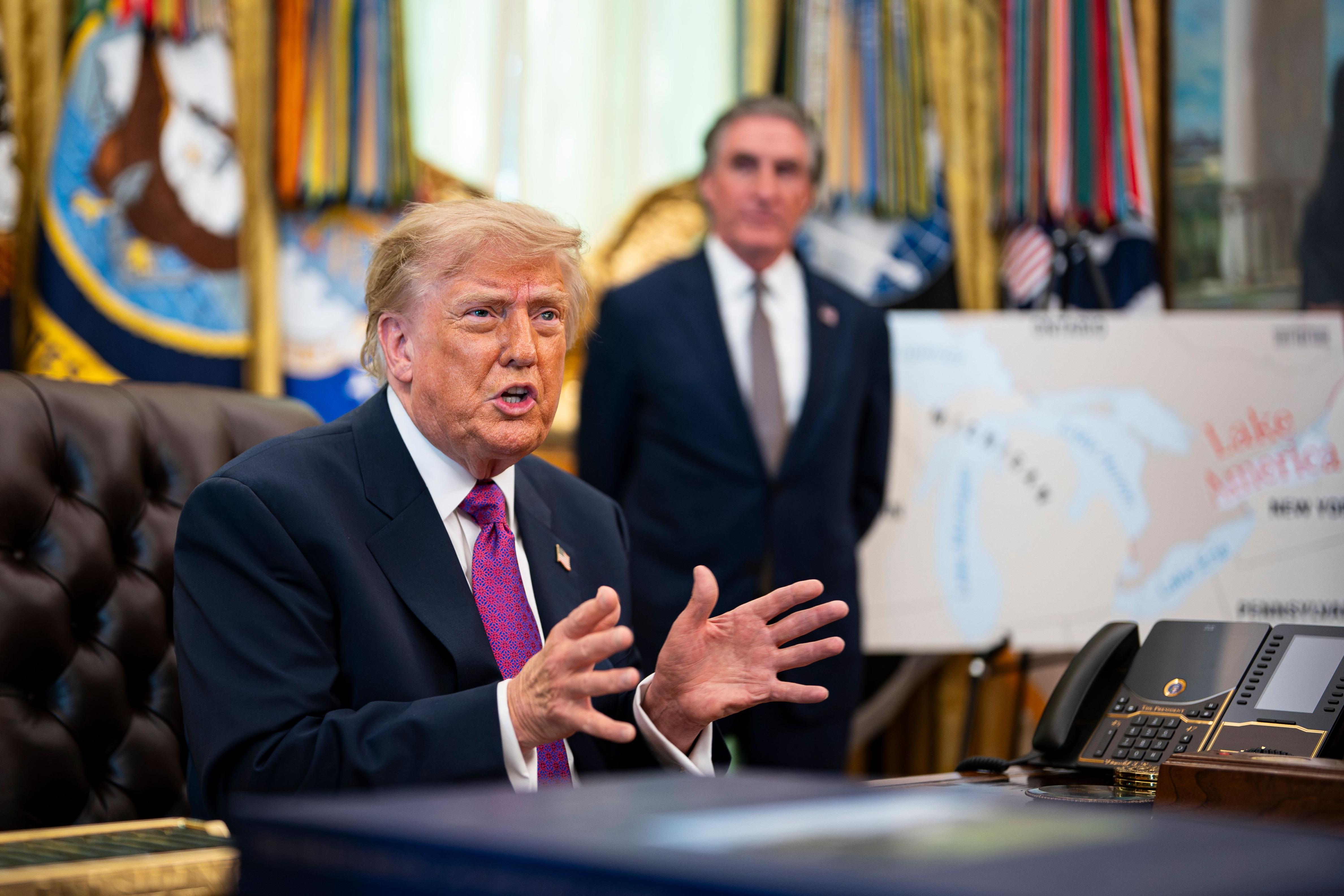
President Donald J. Trump speaks to members of the media in the Oval Office of the White House on August 27, 2026, in Washington, D.C. Al Drago - Pool via CNP/Shutterstock See more of our coverage in your search results.
Add The New York Post on Google President Donald Trump’s tariffs aren’t popular, but he’s found a way to make them even less so — a trade war with America’s most inoffensive ally.
When one thinks of countries that deserve to be subjected to a steady stream of insults (it’s Lake America now, not Lake Ontario) and a punishing regime of tariffs, Canada is far down the list.
Ottawa has been a loyal, if occasionally annoying, friend of the United States for nearly 100 years.
The presence of a well-meaning country with similar values along the 5,000-mile border to our north is a gigantic geo-strategic blessing, although one that is apparently lost on Trump.
Both sides deserve blame for the breakdown in negotiations, but news reports suggest that it was the United States that made additional demands at the 11th hour.
Now both sides are imposing new duties on the other, and Trump is threatening 50% tariffs on all Canadian cars, trucks and parts beginning in the New Year.
It is certainly true that we can impose more economic pain on the Canadians than they can on us, and grind them down economically.
We can also land the 101st Airborne in Nova Scotia.
The contention with Canada is characteristic of Trump’s economically senseless, legally dubious and politically harmful push to tariff everything and everyone he can.
Trump’s imposition of all these duties — often relying on strained interpretations of US statutes — has run directly counter to his promise in the 2024 campaign to reduce prices, a pledge central to his victory.
Although the administration maintains that the cost of tariffs isn’t passed on to American consumers — instead borne by foreign countries and producers — its actions implicitly concede the opposite.
The administration excluded an array of consumer electronics from new reciprocal tariffs on China to avoid unpopular price increases, and it lifted tariffs on a long list of foodstuffs late last year.
Twice this year, including about a week ago, the administration widened exceptions for beef imports.
If tariffs were genuinely cost-free, none of this would have been deemed necessary by the most protectionist administration since that of Herbert Hoover.
A chief argument for tariffs is that they will revive American manufacturing.
Even if this is true, it’s a long-term play, whereas the disruption of tariffs is experienced immediately.
It’s also a questionable proposition: Increasing the price of imported goods used in manufacturing, which is the effect of the scattershot tariffs, doesn’t do US producers any favors.
It is telling that the National Association of Manufacturers opposes the sweeping tariffs.
Polling consistently finds that the duties are unpopular.
Majorities oppose Trump’s handling of the issue, and the public believes the tariffs have increased prices and should be lowered.
The trade war with Canada in particular fares poorly: A YouGov survey found that 62% of people oppose the imposition of 50% tariffs on many Canadian imports.
At the end of the day, Trump has chosen a longstanding ideological goal and his legacy over his short-term political standing.
He has advocated for major tariffs for decades and has finally gotten them.
His most likely Republican successor, JD Vance, presumably wouldn’t roll them back, and the Democratic candidate in 2028 might be equally protectionist.
Regardless, it’s going to be difficult for future presidents to give up the revenue generated by the duties.
And so a president who campaigned on lowering prices has embraced a policy that, at the margins, increases them.
Unless things are smoothed over with our Friendly Neighbor to the North, there will be more where that came from — in a dispute with a country that no one considers an economic threat to the United States.
If the midterms end up sending a broad message of discontent, the tariffs will surely be a reason why.