Michigan Democratic Senate candidate Abdul El-Sayed speaking at a campaign event in Ann Arbor on Aug. 26, 2026. Photo by JEFF KOWALSKY / AFP via Getty Images See more of our coverage in your search results.
Add The New York Post on Google Every conceivable historical benchmark would lead you to believe that Democrats are predestined for a great triumph come November.
The federal government is under unified Republican control, Americans remain deeply dissatisfied with the state of the economy and President Trump’s approval rating lies somewhere in the depths of the Mariana Trench.
Add the ongoing hostilities with Iran and resumption of a foolhardy trade war with our neighbors to the north to the tally, and you have the makings of an electoral landslide.
One that would make a living hell for Trump out of his final two years in the White House.
But a new Echelon Insights poll raises the question: Just how inevitable is this menacing Blue Wave?
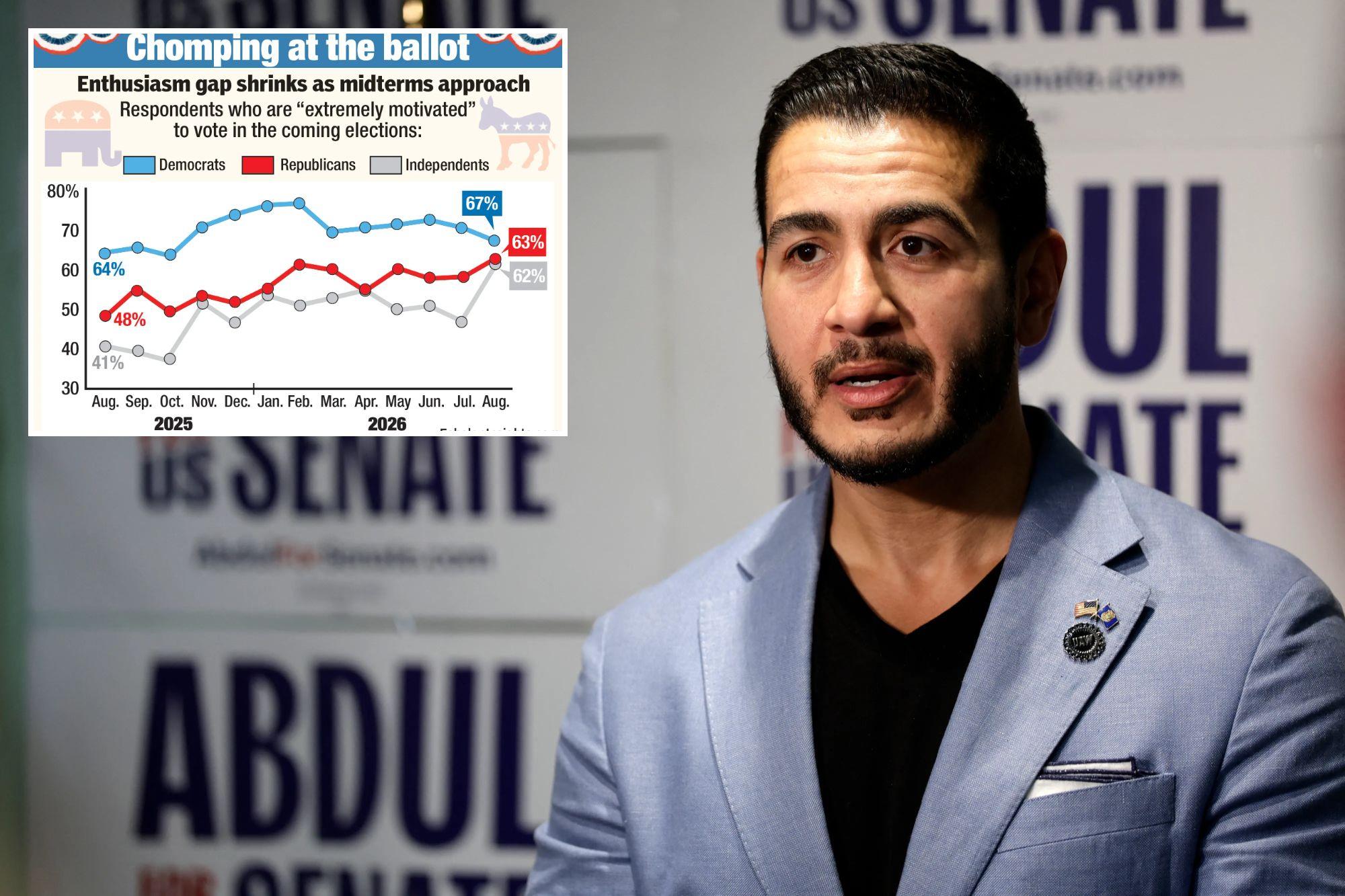
According to the survey, Democrats’ once impressive enthusiasm gap is now nearly nonexistent.
In August 2025, 64% of Democrats indicated that they were “extremely motivated” to cast a ballot the following fall.
Fast forward to this month and that first number has ticked up to just 67%, while the second has shot up to 63%.
The same survey found that the donkeys lead the elephants by five points on the generic ballot, which is just about in line with RealClearPolitics’ average.
A chart showing voters enthusiasm levels before this year’s midterm elections. Echelon Insights That’s a significant enough lead to matter — and likely to propel them back into the majority in the House of Representatives.
But it’s hardly the material that wave elections are made of, especially considering Republicans’ victories in the redistricting wars.
Moreover, the sample used by Echelon Insights may have been slightly biased toward Team Blue.
After all, Trump won the popular vote in 2024, 49.8%-48.3%.
Yet Harris voters (49%) outnumbered Trump supporters (48%) in the survey.
The reason for the surprising softness of Democrats’ lead — and Republicans’ renewed zeal — ought to be glaringly obvious.
Trump’s popularity is waning even among his base.
Which means that it’s negative partisanship that’s responsible for the GOP’s closing of the enthusiasm gap.
And how else to explain Republicans’ increasingly palpable fear of Democrats in power other than the Democratic Socialists of America’s hostile takeover of the party?
After all, the Democrats are hurting most where DSA types have featured most prominently.
Consider the case of Michigan’s Abdul El-Sayed.
The radical pal of 9/11 apologist Hasan Piker who favors a wealth tax and a mandatory, socialized health-care system appears poised to lose Democrats their first Senate race in the Great Lakes State since 1994.
One poll conducted on the eve of the Democratic primary found that Republican Mike Rogers would start a general election contest against El-Sayed with a double-digit lead.
More recent surveys suggest the race is a dead heat.
But that should come as cold comfort to the El-Sayed camp after his disappointing performance in this month’s primary — the ex-director of Wayne County’s Department of Health, Human and Veterans Services prevailed over Rep. Haley Stevens by less than a point after blowing her out in Decision Desk HQ’s polling average by 13.
A similar specter — as well as the ghastly ghost of Graham Platner — hangs over Troy Jackson in Maine.
Like Platner, Jackson is a far-left weirdo with woman problems backed by Bernie Sanders.
Unlike Platner, he lacks an iota of natural political talent.
The result? An indefatigable Susan Collins nipping at his heels in polls.
That’s a big problem; according to the polls, Collins was on track for a blowout loss to Democrat Sara Gideon on the eve of Election Day 2020.
When the sun rose the day after, Collins had beaten the brakes off Gideon, prevailing by 8.6%.
The consequences of Democrats’ national exercise in brand self-destruction are even visible where they demonstrated some measure of self-restraint.
Amid a bloody primary battle with DSA member Karishma Manzur in the Granite State, likely Democratic nominee Rep. Chris Pappas now trails likely Republican nominee John Sununu in a general election matchup, per the University of New Hampshire Survey Center.
In every corner of the country, collectivist, America-hating radicals are overtaking their establishment opponents.
But in so doing, they’ve done irreparable harm to the brand of their entire party — and set the stage for a monumental letdown on Election Day.
Their perverse joy over their triumphs this summer may yet turn to ashes in their mouths.