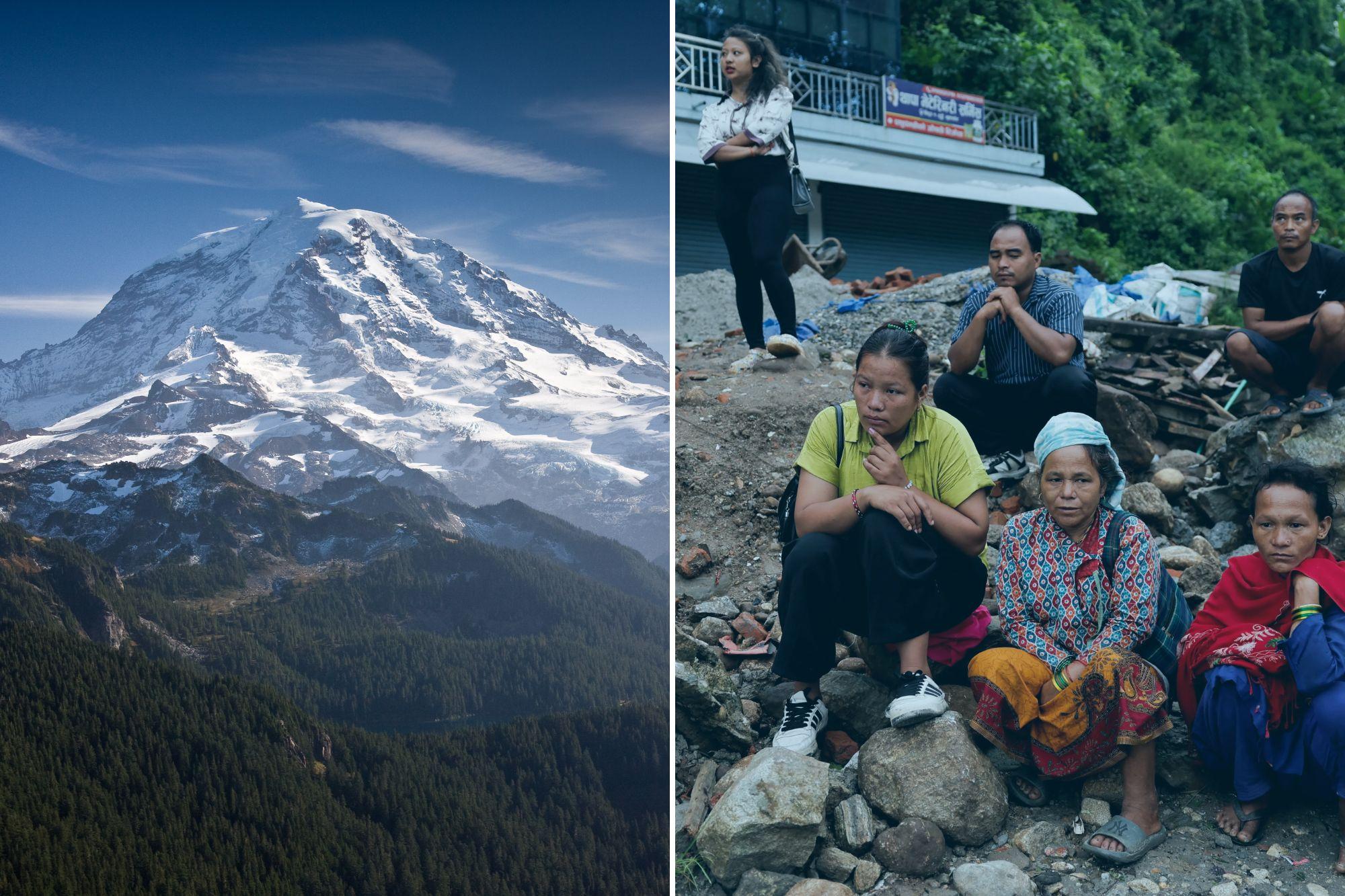
Add The New York Post on Google Experts fear that “America’s most dangerous” volcano, Mount Rainier, could unleash a catastrophe similar to the landslide and floods that devastated Nepal — but with casualties in the thousands.
During the Wednesday disaster, a massive flood that swept through the Nepal and Tibet border, demolishing bridges, roads and other critical infrastructure, CNN reported.
The death toll currently stands at over 350 — but is expected to rise — while over 1,300 people remain unaccounted for, including over 60 US citizens, NBC reported.
The calamity was reportedly caused by a glacier that broke off at an elevation of 17,000 feet and plunged 3,900 feet into the Lhende Khola river valley in Tibet. This rock and ice avalanche temporarily obstructed the river before giving way, unleashing a powerful slurry of mud, ice and rocks through the region.
As rescuers intensify their efforts, some geologists worry that a similar disaster could befall residents of Washington state. Over 3.3 million people across the Seattle-Tacoma region sit in the shadow of Mount Rainier, a heavy glaciated 14,410 foot stratovolcano that’s often considered the US’ deadliest.
Along with discharging ash and magma, the mountain has the potential to unleash lahars, violent slurries of rocky debris, mud and meltwater that originate on the slopes and surge downhill at over 100mph, devastating anything in their path in just minutes.
This would be catastrophic given that Rainier is upstream from Washington’s Pierce County, a hub of 150,000 people that’s located just around 60 miles from Seattle.
Were one of these snowmelt slurries to burst forth from the volcano, it would decimate towns of Orting, Puyallup, and Sumner in just 30 minutes, potentially impacting 60,000 residents.
While there is no evidence that Mount Rainier is about to blow its stack, lahars don’t require an eruption to wreak havoc. A “no-notice” lahar can be triggered by heavy rainfall, snow melt or even a dam failure.
“[No-notice lahars are] the thing that goes bump in the night,” said former Cascades Volcano Observatory (CVO) geophysicist Andy Lockhart. “It creeps me out.”
Even a minor thaw could prove apocalyptic given that Mount Rainier’s 25 major glaciers contain more than five times as much snow and ice as all the other Cascade volcanoes combined.
During the Mount Saint Helens eruption of 1980, the pyroclastic eruption induced rapid snow melt, causing deluges of mud and debris to flow over 60 miles through the Toutle and Cowlitz river valleys, destroying over 200 homes, 195 miles of roads and 27 bridges, the Daily Mail reported.
To avert a similar calamity, the Cascades Volcano Observatory (CVO) has installed a network of monitors throughout the Cascades to keep tabs on seismic activity and lahars.
Meanwhile, on April 23, 45,000 students and staff from over 20 schools participated in one of the world’s largest lahar evacuation drills on April 23.
Lahars are often preceded by the ground rumbling and a “roaring sound like a jet or locomotive,” per a statement by the US Geological Survey.
Upon hearing that sound, residents are urged to –somewhat paradoxically — flee on foot, as this is the best way to get out of harm’s way in the short timeframe that lahars allow.