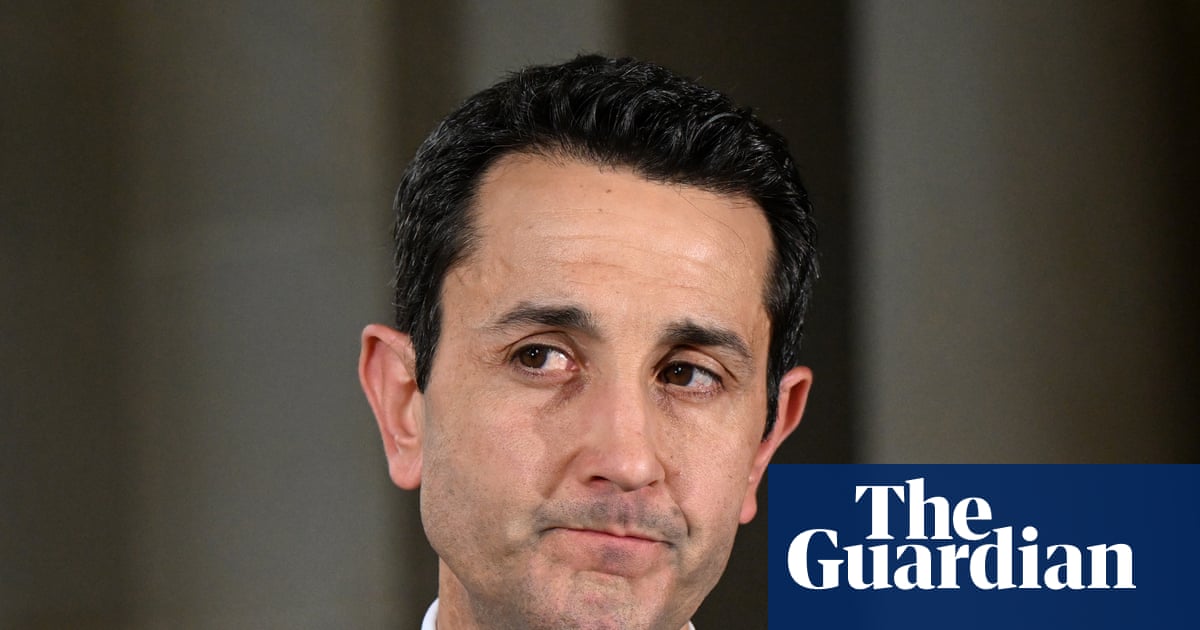
The Queensland premier David Crisafulli declared the legislation would give Queensland ‘the strongest bail laws in the country’. Photograph: Darren England/AAPView image in fullscreenThe Queensland premier David Crisafulli declared the legislation would give Queensland ‘the strongest bail laws in the country’. Photograph: Darren England/AAPQueensland concedes law imposing mandatory jail on some offenders as young as 10 breaches human rights State government says ‘breach bail, go to jail’ laws raise risk of overcrowding in jails, while one expert warns they may lead to ‘cruel outcomes’
Get our breaking news email, free app or daily news podcast
The Queensland government’s latest law and order crackdown – subjecting some children as young as 10 to a mandatory sentence of a year behind bars – could lead to “cruel outcomes”, according to human rights lawyers.
In documents tabled with the legislation on Thursday, the government conceded its laws, dubbed “breach bail, go to jail”, would breach human rights and risk further straining the state’s overcrowded jails, youth detention centres and police watch houses.
It requires an override of the Queensland Human Rights Act.
The legislation applies to a child or adult charged with a “significant offence” while on bail, or failing to appear for a court matter.
For children, a “significant offence” is any of the government’s 47 previously legislated adult crime adult time offences, such as dangerous operation of a vehicle, robbery, and entering a premises and committing an indictable offence.
For adults, they also additionally include sexual offences against children and coercive control.
A person on bail accused of one of the offences would face a much higher bar to be granted bail again. The bill requires that they be remanded in custody unless the court or a police officer is satisfied to a “high degree of confidence” that they would not commit another significant offence.
If convicted of the second offence, they would be subjected to a mandatory minimum 12 month sentence, without parole. It could be served concurrently with any other sentence for the additional offence.
The law applies even if the person is found not guilty of the first offence.
The government concedes that the legislation limits a range of rights including the right to liberty, that persons awaiting trial should not automatically be detained in custody, and the right of children to protection in their best interests.
It also concedes that the additional offence will lead to overcrowding in the state’s corrective services facilities and youth detention centre and as a result “will impact the conditions of detention, engaging the right to humane treatment when deprived of liberty”.
Under the Queensland Human Rights Act, an override is only permitted where exceptional circumstances, such as a state of emergency, exists.
In documents tabled with the bill, attorney-general Deb Frecklington said they were “the prevalence of serious repeat offending committed while on bail”.
Human rights lawyer, Bridget Burton, a senior lecturer at the University of Queensland, said it was there appeared to be no apparent exceptional circumstances justifying the laws, and they would remove judicial discretion, leading to unreasonable sentences.
“Mandatory sentencing prevents judges from considering the circumstances of an offence,” she said.
“When circumstances become irrelevant, we can see cruel outcomes for individuals contrary to what the community would expect, particularly when someone who is a victim also commits an offence.”
Senior lecturer in criminology and criminal justice at Griffith University William Wood said there was little evidence that a mandatory 12-month sentence would be a strong deterrent effect for young people.
He said the court system could already take into account previous offending when determining whether to grant bail and the law removed that discretion.
Wood said the bill would probably affect only the least serious offenders, because a person convicted of a violent offence would already be sentenced to longer than the 12-month term.
Queensland already has the highest youth detention rate of any Australian state, and the state already makes “exceptionally heavy use of pre-trial detention,” he said.
“Increasing incarceration is not in itself an evidence-based youth crime strategy,” he said.
“Once the highest-risk young people are already being detained, expanding detention increasingly captures less serious offenders, with diminishing public-safety returns and growing financial and social costs”.
Premier David Crisafulli declared the legislation would give Queensland “the strongest bail laws in the country”.
Crisafulli said the state planned to open additional jails, but “faced with the choice of full jails and less (criminal) people in your home, I’ve been upfront about that, and I want to protect Queenslanders”.
The legislation also removes the requirement for police to consider diversionary options before charging a child with an offence, and expands an existing exemption to the human rights act in the state’s police watchhouses.