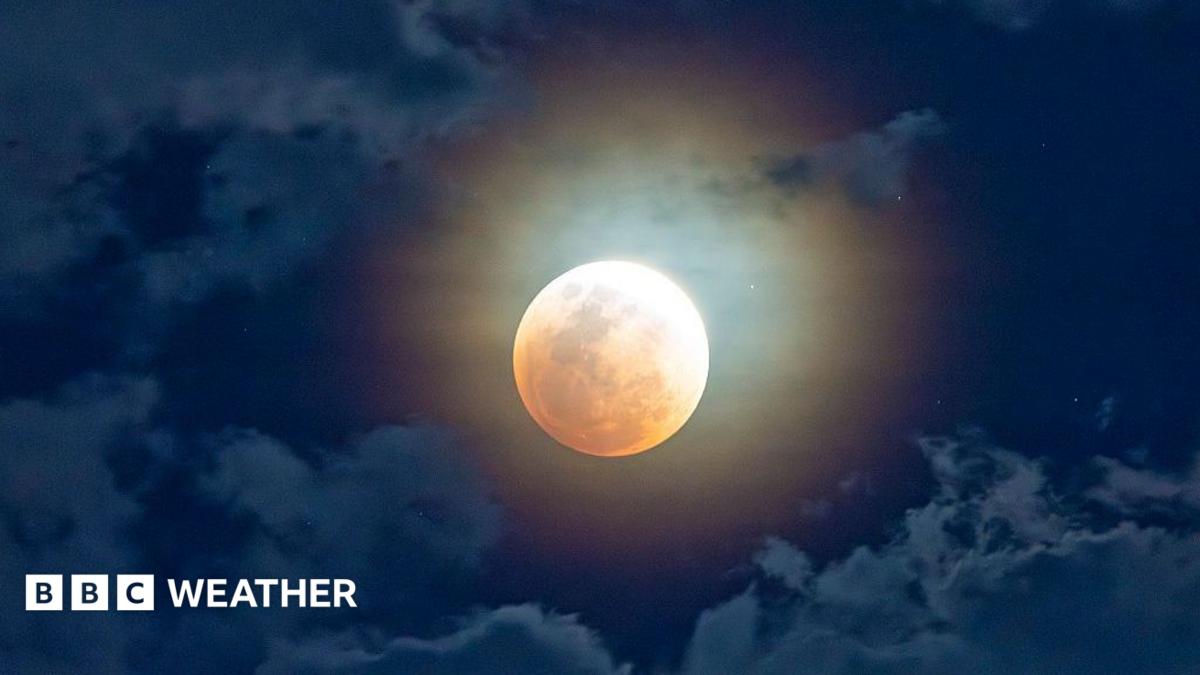
Skywatchers across the UK could get to see a stunning partial lunar eclipse in the early hours of Friday, but cloud may spoil the spectacle for some.
The Sun, Earth and Moon will line up in the night sky causing the full Moon - nicknamed the Sturgeon Moon - to glow an eerie red.
It will occur shortly before moonset meaning it will be low on the horizon, with the Moon appearing bigger and more dramatic than usual thanks to a phenomenon known as the Moon illusion.
However cloud and rain may obscure the view for some, with the best viewing chances likely to be in the south and east of England, and possibly parts of Northern Ireland and western Scotland.
The eclipse will take place in the early hours of Friday and comes just weeks after the UK experienced its most dramatic partial solar eclipse in nearly 30 years.
It will start at around 02:23 BST as the Moon moves into what is called the penumbra, the faint outer part of the Earth's shadow.
The moon will appear to dim slightly - although this will be barely noticeable to most viewers.
The main partial phase of the eclipse will begin at 03:33 as the Moon starts to enter the darkest part of the Earth's shadow - called the umbra.
It will reach its maximum at 05:12, when around 93% of the Moon will be within the darkest shadow.
The partial eclipse ends at 06:51 but this will not be visible in the UK because the moon will have set below the horizon by then.
Exact moonset times vary across the UK - for instance, 06:00 in Lerwick, 06:15 in London and 06:42 in Enniskillen.
Image caption, The different phases and times for the partial lunar eclipse in London, UK. Source: Royal Observatory, Greenwich
Because the Moon will be very low in the south-western sky, the eclipse could be made more dramatic thanks to something called the Moon illusion.
This is a term for when the Moon appears much larger than it normally would, purely due to its position in the sky - close to the horizon, seen alongside familiar objects on the ground.
It is caused by the way in which our brains process visual information.
A lunar eclipse happens when the Earth passes between the Sun and the Moon, causing the Moon to temporarily move into the Earth's shadow.
During a partial eclipse, only part of the Moon enters the darkest section of that shadow, known as the umbra.
The Moon is not completely cut off from sunlight, however.
Sunlight passing through the Earth's atmosphere is scattered, with shorter blue wavelengths scattering more easily, while more of the longer wavelength red light reach the Moon.
These wavelengths are then reflected back towards Earth, giving the eclipsed Moon its reddish colour.
Image caption, A diagram showing the Earth positioned between the Sun and the Moon during a lunar eclipse.
For the best chance of seeing the eclipse, astronomers recommend finding a high location with an unobstructed view towards the south-western horizon.
Clear skies will, of course, be essential - and this may pose a problem for some.
Low pressure will be directly overhead giving the chance of cloud and showers, but it will not be cloudy everywhere.
With slack winds under the centre of the low it will be difficult for forecasts to pinpoint exactly where the banks of cloud will drift - and where any breaks may be.
Image caption, The eclipse may be obscured by cloud and rain for some. The clearest skies are in East Anglia, south-east England, western Scotland and Northern Ireland
The best viewing conditions are likely to be in eastern and south-eastern parts of England, but computer models suggest some areas of western Scotland and Northern Ireland could also have clear spells.
Elsewhere a forecast of cloud and rain looks more likely, but some breaks in the cloud cannot be ruled out and could change from hour to hour.
You can check the latest hourly forecast where you are online or via the BBC Weather app.
Stunning photos capture July's Buck Moon over the UK
Summer 2026 on course to be UK's hottest on record, says Met Office
Stormy autumn, cold winter - how might El Niño affect the UK weather?