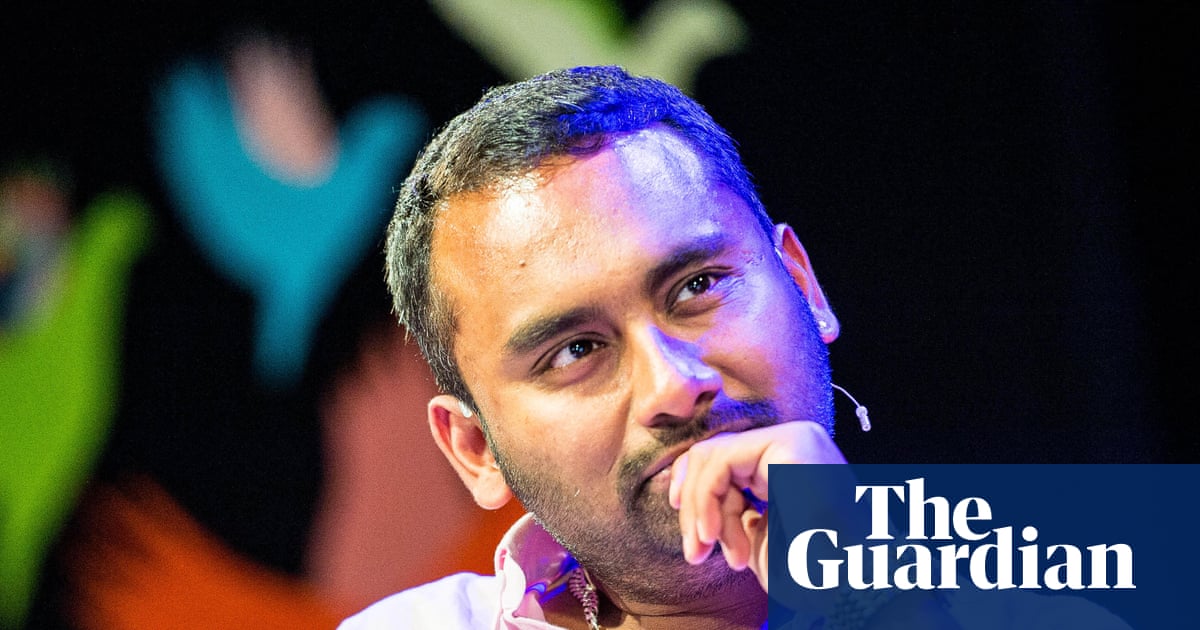
Amol Rajan announced earlier this year that he was leaving BBC News to ‘unleash my inner entrepreneur’ in the creator economy. Photograph: Aled Llywelyn/AlamyView image in fullscreenAmol Rajan announced earlier this year that he was leaving BBC News to ‘unleash my inner entrepreneur’ in the creator economy. Photograph: Aled Llywelyn/AlamyAmol Rajan warns BBC destined to shrink at ‘accelerating rate’Presenter says he is moving to YouTube to avoid being left ‘behind the curve’ as media landscape changes
The outgoing Today programme presenter Amol Rajan has warned that the BBC is destined to “get smaller at an accelerating rate”, as he prepares to depart for a new project on YouTube.
Rajan, who announced earlier this year that he was leaving BBC News to “unleash my inner entrepreneur” in the creator economy, said he was making the shift to ensure he was not “behind the curve”.
It comes with the BBC making savings of £500m over the next two years as it contends with the falling value of its licence fee funding and an increase in the number of people opting not to pay it.
The corporation, along with other traditional broadcasters, is demanding to be given prominence in the algorithms of platforms such as YouTube and TikTok as it faces mounting pressures from an increasing shift away from linear television viewing.
Speaking to the Political Currency podcast, Rajan said Radio 4’s Today programme was “the last big mass-market news programme” – an exception in a world where consumers are increasingly turning to digital platforms.
Read more“I’ve worked for 20 years in the media,” he said. “I had a wonderful 10 years in newspapers, a wonderful 10 years in TV and radio and I’ve always been a bit behind the curve, basically. And I feel that I’ve always been basically in areas of rapid and accelerating decline.
“The Today programme … does not fit with this argument, so I’m arguing against myself, but the BBC and BBC News is in the years to come going to get smaller at an accelerating rate, and I want to go to where the action is, and that’s YouTube.”
Rajan’s comments come with the TV world fretting over the rise of digital platforms. The BBC has already responded by announcing a new partnership to produce content dedicated to YouTube. Matt Brittin, the BBC’s director general, has set reaching younger audiences as one of his top priorities.
Pedro Pina, YouTube’s head for Europe, Middle East and Africa, has insisted that the platform is “not the villain” set to destroy the TV industry.
“That is how the story usually goes, like a well-scripted tragedy,” Pina said on Wednesday in the keynote MacTaggart lecture at the Edinburgh TV festival. “We have our once great hero, we have their terrible downfall, and – in platforms like YouTube – we have an obvious villain. It’s a powerful story. An emotive story. The trouble is that it is not true.”
He said broadcasters could flourish alongside new digital platforms, just as painters continued to flourish after the invention of the photograph. However, he said TV companies no longer had the monopoly they enjoyed in the heyday of linear television.
Read morePina warned against the idea of the government forcing YouTube to give greater prominence to content from traditional broadcasters – an idea that has caused fury among content creators who believe it will mean their videos will be relegated. The idea has been pushed as a solution to online misinformation.
Pina said: “Forced prominence would impair the public interest by unfairly shifting focus from independent creators and production companies, and by recommending that all our viewers watch the same things, disregarding personal taste.
“If this becomes law, many UK-based creators and production companies will see their livelihoods threatened. UK viewers will have to wade through content they may not want, which in itself could undermine the trust that UK public service broadcasters have built up. Forced prominence won’t help anyone succeed – not new independent talent, not viewers and definitely not public service media.”
Elsewhere at the festival, Kevin Lygo, ITV’s managing director of media and entertainment, suggested YouTube’s investment in the UK was tiny compared with that of Britain’s public service broadcasters.
Observing YouTube’s recent £3m commitment to investing in the UK’s creator economy and TV industries, Lygo said the figure “made him chortle” when he compared it with ITV’s estimated £1.2bn spend on content this year.