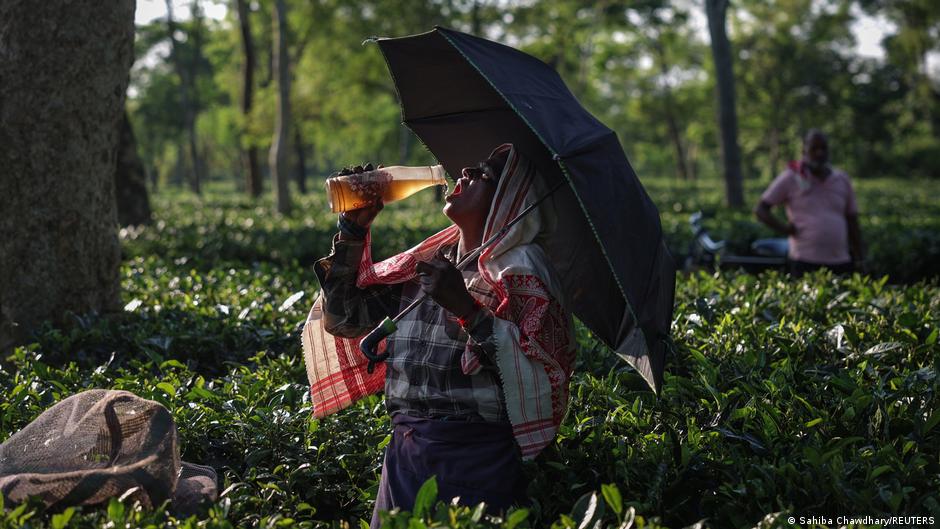
Plantations in Assam produce more than half of India's tea. But rising heat is hurting yields, workers are increasingly leaving for more stable work, and producers are feeling the squeeze of stagnant tea prices.
https://p.dw.com/p/5JP6UWeather extremes are making it harder to pick tea in AssamImage: Sahiba Chawdhary/REUTERSAdvertisementThe problems facing upper Assam's tea gardens are becoming increasingly difficult to ignore for workers like Bidesh Kamar and Sumitra Tanti.
Recent floods disrupted work for weeks in the northeast Indian state, adding even more uncertainty to their already precarious livelihood. More than 50 tea gardens were damaged following a devastating storm that swept across parts of Assam.
"The weather can disrupt work, while wages remain low and work is not as dependable as it once was," she added.
Kamar said the economics of tea have changed.
"Tea is not as profitable as it once was, and there is less certainty about the work," Kamar told DW.
After 15 years working tea plantations, Kamar is now considering whether it is time to "move on to greener pastures."
Their experience points to a growing problem for Assam's tea industry. With the business becoming less profitable and working conditions more uncertain, the industry is struggling to retain the experienced workforce which forms the backbone of the state's tea production.
Assam produces about 52% of India's tea and supports around 700,000 plantation workers and 140,000 small tea growers.
For generations, it's tea plantations have depended on a vast workforce picking leaves by hand.
But that model is now under pressure as the climate gets hotter, tea becomes less profitable and locals increasingly look elsewhere for work.
Oversupply has pushed prices down, while higher wages, fertilizer and fuel costs are squeezing producers.
Sanjiv Gogoi, who owns the 400-acre (162-hectares) Sanjiv Tea estate, said tea producers are grappling with a whole range of problems.
"Productivity has fallen, and the labor supply is not always reliable. More workers are leaving the plantations because the work no longer pays enough," Gogoi told DW.
The pressure is even greater on small growers, who produce nearly half of Assam's tea, he said.
"They have little bargaining power and often have to sell their freshly picked leaves to factories at low prices."
At the same time, erratic rainfall, rising temperatures and new pests are reducing yields and making traditional tea-growing areas increasingly vulnerable.
In Assam's major tea-growing districts, temperatures now regularly reach 36°C to 40°C (+100° F), putting both tea plants and workers under severe heat stress.
Research shows that every 1°C rise in temperature can reduce tea yields by about 87 kilos per hectare in India.
For tea workers, who spend hours outdoors picking leaves, extreme heat adds another physical strain to already demanding work, with dehydration, exhaustion and fainting reported during the hottest hours.
According to statistics from India's North Eastern Tea Association (NETA), tea prices have barely kept pace with the rising cost of producing the crop. More over, labor costs now account for roughly 60% of all production costs, leaving plantations squeezed between rising wages and weak prices.
This has created a labor crisis. Plantation workers earn around 250 to 280 Indian Rupees (€2.30–€2.60 or $2.63-$2.94) a day, while unions are demanding 350 to 500 to reflect the rising cost of living.
"The most fundamental concern is the widening gap between the cost of producing tea and the price we realize from the market," Bidyananda Barkakoty, tea farmer adviser at NETA and former vice-chairman of the Tea Board of India told DW.
He warned the departure of experienced workers was affecting both productivity and quality. Good tea depends on careful plucking of the right leaves, something that becomes harder when experienced workers are in short supply.
Meanwhile, absenteeism in some tea growing districts has reportedly reached more than 50%, as workers choose construction, urban jobs or government employment schemes that offer better and faster returns.
Harkirat Singh Sidhu, a veteran tea planter with more than 55 years of experience across plantations in nine countries, says Assam's industry must adapt.
Climate change reshaping West Bengal's tea industryTo view this video please enable JavaScript, and consider upgrading to a web browser that supports HTML5 video
"We need to make the changes and not be pushed into making changes," Sidhu told DW.
He predicted that labor issues will only grow worse, "making mechanization a necessity rather than an option."
Sidhu advocates for regenerative farming to build resilient soil, combined with upgraded drainage networks, shade canopy management, and reduced reliance on chemical pesticides.
"Everything around us has changed, and so we need to seriously think out the changes we need to work out," he added.
As experienced workers leave the tea industry, estates increasingly rely on temporary or mechanical harvesting, which can reduce quality and prices further.
The result is a difficult downward spiral. Falling productivity reduces revenues, leaving estates with less money to invest in replanting, irrigation and measures to cope with the changing climate.
That, in turn, makes the industry even less attractive to workers.
"The younger generation will stay only when they see a future in the tea gardens, not merely a job," said Barkakoty.
That means better incomes and living conditions for workers, but also offering them skilled jobs through mechanization and technology.
Carbon neutral tea farming in Assam To view this video please enable JavaScript, and consider upgrading to a web browser that supports HTML5 video