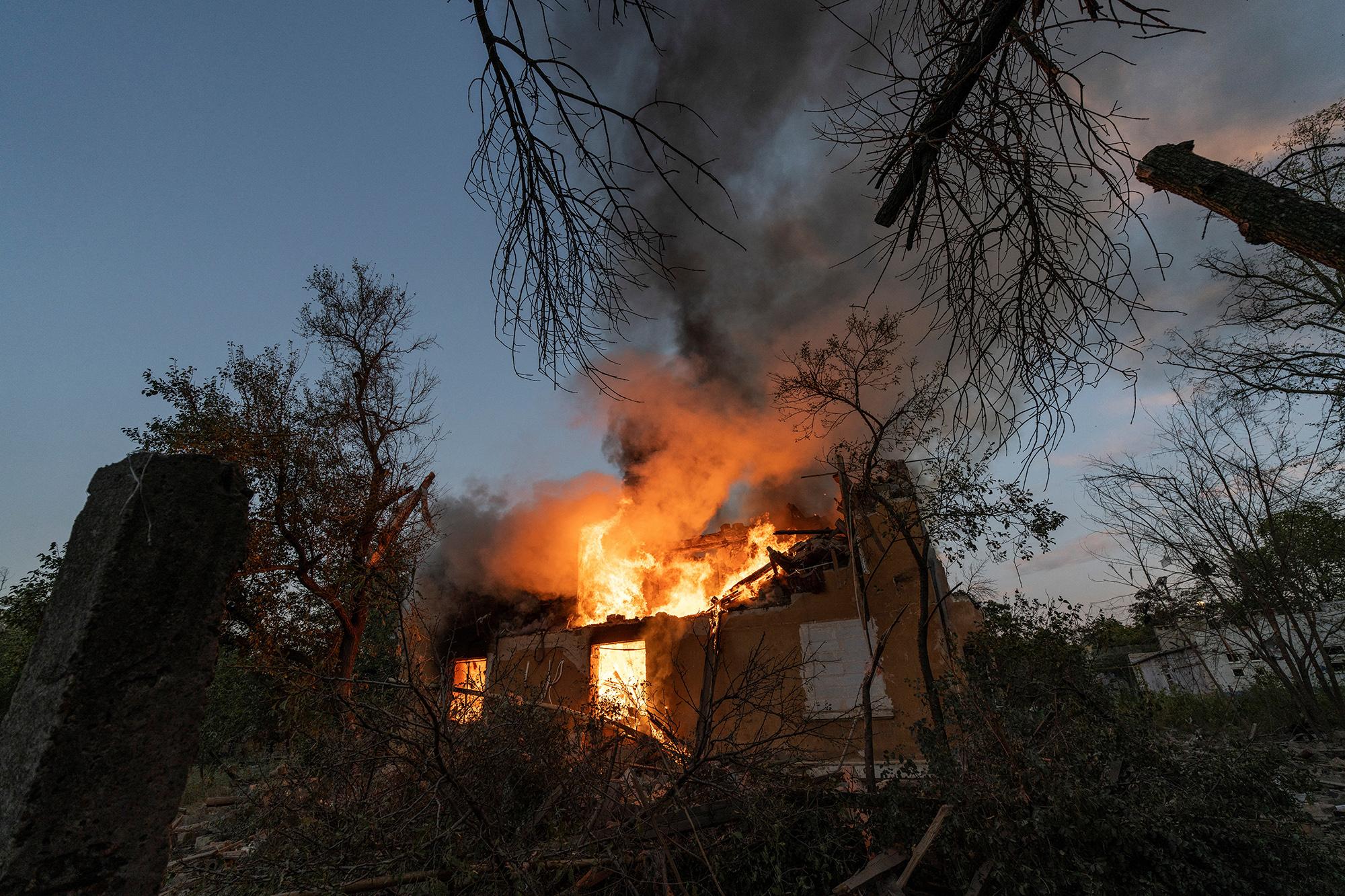
Fire and smoke rises from an apartment building hit by a Russian air strike, amid Russia's attack on Ukraine, in the frontline city of Kramatorsk in Donetsk region, Ukraine August 25, 2026. via REUTERS See more of our coverage in your search results.
Add The New York Post on Google Ukrainians marked their country’s 35th Independence Day on Monday with great pride — but little fanfare.
There was none of the pageantry that accompanied the celebration in the past: Public holidays have been put on hold in Ukraine since February 2022, when Russian dictator Vladimir Putin launched the largest European invasion since World War II.
Amid the daily horrors and ever-present dangers of Russia’s war, and internal debates over the wisdom of a wartime national election, it’s easy to understand why most Ukrainians don’t feel particularly festive.
Yet few holidays in the world today are more meaningful than Ukrainian Independence Day.
Indeed, it gives freedom-loving people everywhere good reason to celebrate.
To understand why, we must place the current war in its historical context.
The invasion Putin launched four-plus years ago stunned the world, but it didn’t come completely out of the blue.
On the contrary, it’s merely the latest chapter in a dark epic of imperial aggression stretching back hundreds of years.
Ukraine’s fight for freedom is one of the longest statehood struggles in world history: As far back as 1731, French enlightenment philosopher Voltaire noted that “Ukraine has always aspired to liberty.”
Even then Russia was engaged in the subjugation of Ukraine — a process that continued for centuries, as generations of Russian czars sought to wipe Ukraine off Europe’s map.
Russian efforts to extinguish Ukrainian identity only intensified during the totalitarian 20th century under a series of Soviet commissars.
In the 1930s, Joseph Stalin deliberately starved millions of Ukrainians to death in their own homes as part of a systematic campaign to decapitate Ukraine.
That act of mass murder, the Holodomor, was “the classic example of Soviet genocide” according to Raphael Lemkin, the man who coined that term.
Since coming to power in 2000, Vladimir Putin has enthusiastically embraced this genocidal legacy.
Like many Russians, he has never come to terms with the collapse of the USSR or the reality of an independent Ukraine.
Instead, he has continued to insist Ukrainians are actually Russians (“one people”) while regularly questioning Ukraine’s right to exist, accompanying his extreme anti-Ukrainian rhetoric with policies of increasingly open aggression.
Initially, Putin sought to subvert post-Soviet Ukraine’s fledgling statehood via political, cultural and economic interference in Kyiv’s internal affairs.
The watershed moment came in February 2014, with the Russian seizure of Crimea, soon followed by the stealth incursion into eastern Ukraine’s Donbas region — both setting the stage for the full-scale invasion of 2022.
Putin has tried to justify his actions in the international arena, claiming that Russia’s fears of an enlarging NATO necessitated invasion.
He’s pretended to be at war with Ukrainian “Nazis” — a self-evidently absurd accusation to level against a country with a Jewish president.
But when speaking to Russian audiences, Putin has been far more honest about his imperial ambitions.
Russia, he says, is simply reclaiming its “historical lands.”
The crimes of the Russian army in occupied Ukraine mirror Putin’s chilling words.
Throughout areas under Kremlin control, all traces of Ukrainian language, culture and history are being ruthlessly removed and replaced by an artificial imperial identity.
In an echo of earlier Stalinist terror, Putin’s troops have jailed countless thousands of Ukrainians deemed to be potential threats to Russian rule.
The United Nations has classed these mass arrests as a crime against humanity.
Ukrainians understand Putin’s genocidal agenda perfectly well, which is why they’re so determined to fight on.
They know that if Ukraine stops defending itself, their country will soon cease to exist.
Putin is rejecting all Ukrainian calls for a cease-fire, continuing to insist on redress for what he calls the “root causes” of the war — widely regarded as Kremlin code for regime change in Kyiv.
Putin’s maximalist stance makes a mockery of US-led efforts to broker a compromise peace.
Russia’s ongoing invasion also represents a much broader challenge to the global community.
If Putin is permitted to erase an entire nation in the heart of Europe, it will reverse decades of progress in the fight for democratic freedoms — and plunge the world into a new era of international instability.
In 2022, most experts believed Ukraine would fall in a matter of days.
But nearly five years on, it continues to stand tall — and is now closer to securing true independence than at any time in its troubled history.
That’s what makes Ukrainian Independence Day a genuinely miraculous holiday, and an occasion that anyone who values freedom should cheer.
Peter Dickinson, a Kyiv-based British journalist, is editor of the Atlantic Council’s UkraineAlert blog.