Starlink promises better connectivity in remote and mountainous areas. But in one of Southeast Asia's most tightly controlled online environments, more network access doesn't mean more free speech.
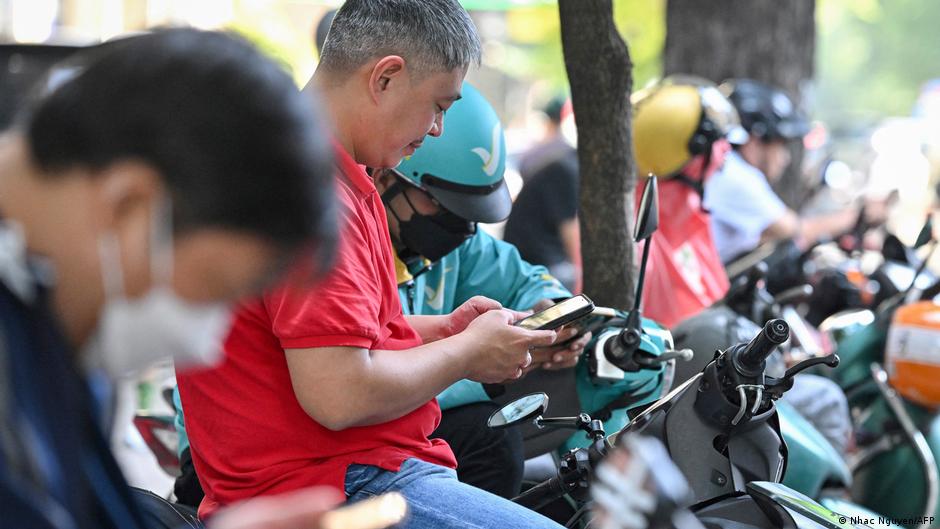
https://p.dw.com/p/5JM87Vietnam already has high mobile network coverage, but information is tightly controlledImage: Nhac Nguyen/AFPAdvertisementElon Musk's Starlink has begun selling satellite internet in Vietnam, bringing its high-speed service to one of the world's most tightly controlled online environments.
The satellite internet service operated by Musk's SpaceX began accepting orders from Vietnamese customers this month, with residential packages starting at around €37 ($43) a month.
Vietnam's government announced in March 2025 that it would allow SpaceX to launch Starlink on a controlled trial basis, waiving the usual restrictions on foreign ownership. The trial is capped at 600,000 subscribers and is due to run until the end of 2030.
The service is operated through Starlink Services Vietnam, a local SpaceX subsidiary established last September.
Vietnamese authorities subsequently licensed four ground gateway stations and up to 600,000 Starlink terminals for the initial rollout. The gateways allow satellite traffic to connect with terrestrial telecommunications infrastructure inside Vietnam.
Vietnam authorized the trial in March 2025 as it sought to head off threatened US trade measures over its large bilateral trade surplus.
At the time, some analysts viewed approval of Starlink, alongside tariff reductions on several US products, as part of Hanoi's effort to ease trade tensions with Washington.
Vietnam officially connected to the global internet in 1997. By the end of 2025, it had around 85.6 million internet users, equivalent to 84.2% of the population, according to government data.
Conventional internet infrastructure is already extensive. Around 85% of Vietnamese households had fiber-optic internet, while there were more than 110 million mobile broadband subscriptions, and the country's 5G network covered around 92% of the population, according to official statistics.
Starlink is relatively expensive compared to other network options, but its most obvious advantage is not in well-connected cities such as Hanoi or Ho Chi Minh City but in mountainous, remote and island communities where terrestrial infrastructure remains weaker.
The Vietnamese government says Starlink could help increase internet access in remote areas, islands and places without adequate terrestrial telecommunications infrastructure.
Because satellite connections rely less on local cables and towers, they could also provide backup communications when terrestrial networks are damaged by typhoons, floods or landslides.
However, Starlink currently advertises its cheapest household plan in Vietnam at about €37 a month, while the necessary hardware starts at roughly €284.
In rural areas, where Starlink could potentially be most useful, average monthly income is just €259, according to Vietnam's National Statistics Office.
"Without subsidies, it will be unaffordable for many rural households. Its greatest impact may therefore come through shared connections for institutions such as schools, clinics and local government offices rather than individual subscriptions," Khac Giang Nguyen, a visiting fellow at the ISEAS-Yusof Ishak Institute in Singapore, told DW.
Freedom online: Who's negotiating it?To view this video please enable JavaScript, and consider upgrading to a web browser that supports HTML5 video
Whatever Starlink does for connectivity, there is little indication that its arrival will loosen Vietnam's increasingly tight control of online speech.
Freedom House's 2025 Freedom on the Net report gave Vietnam a score of just 22 out of 100 and classified the country's internet as "not free." Among the Asia-Pacific countries assessed, only China and Myanmar scored lower.
And foreign technology companies are already central to enforcing those restrictions.
Vietnamese authorities said Facebook, YouTube and TikTok complied with more than 94% of government requests to remove or block content during the first half of 2026.
Human Rights Watch and other rights groups have repeatedly criticized foreign platforms for facilitating state censorship.
In previous years, Hanoi publicly reported compliance rates of around 90% or higher for requests made to Facebook and YouTube to remove content the government considered illegal or anti-state.
The 2025 decision approving the Starlink pilot made clear from the outset that connectivity would remain subordinate to state security concerns, with the telecoms ministry stating that the "programme will adhere to national security and defence principles," according to the news website VNExpress.
Vietnam has also steadily expanded the legal tools available to police the internet. Decree 147, which took effect in December 2024, requires social media companies to verify users, hand over certain data and remove content deemed illegal by the authorities within 24 hours.
A new Cybersecurity Law took effect in July, further consolidating state control over cyberspace. New implementing regulations issued on August 19 allow authorities to demand that online content be removed within 24 hours and provide for accounts to be restricted or blocked for repeated violations.
The law also for the first time explicitly refers to constructing a "national firewall" to counter cybersecurity threats.
"As Vietnam is an interesting market for Starlink and the service is on a trial period, the company will ensure that it sticks to the governmental regulations rather than offering the Vietnamese citizens technical options to circumvent censorship," Alfred Gerstl, an expert on Southeast Asia at the University of Vienna, told DW.
Starlink must operate through a Vietnamese company and licensed domestic gateway stations, meaning that its service is not being introduced as a parallel internet infrastructure beyond the reach of Vietnamese regulators.
An analysis by the Singapore Space Agency last month noted that Starlink in Vietnam, unlike in most other Southeast Asian countries, will be channeled through four domestic gateway earth stations and supervised jointly by the Ministry of Science and Technology, the Ministry of National Defence and the Ministry of Public Security.
"Vietnamese instinct is risk containment through enclosure," the report noted.
According to Gerstl, "Starlink will not open a breach in the Bamboo Firewall," a reference to the nickname for Vietnam's system of legal restrictions, content controls and technical measures to regulate the internet.
"The regime will continue to uphold digital sovereignty. Indeed, censorship, currently less strict than in China, is expected to be further expanded in the future," he added.
Starlink may provide Vietnamese users with another way to get online, but it does not provide them with an internet beyond the reach of the Vietnamese state.
At best, said Giang, Starlink may broaden access to information for communities that previously had poor connectivity, which is beneficial in itself, "but better connectivity does not necessarily mean greater freedom of speech," he added.
Bypassing the censors: How to access blocked online content To view this video please enable JavaScript, and consider upgrading to a web browser that supports HTML5 video