play Live Sign upShow navigation menuplay Live Click here to searchsearchSign upOPINIONOPINION, Opinion|RohingyaWhat would justice look like if there were no Rohingya left in Myanmar?Nine years after the 2017 atrocities, Rohingya are still being forced to flee because the genocide has never stopped.
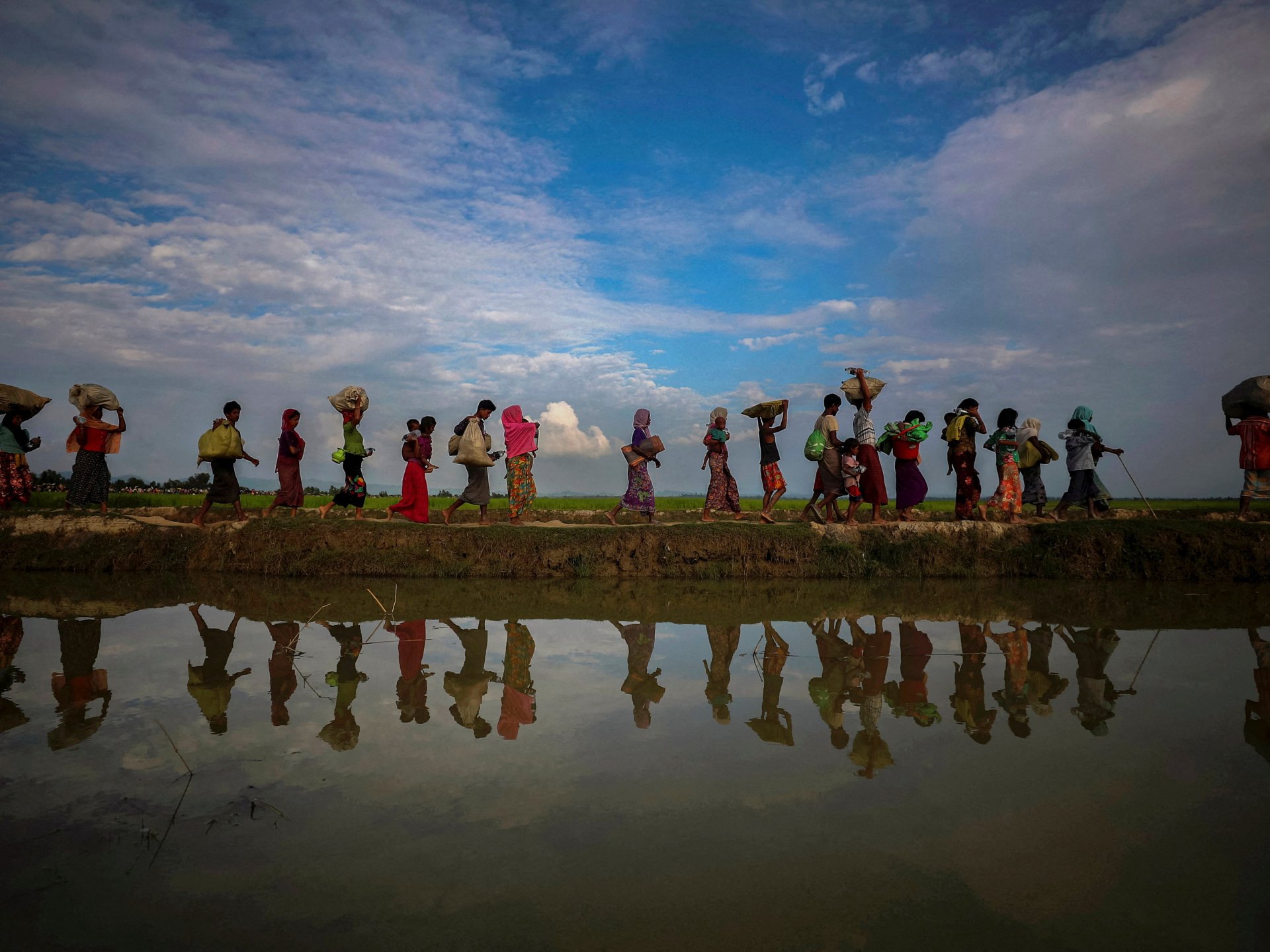
xwhatsapp-strokecopylinkgoogleAdd Al Jazeera on GoogleinfoRohingya refugees walk along an embankment next to paddy fields after fleeing from Myanmar into Palang Khali, near Cox's Bazar, Bangladesh on November 2, 2017 [Hannah McKay/Reuters]August 25 is an incredibly painful day for the Rohingya. It marks the anniversary of the 2017 genocidal campaign by the Myanmar military. Babies and young children were thrown into fires. Women and young girls were systematically gang-raped and mutilated. Entire families were slaughtered as they fled. Others were trapped inside their homes and burned alive. More than 700,000 of our people were forced to flee to Bangladesh.
The Rohingya, who are an ethnic Muslim-majority group who speak their own language from the Indo-Aryan family, have long faced discrimination and persecution in Myanmar.
Today, about 1.2 million Rohingya remain trapped in camps in Bangladesh, while a new wave of persecution is forcing more Rohingya from their homes in Rakhine state. Others are risking their lives at sea in a desperate search for safety.
In this desperate situation, there is a ray of hope raised by international justice proceedings in Argentina and the International Court of Justice (ICJ). Still, the international community is falling short in fulfilling its commitments to ensure accountability and protect the Rohingya.
Over the past two years, the balance of power in Rakhine has dramatically changed. The Arakan Army (AA), an ethnic Rakhine armed group, now controls most of the state, including the main Rohingya areas in the north. But the brutality and persecution Rohingya face have not ended.
As the AA has consolidated its control, evidence has mounted of mass killings and targeted attacks on civilians, documenting what Rohingya communities have been warning of.
Rohingya also face forced recruitment, forced labour, detention and severe restrictions on movement. Sexual violence, a hallmark of the Rohingya genocide, is continuing under AA authority.
Rohingya in Rakhine report that the violence and oppression they now face from the AA is just as brutal as the Myanmar military’s ethnic cleansing in 2017. Taken together, we see these abuses as part of a deliberate strategy to drive Rohingya from their homes and continue their erasure from Myanmar.
The same anti-Rohingya racism that drove decades of persecution by the Myanmar military is also at the heart of the AA’s treatment of the Rohingya. The perpetrators may have changed, but the dehumanisation and denial of our identity and rights continue.
The AA is completing what the Myanmar military started. Rohingya are being driven from their villages and prevented from returning, while their land is confiscated and new Rakhine settlements are built on it, sometimes by Rohingya coerced into forced labour. The possibility of return is being destroyed in real time.
More than 150,000 Rohingya have fled to Bangladesh since late 2023, just as international humanitarian funding for refugees is being slashed. Learning centres in Cox’s Bazar have closed and essential services are being cut. Children who fled genocide are growing up without education or hope for their future. Others were born in the camps and have never known a life outside them. The international community is allowing an entire generation of Rohingya children to be abandoned.
Rohingya are being forced to choose between continuing persecution in their homeland and hunger, insecurity and an increasingly desperate existence in camps.
For those forced to flee, there is often no safe route to protection. The very people forcing Rohingya to flee are often involved in and profiting from their trafficking as they try to escape. In July, two boats carrying more than 500 Rohingya, including children and young people, sank after leaving Rakhine. No one would put their children on such a dangerous journey unless staying was even more dangerous.
Meanwhile, there is growing anti-Rohingya sentiment in countries that host them as refugees. Governments talk about Rohingya returning home while more are being forced out and the land they would return to is being taken. We want to go home. But we want to go home with our rights: citizenship, equal rights and the right to return to our own land.
For nine years, the Myanmar military leaders responsible for genocide against Rohingya have faced no real consequences. The architects of the genocide remain free, while the same military has gone on to commit atrocities against communities across Myanmar. Accountability is not only about the past. It is about stopping the violence happening now and preventing further atrocities.
The world cannot repeat the same failure with the Arakan Army. We have seen this pattern before and know where it leads. The longer the Myanmar military and AA are allowed to act with impunity, the closer we come to the complete erasure of the Rohingya from Rakhine.
Rohingya survivors and organisations have spent years documenting crimes, giving evidence and fighting for accountability. We had to pursue justice on the other side of the world because governments and international institutions failed to deliver it.
That fight is finally producing results. My organisation, the Burmese Rohingya Organisation UK (BROUK), brought a universal jurisdiction case in Argentina which has resulted in international arrest warrants for 22 Myanmar military officials and three civilians, including the military government’s leaders Senior General Min Aung Hlaing and General Soe Win, for genocide and crimes against humanity. We are also pursuing reparations for Rohingya survivors.
A judgement is also expected in the coming months in the genocide case brought by The Gambia against Myanmar at the ICJ.
Rohingya are getting closer to justice in international courts but at the same time are being pushed further from our homeland. Legal progress means little if Rohingya continue to be killed, forced out and stripped of the land to which they hope one day to return.
We have fought for years to get this far. Now governments must act. Every possible pressure point must be applied.
States must enforce the Argentinian arrest warrants whenever those wanted enter their jurisdictions, and Interpol must act on Argentina’s request for red notices. Governments must impose coordinated targeted sanctions on the AA and the Myanmar military, alongside restrictions on arms, aviation fuel and revenue streams that enable further atrocities. Maximum international pressure must be applied on the AA to end its persecution of Rohingya and ensure our protection and equal rights.
The United Nations Security Council must act. The United Kingdom, as penholder on Myanmar, must push for an urgent council meeting on the atrocities taking place in Rakhine and the continued failure to protect the Rohingya.
Governments must restore and increase humanitarian funding for Rohingya in Bangladesh and Rakhine, facilitate cross-border aid and pressure the Myanmar military and the AA to end restrictions on humanitarian access.
Governments must pursue every available route to justice and accountability for crimes by the Myanmar military and the AA. They must also be ready to respond to the forthcoming ICJ judgement.
Justice and accountability delivered years too late will mean nothing if there are no Rohingya left in Myanmar.
Justice is not only about what happens in courtrooms. For Rohingya, it means being able to return to our villages and our land. It means restoring the citizenship and rights that have been taken from us. Above all, it means being able to live freely and as equals in Myanmar, without ever again facing persecution and genocide.
The views expressed in this article are the author’s own and do not necessarily reflect Al Jazeera’s editorial stance.