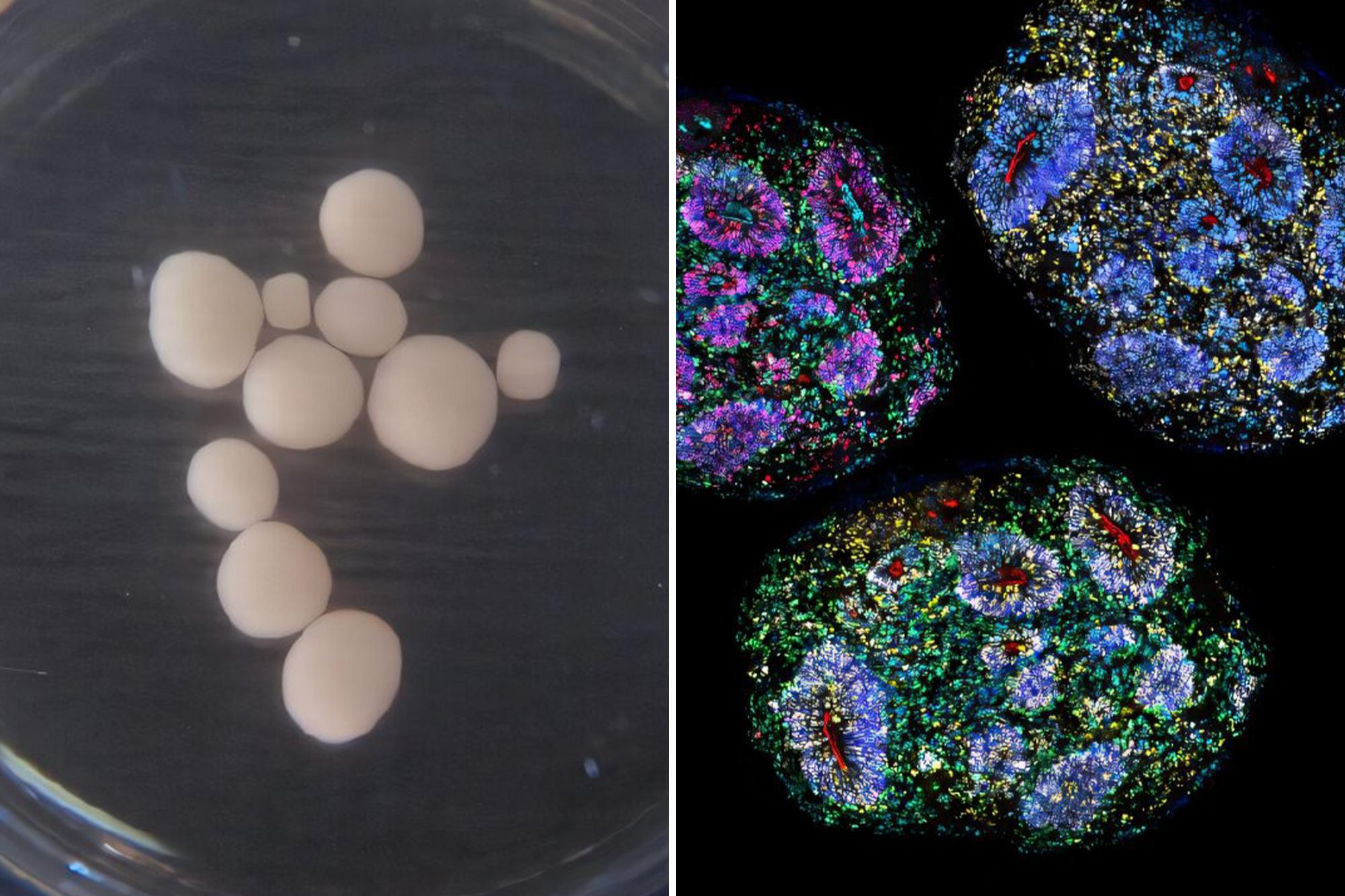
Add The New York Post on Google A team of scientists have produced organoids that have become the world’s oldest lab-grown human brains — with some cells growing for around seven years.
Harvard scientists developed the peppercorn-sized cell clusters for more than five years – shattering the previous record of 694 days, according to an article published in Nature last Wednesday.
But the paper’s leading author, Paola Arlotta, has since revealed some of the cells grew for around seven years, according to Agence France Presse (AFP).
“The data indicate [s] that human brain organoids record the passage of time following endogenous milestones and using similar epigenetic mechanisms,” the study claims.
Scientists have grown organoids that survived for five years. Irene Faravelli and Noelia Antón Bolaños “The work demonstrates that a diversity of cells in organoids can develop over considerable time periods and are capable of both recording and recalling their developmental age.”
Organoids are 3D clusters of cells that mimic the structure and function of human organs – and they are used by scientists to test new drugs, model diseases and study human development.
But the cell clusters usually die within two years because they are starved of oxygen and there is no blood vessel system. Meanwhile, it takes almost 20 years for the human brain to fully develop.
The scientists combined cells from an artificial brain, which was one year old, and mixed them with others that were just two weeks old.
Arlotta, the Golub Family Professor of Stem Cell and Regenerative Biology, said the younger cells behaved as normal – but the older cells “jumped ahead a whole chunk of development.”
Scientists combined cells from an artificial brain and cells from a brain just two weeks old. Muotri Lab/UCTV The scientist noted that the cells produced neurons, which normally take around four months.
It effectively “warped time” for brain development – which the scientist described as a “super cool” process.
The brain organoids have since been destroyed – but Arlotta suggests the cells could last longer.
“Nobody really knows,” she said, regarding a potential time frame.
Neuroscientist Guo-li Ming described the feat as a “technology breakthrough,” according to NPR.
Scientists across the US have used organoids when it comes to studying Alzheimer’s disease – the sixth-leading cause of death in the US.
Cells are used to model how the disease can advance – monitoring characteristics such as amyloid-beta and tau plaque formation, the protein which ultimately kills brain cells.
Arlotta hopes the recent experiment will also provide insight into how diseases like schizophrenia advance.