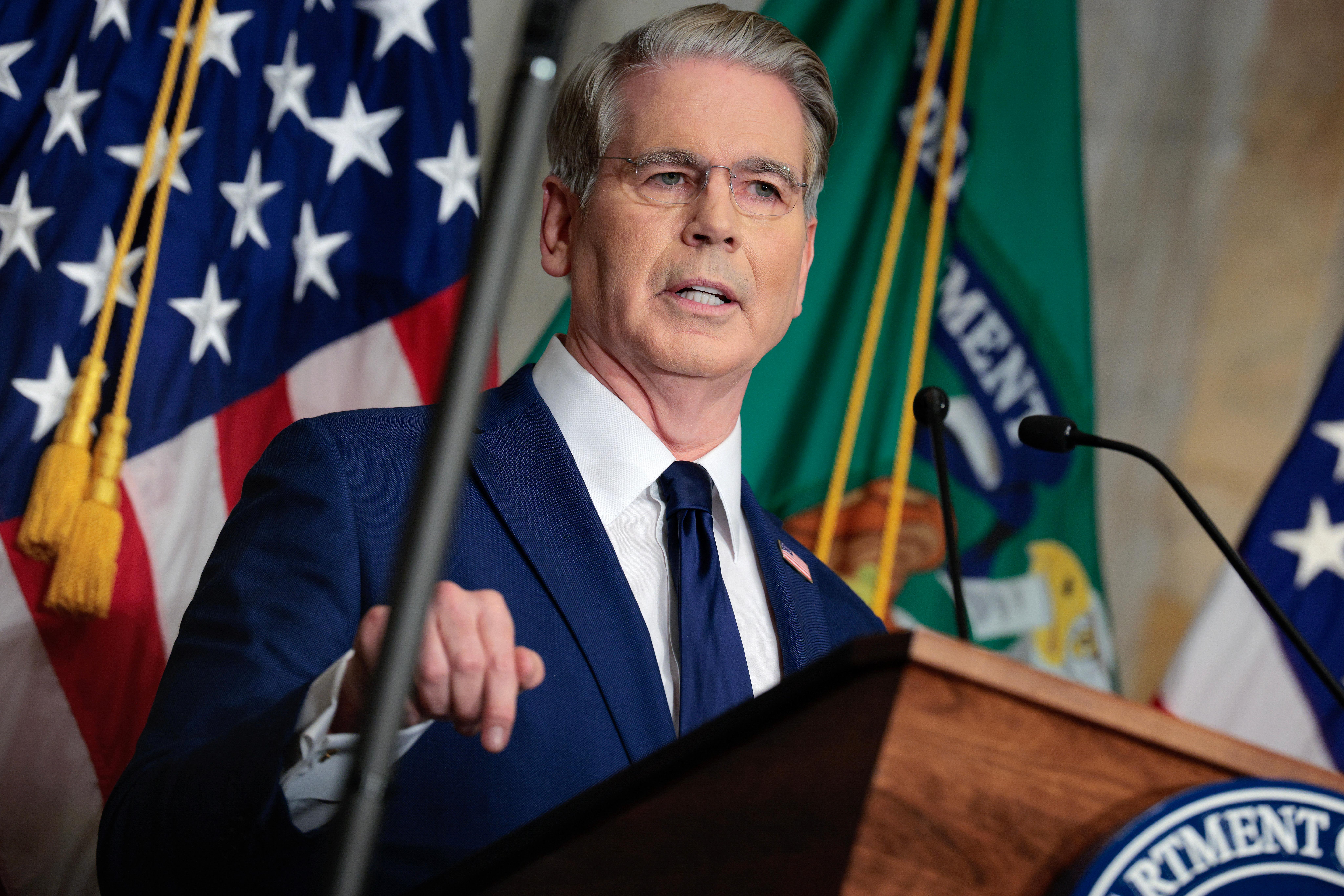
Treasury Secretary Scott Bessent announcing "Operation Economic Outcast" during a press conference on Aug. 24, 2026. Photo by Chip Somodevilla/Getty Images See more of our coverage in your search results.
Add The New York Post on Google Team Trump fired a powerful shot across Tehran’s bow Monday as Treasury Secretary Scott Bessent rolled out “Operation Economic Outcast.”
The ultimate goal: complete “economic asphyxiation of the regime,” per Bessent — i.e., blocking “every potential source of revenue that funds the [Islamic Revolutionary Guard Corps] and the evil Iranian regime” until it cries uncle.
For now, President Donald Trump has begun pressing world leaders to halt all economic interactions with Iran, and threatening to lock them out of the “US dollar system” if they refuse.
“Those who tether themselves to Tehran should expect to share in the isolation of a withering regime,” warned Bessent.
That’s a strong threat, and it’s sure to ratchet up some added economic pain for Iran, which is already in a world of hurt.
Meanwhile, Team Trump also slapped sanctions on nearly 60 entities, individuals and vessels tied to Iran’s “nuclear and missile technology procurement, cyber operations and oil‐revenue generation networks.”
The threat of sanctions on Iran’s business partners is already showing signs of success: Last week, its top trading partner, the United Arab Emirates, cut off all its commercial and financial ties.
That’s major: The UAE supplied 30% of Iran’s imports and took 13% of its non-oil exports.
As Bessent told The Post, Abu Dhabi’s action as Washington began to launch Economic Outcast is no coincidence, but “likely causal.”
And just hours before the Treasury announcement, Iran’s currency hit an all-time low — 2.02 million rials to the dollar.
That comes as inflation (now 100%) and unemployment soar.
And as Iranian oil exports, the regime’s chief source of income, has fallen to near zero, thanks to the US blockade.
Iran’s military is also feeling the squeeze: “To the ordinary soldiers supporting this regime,” said Bessent, “as more and more of your paychecks stop . . . ask whether your commanders are leading your country to triumph or ruin.”
Why only threaten countries that trade with Iran, rather impose sanctions now?
To give “everyone the opportunity to remedy bad behavior,” Bessent explains: “Why would I want to blow up the global financial system? We believe that it is important to . . . give people a cure period, but they should know that that will move very quickly and that we are serious.”
Of course, some countries — like China — may resist.
They’ll have to learn the hard way, with Trump making good on his warnings and actually imposing tough secondary sanctions.
Even then, Iran’s leaders may try to hold out, praying Democrats win the midterms and tie Trump’s hands.
But for now, America’s got the upper hand, is quickly tightening it around the Islamic Republic’s throat.
It looks like the best hope yet for a lasting resolution to this regime’s menace to civilization.