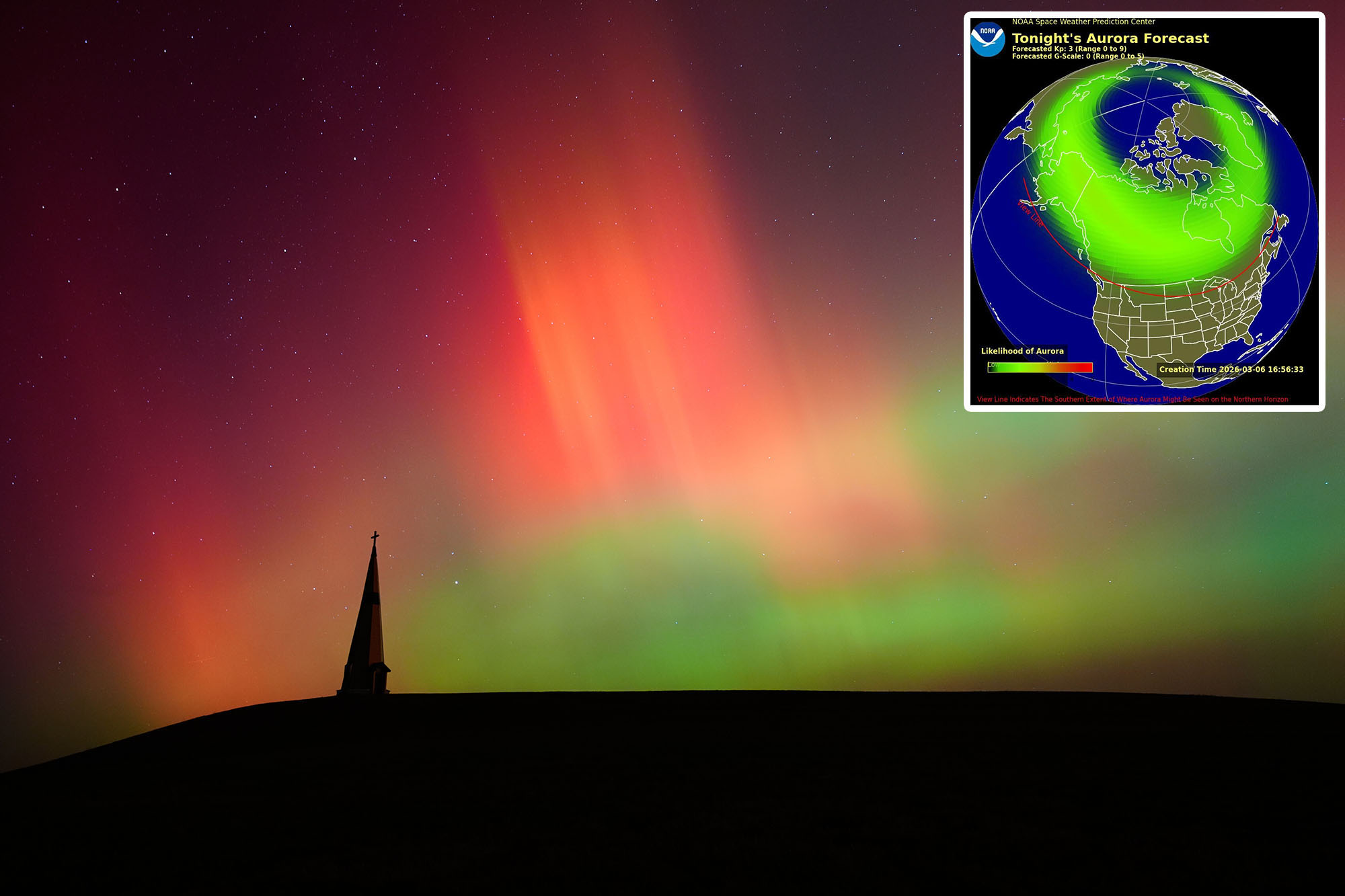
For those who’ve always wanted to experience the magic of the Northern Lights — but don’t live in one of the typical prime viewing locations — tonight and this weekend may just be your chance.
The National Oceanic and Atmospheric Administration (NOAA) recently issued a geomagnetic storm watch due to a high-speed solar wind stream, increasing the potential for geomagnetic activity across several northern US states and Canadian provinces from Friday, March 6 to Sunday, March 8.
The storm is likely to make the aurora borealis (the scientific term for the Northern Lights) visible at more southern latitudes than is typical.
Provided the skies are clear, residents of Alaska, Washington, Idaho, Montana, North Dakota, South Dakota, Minnesota, Wisconsin, Michigan and Maine have the best chance of seeing the light display between 10 p.m. and 2:00 a.m. local time — the period in which geomagnetic activity is known to peak.
The month of March is typically one of the best times to see the aurora borealis, as it includes the spring equinox, according to BBC Sky at Night Magazine. The month of September is prime viewing time too, as it includes the autumn equinox. The correlation is known as the Russel-McPherron effect, named after the two scientists who noticed the pattern.
The Northern Lights are the visible result of how the sun interacts with Earth’s magnetic field. While the sun has various levels of activity year-round, during the peak of the solar cycle (which Earth is currently in), an increased chance of events like coronal mass ejections (CMEs) and coronal holes lead to solar storms.
When these hit the planet, magnetic field lines shoot solar particles toward the North and South Poles, producing the other-worldly swaths of color in the sky.
To get the best possible view of the nature-made spectacle, find a spot away from the city lights, which is easiest to find using a light pollution map or dark-sky finder. While auroras are difficult to acutely predict and take place in waves, checking live forecasts throughout the evening can be helpful.
For those hoping to capture the moment on camera, simply switch to Night Mode or Pro Mode on iPhone settings, as advised by People. Main lens is best — not ultra-wide. RAW format, if available, is also ideal if the plan is to edit later.