Add The New York Post on Google Homebuyers are saving thousands of dollars by using artificial intelligence to cut out some of the costly legwork traditionally performed by real estate agents — while still keeping a human broker on call to negotiate and close the deal.
The new model is geared toward buyers who already scour listings and open houses themselves, but still want an expert to handle offers, contracts and the closing process — without having to cough up a percentage-based commission.
The model is part of a broader push to use AI to automate work once performed by professional middlemen — from managing investments and preparing taxes to booking travel — with TurboHome betting the same shift is coming for residential real estate.
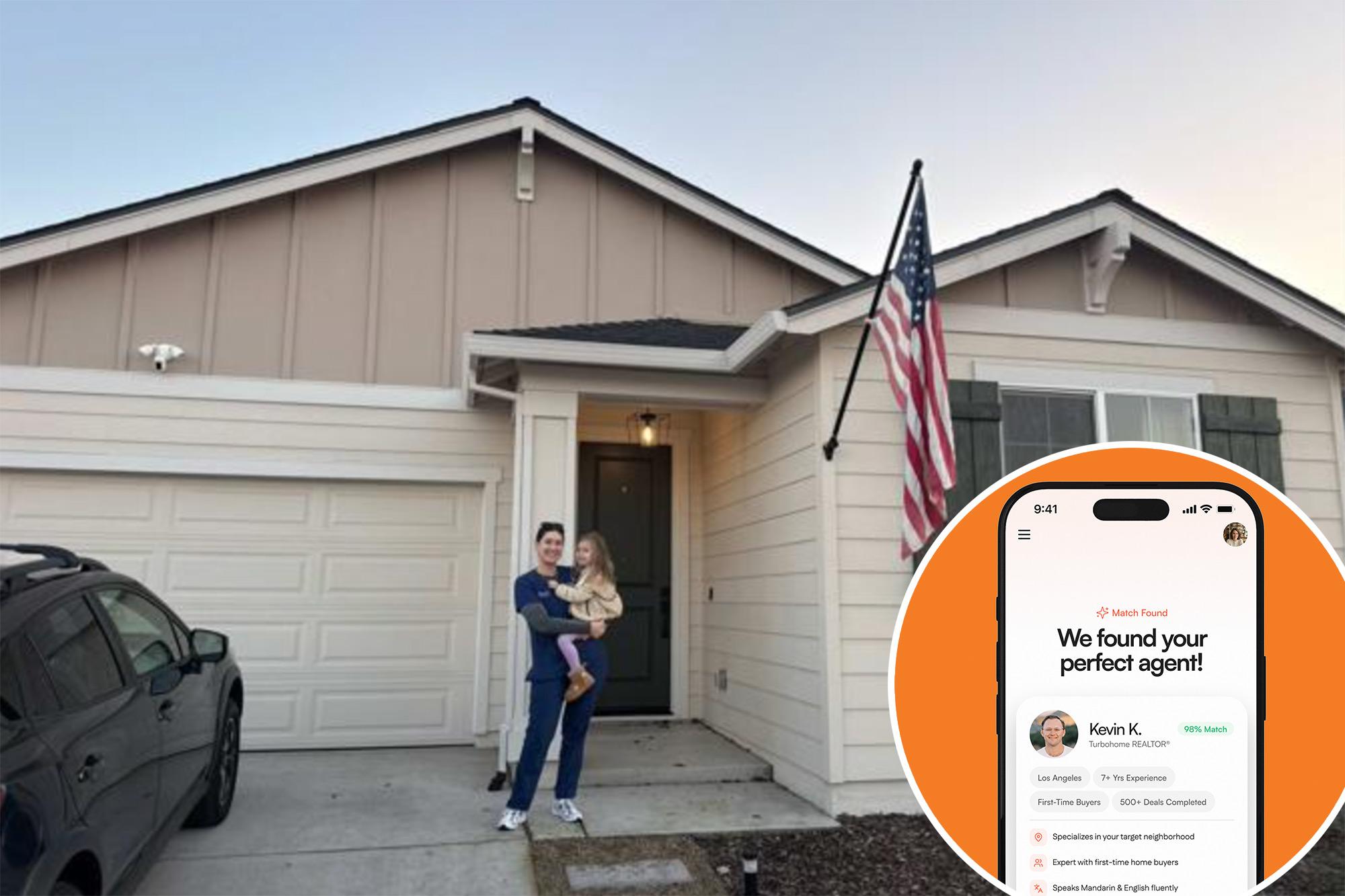
“The experience feels like Zillow on steroids,” Ben Bear, CEO of AI-powered brokerage TurboHome, told The Post, referring to the company’s new dashboard.
TurboHome, which launched in late 2024, charges a flat fee at closing rather than keeping the full buyer-agent commission. When a seller pays TurboHome a commission above that fee, the company returns the difference to the buyer as a rebate.
For example, on a $1.5 million home where the seller agrees to pay a 3% buyer-agent commission, TurboHome would receive $45,000, keep its $12,000 flat fee and rebate the remaining $33,000 to the buyer, according to the company.
Buyers can generally use the rebate for eligible closing costs, to buy down their mortgage rate or, depending on the transaction and lender requirements, receive it as cash after closing.
The company says it has facilitated 388 transactions totaling $440 million in home sales.
Bob Miller, broker and owner of Millshire Realty in Lakeland, Fla., told The Post that AI-powered brokerages could put pressure on traditional commissions — particularly for simpler transactions — but said the technology is unlikely to eliminate agents altogether.
“I don’t believe AI signals the end of the real estate agent, but I absolutely believe it will change the industry,” Miller said.
He said lower-priced and more straightforward deals could increasingly migrate toward AI-heavy, flat-fee models, while more complex purchases would still require human judgment.
“As you move into higher-end properties and more complicated transactions, I don’t believe the human element is going anywhere,” Miller said. “AI can provide information, but it can’t completely replace experience, judgment and relationships.”
Miller said the bigger threat to traditional agents is not outright replacement, but pressure to justify what they charge.
“AI isn’t going to eliminate the real estate agent,” Miller said. “It’s going to force real estate agents to prove what their human expertise is actually worth.”
TurboHome isn’t alone in challenging the traditional commission model. Bear acknowledged that regional flat-fee buyer brokerages also offer commission rebates, though he said few combine them with an AI-native buying platform and licensed human agents.
The savings can add up quickly, the company boasts.
Ravi Surampudi, a 38-year-old software engineer at Workday, is set to receive a $21,750 rebate after purchasing a new $1.125 million home in Prosper, Texas.
The builder agreed to pay a 3% buyer-agent commission, or $33,750, with TurboHome keeping its $12,000 flat fee and returning the remaining $21,750 to Surampudi, according to the company.
Surampudi said he and his wife had already done much of the house hunting themselves and knew what they wanted before making a trip to Texas.
“TurboHome’s model made a lot more sense for us because we are getting the best of both worlds,” Surampudi told The Post.
“Some closing cost credit, but also the facilities of an actual human being, rather than submitting docs across a portal.”
The company’s pitch is that AI can automate much of the work performed behind the scenes by traditional agents — including comparable-sales analysis, disclosure reviews and property recommendations — while human agents concentrate on advice and negotiation.
“At a high level, 80% of people are finding the home themselves on Zillow,” Bear said.
A Q2 2026 ResiClub survey cited by TurboHome found that 77% of US homeowners surveyed said they found their most recent home themselves, compared with 22% who said their agent found it.
“What we’ve tried to do is reorient around the consumer as the customer,” Bear added.
“How can we have the fewest agents possible doing the most deals, but use the technology to make it a full-service experience?”
Bear said TurboHome agents generally close between 30 and 50 transactions annually. The company cited a Consumer Federation of America study that found 70% of agents sold five or fewer homes over a 12-month period.
The startup’s new dashboard pushes more of its AI-powered property research, valuation and transaction tools directly into buyers’ hands.
Customers can search for properties using conversational queries, request valuations and comparable sales, book tours and begin drafting offers, according to Bear.
They can also communicate with both an AI assistant and their assigned human agent through the same interface.
TurboHome currently has 14 agents, according to the company. Its regional managers are salaried employees while most of its local agents are independent contractors.
“You don’t have to do this,” Bear said of the self-service tools. “You can still have the agent do it all for you.”
The growing use of AI also raises questions about what happens to the personal and financial information consumers provide to such platforms.
TurboHome said it uses third-party AI models but does not use consumer data to train them. Its AI processes chat messages, files and buyer profile information for personalization, but the company said it does not send customers’ names, email addresses or phone numbers to outside entities.
Miller said the issue warrants scrutiny as more of the homebuying process becomes automated.
“There are also legitimate privacy and consumer-protection concerns,” he said. “Real estate transactions involve sensitive financial and personal information, so consumers need to know how that data is being stored, protected and used.”
That hybrid approach appealed to Surampudi, who was purchasing remotely and didn’t need an agent accompanying him to scores of showings.
“If you know what you want and you’ve done your research,” he said, “then I don’t see any [reason] to look at any other real estate agents, because then the rest of the 90% is handled by them pretty easily.”
Other buyers similarly said the financial savings — rather than the flashy AI features — initially attracted them.
Letty Neuendorff, a 39-year-old analyzer technician for an energy company in the Houston area, received a $6,150 closing credit when she bought a $410,000 five-bedroom home in Clear Lake. TurboHome collected a matching $6,150 fee.
Neuendorff, who has bought several homes previously, said she didn’t use TurboHome’s consumer-facing AI tools during her purchase. Instead, the technology operated largely behind the scenes while she dealt with her agent, Jake.
The transaction moved at breakneck speed: Neuendorff said they closed in 15 days after her agent connected her with a mortgage broker capable of meeting the tight deadline.
“There’s no way that we could have pulled this off in fifteen days had I not had a good broker and a good rep,” Neuendorff said.
She said the biggest difference from her previous experiences was responsiveness.
“I was able to get top notch communication, which I think is the most important thing,” Neuendorff said.
Neuendorff has already recommended the company to her sister.
“I know this sounds like it’s kind of a little fishy,” she recalled telling her, before adding: “Thank goodness for technology, for sure.”
Melissa Pereira, 34, chief of audiology for a large healthcare system, likewise sought out a cheaper alternative when she bought her second home, a $625,000 single-family property in Roseville, Calif.
Pereira said she had contacted several traditional Realtors but hadn’t found the right fit before discovering TurboHome through an online search.
“The communication was fantastic,” Pereira said. “They were immediately responsive to anything via text or email. I would typically hear back from them within the hour.”
Her deal was structured differently from a conventional rebate.
Instead of collecting a percentage-based buyer-agent commission, TurboHome charged the seller its $9,000 flat fee. That reduced the total commission cost and freed up money that could be used to lower Pereira’s purchase price while still allowing the seller to receive the proceeds needed to buy a replacement property, according to the company.
Pereira estimated that the arrangement saved her about $10,000.
“If you’re trying to buy in a more competitive area, TurboHome is an excellent tool,” she said.
“Especially if you’re a second time home buyer and know what you’re looking for, have done it before.”
The company says its transactions have ranged from $200,000 to $12 million.
It completed deals in 76 cities across California and Texas during the second quarter and said its buyers won 49% of their offers during the quarter.
Bear said the business is designed around the idea that AI will increasingly take over routine tasks without eliminating the human agent entirely.
“I don’t know that the human part is ever going to go away,” Bear said.
“Almost everything that can’t be automated today will be possible to automate in the future,” he added, “with the exception of the human to human piece.”
For buyers who want an agent to spend every weekend finding and showing them properties, however, Pereira said the old-fashioned approach may still make more sense.
“If they’re looking for somebody to spend weekends showing them houses and doing all the legwork of finding a place, TurboHome wouldn’t be a great fit,” Pereira said.
“But if you want the expertise on negotiations, contract and getting you to closing, then TurboHome is a great fit for you.”