Nine years after the Rohingya were driven from Myanmar, claims of progress on refugee returns have revived talk of repatriation.
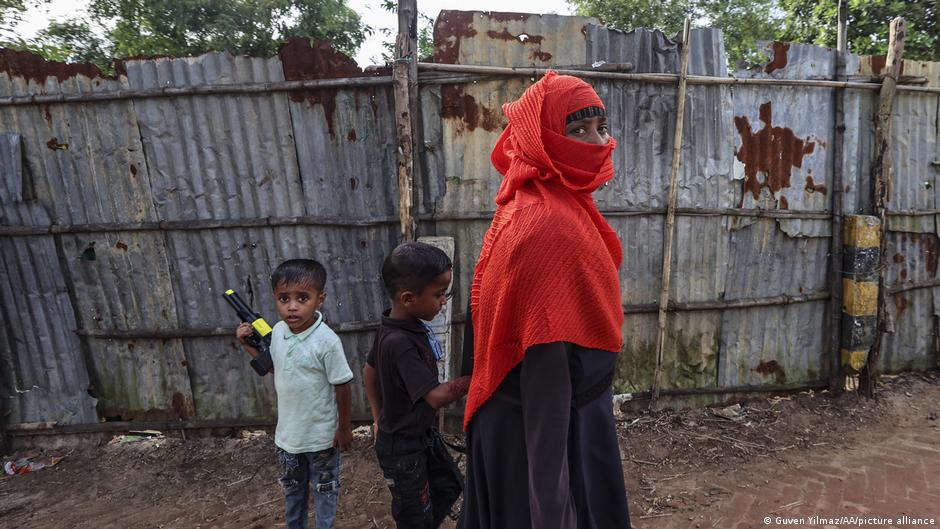
https://p.dw.com/p/5JJcaWomen and children suffer the most among camp residents who have limited access to food and clean waterImage: Guven Yilmaz/AA/picture allianceAdvertisementMyanmar's military-backed government is again talking about bringing Rohingya refugees home from refugee camps in neighboring Bangladesh.
Earlier this month, authorities in Naypyidaw, Myanmar's capital, said they had made progress verifying Rohingya refugees in Bangladesh for possible repatriation.
Of the 820,000 names submitted by Bangladesh, Myanmar said it had verified around 308,000 as former residents but would not repatriate them until security conditions improve in civil war-torn Rakhine State.
But analysts told DW that large-scale, safe repatriation is now arguably further out of reach than at any point since 2017. Myanmar is engulfed in civil war, the military no longer controls most of Rakhine state, and the Rohingya remain denied citizenship.
In August 2017, Myanmar's military launched sweeping operations in northern Rakhine state after alleged attacks by the Arakan Rohingya Salvation Army (ARSA) militant group on security posts.
More than 750,000 Rohingya, a long-persecuted Muslim ethnic minority in predominantly Buddhist Myanmar, fled to Bangladesh, joining hundreds of thousands displaced by earlier crackdowns.
Muslim-majority Bangladesh now hosts around 1.2 million Rohingya refugees, mostly in camps around the southern coastal district of Cox's Bazar, according to UN bodies.
Myanmar does not recognize the Rohingya as one of its 135 officially recognized ethnic groups and has long referred to them as "Bengalis," implying they are migrants from Bangladesh despite generations of Rohingya having lived in Rakhine.
UN investigators found evidence of genocidal intent by Myanmar's military, while the United States argued in 2022 that members of the military had committed genocide and crimes against humanity against the Rohingya.
A genocide case brought by the West African nation of Gambia against Myanmar remains before the International Court of Justice in The Hague.
Myanmar's 2021 coup triggered a nationwide civil war that is still raging, even after a much-criticized election earlier this year saw the formation of a civilian government, which remains dominated by officials from the military and junta.
"Safe repatriation is simply not possible," Ronan Lee, a researcher at Loughborough University and author of the 2021 book "Myanmar's Rohingya Genocide," told DW.
There is a civil war in Myanmar and the economy has collapsed, Lee said, meaning a return under present conditions would carry a high risk of the Rohingya again facing violence from the military.
"Myanmar's government is dominated by the same military that genocidally deported the Rohingya in 2017," Lee added. "Life in Myanmar today would be more dangerous for the Rohingya than when they were forcibly deported in 2017."
Moe Thuzar, head of the Myanmar Studies Program at Singapore's ISEAS-Yusof Ishak Institute, agreed that repatriation is much less realistic today than at any point since 2017.
Even if Myanmar's military-backed authorities wanted to facilitate returns, which few analysts think they do, they no longer control most of Rakhine, Thuzar noted.
The Rakhine-based ethnic Arakan Army, an ethnic Rakhine armed group distinct from the Rohingya insurgent group ARSA, now controls much of the state, including northern areas from which many Rohingya fled.
Rohingya caught in the middle of Myanmar's civil warTo view this video please enable JavaScript, and consider upgrading to a web browser that supports HTML5 video
UN reporting has documented serious abuses against Rohingya by both the Myanmar military and the Arakan Army, including restrictions on movement, arbitrary detention and forced recruitment.
Antje Missbach, professor of global and transnational migration and mobility at Bielefeld University in Germany, told DW that even if a voluntary return policy could be agreed, Myanmar's government has not offered the Rohingya citizenship.
Many Rohingya villages have also been destroyed, while others are now occupied by different communities, she added.
"Rakhine is not safe," she said, noting that hundreds of thousands of Rohingya are estimated to have left Myanmar for Cox's Bazar in Bangladesh over the past two years.
Yet if returning to Myanmar looks increasingly unrealistic, remaining indefinitely in Bangladesh is also becoming more difficult. Funding shortages, worsening insecurity and a lack of opportunities to work or study are putting new pressure on the camps.
"The worsening conditions in Bangladesh's Rohingya camps are fundamentally altering refugee behavior, pushing a population already traumatized by genocide into increasingly desperate and precarious survival strategies," Rafiqul Islam, a professor of peace and conflict studies at the University of Dhaka, told DW.
"The camps, which host nearly 1 million refugees, are facing a perfect storm of crisis: severe overcrowding, chronic underfunding, food ration cuts, limited educational and livelihood opportunities, and growing security concerns," he added.
There has been an increase in Rohingya refugees trying to make dangerous sea voyages to Malaysia, Indonesia, or other Southeast Asian countries, while gang violence and other criminal activity are on the rise, Islam said.
There is also a growing trend of child marriage, child labor, and school dropout rates, "as families struggling with food insecurity are forced to make impossible choices between education and survival, sacrificing their children's futures for immediate needs," Islam added.
Bangladesh: Could the UN help the Rohingya return home?To view this video please enable JavaScript, and consider upgrading to a web browser that supports HTML5 video
Food insecurity is now universal across the camps, according to the World Food Programme. UNICEF reported last year that admissions of Rohingya children for treatment of severe acute malnutrition had risen 27% year-on-year.
Mizanur Rahman, an anthropologist at Jagannath University in Dhaka, told DW that Bangladesh has legitimate concerns about bearing the burden of such a large displaced population, so the answer cannot simply be to ask Dhaka to do more. "There needs to be genuine international burden-sharing," Rahman said.
The UN and Bangladesh say $710 million (€608 million) is needed in 2026 for the most urgent refugee and host-community needs, of which around 60% has been funded.
The EU has allocated €23.4 million in humanitarian funding for Bangladesh this year, most of it supporting Rohingya refugees and host communities, and separately announced a €14 million development grant through UNHCR in June.
While the Rohingya remain unable to build permanent lives in Bangladesh, the conditions for a safe, voluntary and dignified return to Myanmar appear to have moved further out of reach.