US President Donald Trump is encouraging Iranian Kurds to fight against the regime in Tehran. A Kurdish offensive, however, could create new challenges in Iran and in the wider region.
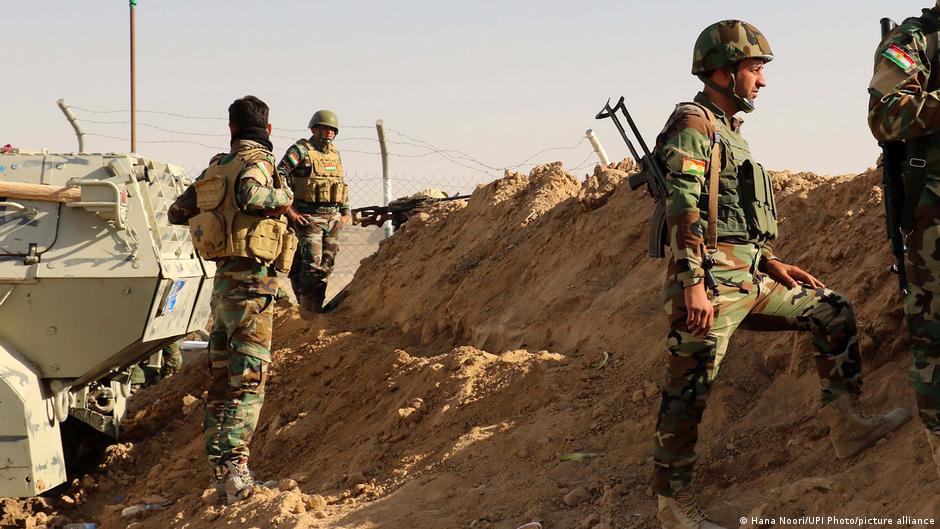
https://p.dw.com/p/59wnKKurdish figthers stand guard in northern IraqImage: Hana Noori/UPI Photo/picture allianceAdvertisementUS President Donald Trump was forthright when he said it would be "wonderful" if Iranian Kurdish forces based across the border in Iraq launched attacks against the Islamic clerical regime in Tehran.
"I think it's wonderful that they want to do that, I'd be all for it," Trump told the Reuters news agency on Thursday.
According to unconfirmed reports, Trump has already spoken with several Kurdish leaders in recent days. There is also speculation that the US Central Intelligence Agency (CIA) may have been supplying weapons to Kurdish groups for months.
The White House, however, has denied the reports.
The Kurds are among the largest stateless ethnic groups in the world. They number roughly 30 million and are scattered across Iraq, Iran, Syria and Turkey. They speak their own language, with several dialects, and most are Sunni Muslims.
About 9 million Kurds live in Iran, mainly in a stretch of land along the country's western borders with Iraq and Turkey. They have a long history of grievances and rebellions against both the current Islamic Republic and the monarchy that preceded it.
In recent decades, many Iranian Kurds have fled to neighboring Iraq to escape repression in their home country.
In Iraq, the Kurds govern a semiautonomous area in the northern part of the country. Some Iranian Kurds now see an opportunity to secure similar autonomy in Iran.
Will Kurdish groups work with US in the war against Iran?To view this video please enable JavaScript, and consider upgrading to a web browser that supports HTML5 video
Hanna Voß, a Middle East expert at the Friedrich Ebert Foundation in Beirut, views the discussion about Kurdish fighters in Iran primarily in the context of the current military situation.
"It has become clear to the parties involved that their goals cannot be achieved from the air alone," she said.
This raises the classic question of so-called "boots on the ground," Voß added.
US officials have repeatedly said that they do not want to deploy ground troops to Iran. In this context, Kurdish groups may end up serving as a de facto ground force.
Thousands of Kurdish fighters are already stationed along the approximately 1,500-kilometer border between Iran and Iraq.
Observers believe it is possible that they could advance into Iran with the support of US and Israeli air strikes.
Trump has promised Kurdish leaders "extensive air cover," the Washington Post reported, citing informed sources.
Israel's air force has already bombed military, border and police posts in western Iran.
However, there are doubts over the military capabilities of Kurdish groups.
A US government representative told the media outlet Axios that, in the worst case scenario, they could "become cannon fodder."
Hessam Habibi Doroh, a conflict researcher at the Institute for Peace Support and Conflict Management (IFK) in Vienna, said that Kurdish groups are the "strongest politically and militarily" compared to others in Iran's border regions due to their long history of political and military conflicts.
At the same time, the groups are organized very differently, he pointed out. "They are not uniform, but they have strong networks."
How the Iran war compares to the US's 2003 invasion of IraqTo view this video please enable JavaScript, and consider upgrading to a web browser that supports HTML5 video
Many Kurdish politicians stress that they are not seeking secession from Iran.
Hassan Sharafi, of the Democratic Party of Iranian Kurdistan, told DW's Persian service that Iranian Kurds view themselves as part of the country.
When Kurds talk about democracy or equal rights, Sharafi said, they are often accused of separatism. "There has never been a precedent in history for a part of Iran being separated from its people," Sharafi noted. If such secessions had nevertheless taken place, they were "the result of the actions or incompetence of rulers," the politician added.
Doroh sees more than just a spirit of optimism in the Kurdish regions.
"There is discussion that some Kurdish groups had already declared their willingness to actively fight against the Islamic Republic before the war," he said, adding that many view the current situation as a historic opportunity.
Still, people are exercising great caution, Doroh underlined. "They believe any movement will be ruthlessly suppressed by the regime."
At the same time, Kurdish groups in Iran are trying to prepare the population for possible escalation.
The Kurdistan Free Life Party (PJAK), a political and armed militant group, called on people in western Iran to establish local structures in villages and neighborhoods, warning that the regional situation could escalate into a prolonged war.
Voß described the military capabilities of Kurdish groups as limited.
Even if they received weapons from abroad, relatively small units would be facing the Iranian regime's highly organized security apparatus, she said. "The Iranian system emerged from a revolution and has been preparing for a possible counterrevolution for decades."
In addition, a Kurdish advance could trigger new tensions in Iran's multi-ethnic society. "Military support for individual ethnic groups could further fuel internal conflicts," warned Voß.
Many Iranians — especially those outside the Kurdish regions — would view such a scenario with skepticism, she added.
Habibi pointed to a possible response from the regime.
The Iranian media is increasingly talking about Kurdish groups wanting to destroy Iran, he said. "In my opinion, this is greatly exaggerated."
At the same time, Doroh underscored, Tehran could use such narratives to mobilize other ethnic or religious groups against the Kurds. "There is both an ethnic and a religious card that can be played."
A strengthening of Kurdish forces could also have an impact on Turkey, which is itself embroiled in a conflict with Kurdish outfits.
"President [Recep Tayyip] Erdogan naturally has no interest in seeing Kurdish groups strengthened anywhere in the region," Voß said.
There are also reservations among Kurds themselves. "This experience of being let down by international partners is very much present," Voß pointed out, referring to their previous cooperation with the US.
For many observers, therefore, the focus is less on the question of a Kurdish uprising than on the possible consequences for the stability of the region.
A Kurdish military advance could bring short-term tactical advantages, but in the long term, it could trigger new conflicts. "Strategically, this has little depth," said Voß, stressing that a completely chaotic Iran is hardly in the interests of most countries in the region.
This article was originally written in German.