Image source, Chris Haston/WBTV via Getty ImagesImage caption, The Cat in the Hat, a character from the eponymous Dr Seuss book, has been depicted on screen multiple times, including photographed here on a US talk show
"He's so scary!" says 16-year-old Skye, recoiling at the mention of the Cat in the Hat.
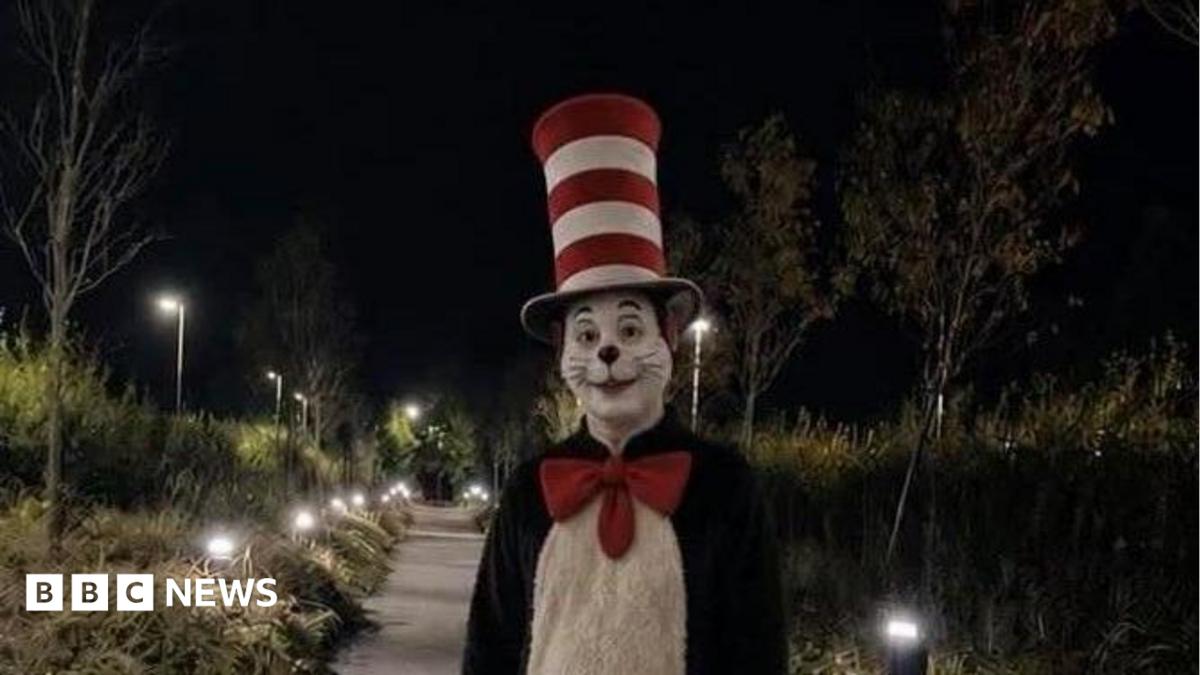
Viral images purporting to show a life-sized version of the Dr Seuss character on the streets after dark have sparked fear and confusion among teenagers.
The posts, seen by millions, have convinced some young people that the character is real and that they might encounter it, prompting police forces in Ireland and the UK to issue statements confirming that the images and videos are fake.
"I was having a sleepover," Skye elaborates, "but everyone started watching Cat in the Hat videos. It was 3am. I wanted to go home. When I started walking down my friends' driveway, I got totally freaked out that the Cat in the Hat was going to jump out. I had to call my mum to pick me up."
A quick scroll through TikTok reveals numerous accounts, many of them created in the past few weeks, sharing photos and videos of an elusive black-and-white feline wearing the famous, towering, crooked red-and-white striped hat.
One post showing the original Cat in the Hat costume, accompanied by the caption "Help, what do I do?", has received 14.6m views in just three weeks.
The comments add to the sense of frenzy, with followers asking, "Why is he taxidermied?" Others zoom in on parts of the costume and post conspiracy theories about Mike Myers, who played the character in the 2003 film, being trapped inside.
Another popular account set up this week, posts videos of a real person dressed in a cat in the hat costume, dancing, with captions like "Kent I'm coming. lock your doors." Other users are sharing the videos, adding their own captions and locations across the UK.
Many of the AI generated images have been centred on the Irish counties of Limerick and Wexford, where shaky videos purportedly showed the character wandering through the streets, causing alarm and confusion among residents.
In Wexford, the local Gardaí (police force) quickly dismissed the sightings as fake and confirmed that the images had been generated using artificial intelligence.
Image source, Wexford GardaThat has not stopped the pictures and videos from spreading online - along with unverified claims posted without evidence that the Cat in the Hat has been involved in violent assaults.
"I low-key wanna go meet him…" says 14-year-old Lily, who heard that the Cat in the Hat had arranged a "meet and greet", inviting local TikTok followers to come to the woods in Galashiels, a small town in the Scottish Borders.
"You are not going to meet anyone in the woods in the middle of the night!" she told her.
There is a point at which viral dancing videos and AI-generated clips of the Cat in the Hat become something potentially more sinister, with real-world consequences beyond their impact on teenage imaginations.
In England, South Yorkshire Police has denied social media claims that a 'killer Cat in the Hat' has been spotted. Posts about the alleged sightings have attracted hundreds of thousands of views on TikTok.
There is also a fake Facebook post claiming to be from Yorkshire Police - no force with that name actually exists - and suggesting that the force is taking the rumoured sighting seriously.
In response, a South Yorkshire Police spokesperson said: "If you do see posts online providing policing updates and advice, please check that they are from an official policing account. The cat is not out of the hat on this one… Please don't believe everything you read on social media."
As with so many trends driven by TikTok, comedic reaction and spoofery is what will be appearing right now on many people's For You page.
In recent days, depending largely on what your algorithm serves up, you may be seeing nearly as many people in Cat in the Hat costumes dancing to Beyonce as those stalking the streets. There are several jokey videos depicting police chasing human sized cats, and Scottish drag performer Ellie Diamond has issued a video declaring that she is not the Cat in the Hat killer.
And Irish TikTok star Garron Noone said on one post that it should have been obvious it was a hoax "because even the most soulless, evil, vicious monster" would be "traumatised looking in the window of a Wexford person".
Snapchat filters and images shared in group chats suggest that many teenagers - and those not so young - are simply having harmless fun with the trend.
But some do remain perturbed, including another teenager in the Scottish borders, 16-year-old Ellie, who says: "I was so scared of him when I was little," Ellie confides. "Now it's like he's actually come to life to haunt me."
A post on X that appears to have accelerated the current viral phenomenon appears to have been made on 8 August, by DiscussingFilm, when the pop culture site posted that the original costume was being auctioned off by Propstore.
The post has 10 million views. , externalComments describe it as "nightmare fuel" and "genuinely haunting", suggesting it had been pulled from a 'cursed attic'.
The lot is scheduled to be sold, external on Wednesday as part of an auction of 1,400 pieces of film and TV memorabilia and is predicted to fetch a price of up to $24,000 (£17,500).
Image source, PropstoreImage caption, The costume, which has shown noticeable signs of disrepair, was put up for auction by online retailer Propstore for $12,000-$24,000
Emily, a mother in Scotland, says the trend reminds her of the "Momo Challenge", a notorious internet hoax and digital urban legend. At the time, fact-checkers and authorities found no verified evidence linking the meme to children harming themselves, although the frightening images were still capable of causing distress.
"I'm not worried about my daughters, but there could be people with bad intentions who might take advantage of this trend to manipulate teenagers."
For now, the evidence points not to a real, roaming Cat in the Hat, but to a rapidly evolving online story built from an auctioned film costume, people in costume, AI-generated material and unverified posts.
Whether the claims began as a joke or were deliberately designed to frighten and manipulate, the advice from police is the same: pause before sharing, check the original source and date, look for confirmation from official police accounts, and treat invitations to meet strangers, especially at night or in isolated places, as a serious warning sign.
The rapidly evolving trend terrorising or tantalising teenagers on TikTok across the UK and Ireland is a reminder that online fear can quickly spill into the real world.
Additional reporting by John Hand