Add The New York Post on Google In his 1919 poem “The Unknown Friends,” American poet Edgar Guest wrote that “each one of us has friends that he / Has yet to meet and really know.”
But what happens when Americans no longer want to meet and really know each other? And when tech keeps them from doing so?
The data tell us that Americans are quite literally speaking to each other less. A March 2026 study demonstrated that the number of words the average person uttered fell by 28% between 2005 and 2019. That’s a drop of about 330 spoken words a day, or 120,000 over the course of a year.
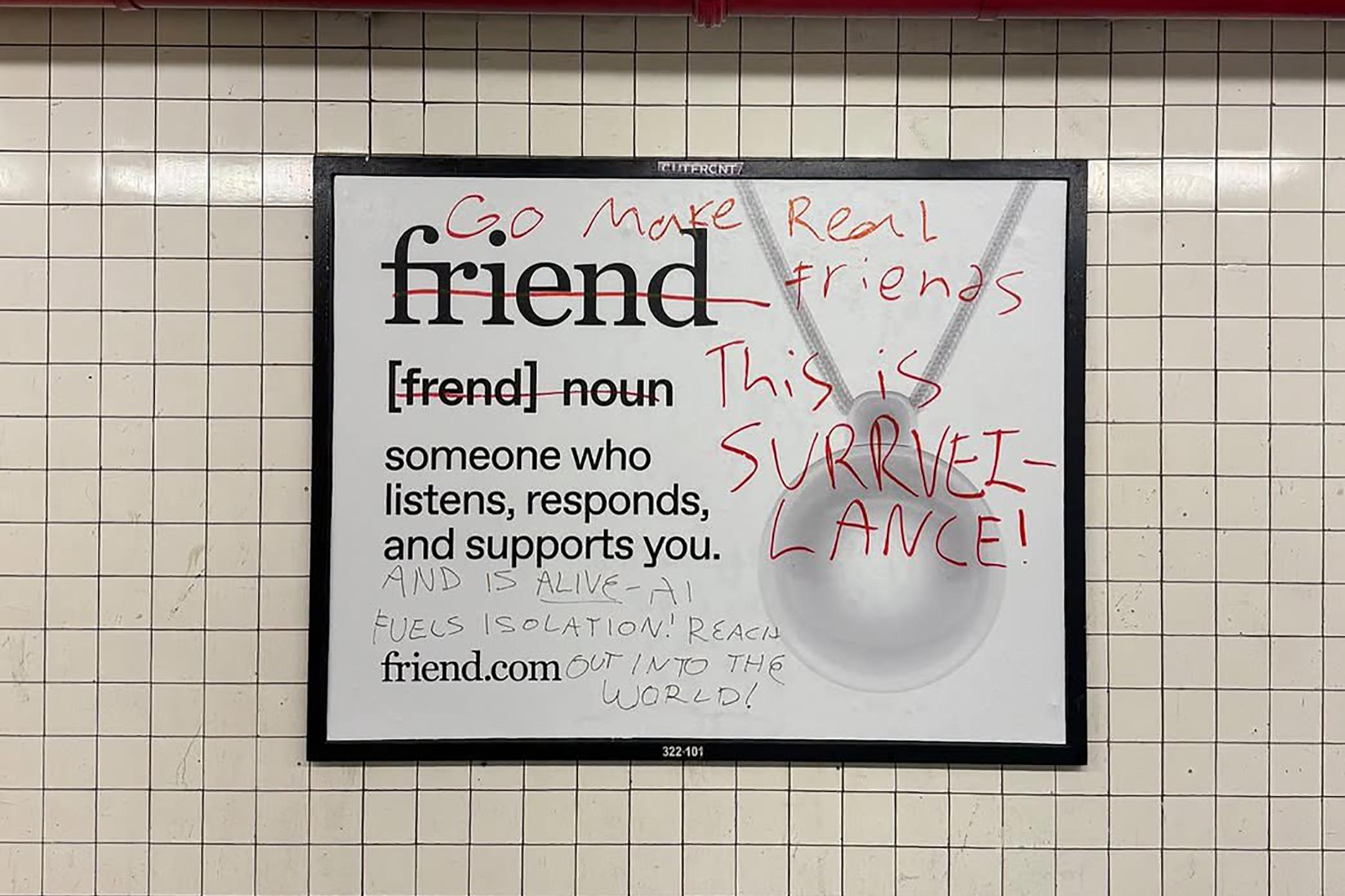
Silicon Valley is unworried. If anything, they’d like to see those numbers come down even more. In July, tech startup Friend launched a new iteration of its controversial AI necklace, designed to talk back to lonely users. Americans will be talking, but not to other humans.
A Friend AI campaign advertisement is shown in an undated photo. @CryptoVonDoom/X This is continuation of existing trends. In 2019, research out of Britain showed that digital conversation between Britons outpaced in-person communication.
Then COVID came along. Isolation and loneliness got a lot worse.
A recent survey discovered that almost 10% of all Gen Zers say they had zero face-to-face interaction in their daily life.
A 2025 American Enterprise Institute survey revealed that only 40% of Americans report talking to their neighbors regularly (at least a few times a week), down from 59% in 2012. The drop is most pronounced among young adults (18-29): in 2012, 51% reported social interaction with their neighbors at least a few times a week. By 2025, that number had dropped to 25%.
On top of that, data from the U.S. Bureau of Labor Statistics show that the average time spent socializing per day has fallen from 41 to 35 minutes in the last 10 years. That trend, though sharpest in young adults, is evident in every generation.
What’s driving these trends? It’s not just one thing.
But it’s hard to identify any culprit guiltier than our technology habits.
Electronic messaging is now our default way to communicate. Every day, more than 360 billion emails are sent and 27 billion texts are exchanged. Billions of posts and comments are made on social media every day. To make matters worse, this content is increasingly generated by AI bots. All those texts, emails, social posts, videos, and comments give us the illusion that we’re getting plenty of human connection.
Even in 2012, just five years into the smartphone era, there was emerging evidence of the adverse effects of virtual communication. A study published that year from researchers at the University of Maryland drew a connection between mobile phone use and antisocial behavior:
A teenager chats with friends on a smartphone while lying on a couch. (233949243) motortion – stock.adobe.com “Mobile phone use evokes feelings of connectedness to others, thereby fulfilling the basic human need to belong and subsequently reducing the need to connect with anyone else. This decreased desire for social connection negatively affects concern for other people, which will exhibit itself as reduced desire to help others.”
In other words, technology, besides cutting us off from other people, makes us more self-centered. Algorithms and AI seem to serve this very purpose. They are designed to satisfy our preferences and to flatter, affirm, and satiate us.
Researchers discovered that AI affirms users’ actions 49% more often than humans, “including in cases involving deception, illegality, or other harms.” Such affirmation reinforces antisocial behavior.
In his 1952 book “How to Talk to People,” speech expert Irving Lee wrote that “people can stand some coaching in the arts of talking together.” Almost 75 years ago, Lee hit it on the nail: “Without the means, the capacity, and the will to communicate,” community life fails. The means would be the skills needed — like how to begin and end conversations how to listen well, and how to seek to understand before being understood.
The capacity would be the desire it takes to even want to talk to others. We must be open and humble and remember that every human being before relied on face-to-face interaction. Take time today to share your smile, your intellect, and your beautiful, life-giving voice with someone who really needs it. And these days, that’s all of us.
Andrew McDiarmid is a Senior Fellow and Director of Podcasting at the Discovery Institute.