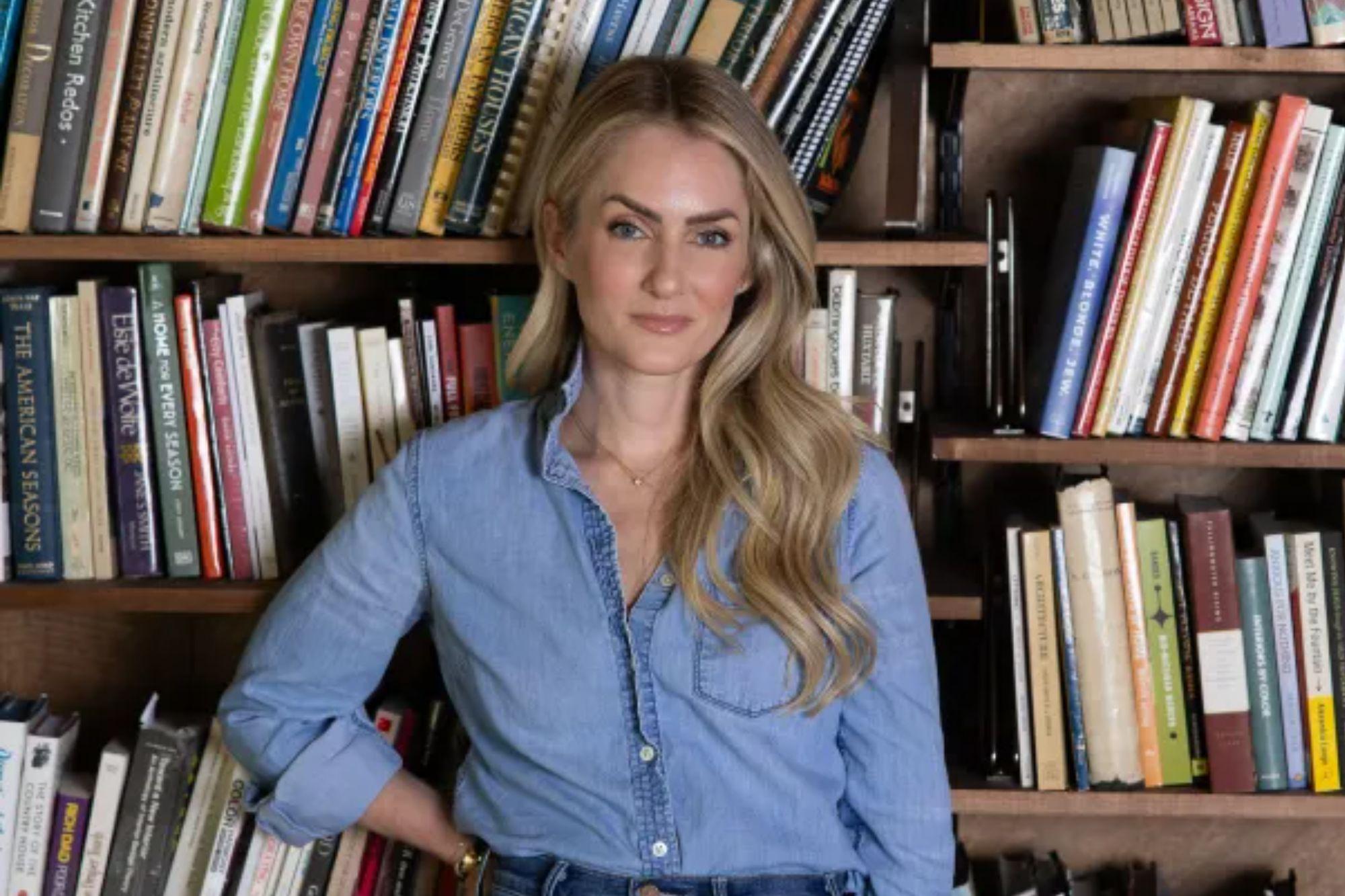
Add The New York Post on Google Alyssa Rosenheck has always been a fighter.
In seventh grade, a classmate at her Tulsa, Okla. middle school, lost her wallet and, in front of the entire biology class, exclaimed “the Jew took it”.
“I get up and I knock her down,” the photographer and activist told the Post. “And I immediately got sent to the principal’s office.
“My dad — who’s this big New York Jew — storms in, looks at me, looks at the principal, and says, ‘Lissy, let’s go’.
“He said, ‘My daughter has the right to deck whomever offends her people and her family’, and so I learned to defend.”
Although, she is quick to point out, this was her one and only physical fight.
Rosenheck, 44, has spent the years since the October 7, 2023, Hamas attack which killed more than 1,200 Israelis defending her people — and fighting against Anti-Zionism, arguing it’s become a byword for antisemitism.
“I don’t like bullies,” she said. “And I like justice. I like being able to exist in the world and not have repercussions solely for my immutable characteristics.”
She has written a book; part exploration of her own roots and personal faith and part treaty on why antisemitism has exploded in the US, called “White. Blonde. Jew.” released this week.
She put pen to paper after being targeted with antisemitic threats and traveling to the area of Israel next to the Gaza strip to interview Israeli combat heroes, hostages, and families, including the siblings of Eden Yerushalmi, a 24-year-old Pilates instructor kidnapped and slain by Hamas.
“I look back and I think there are pros and cons to growing up in areas where there’s not large Jewish communities,” said Rosenheck. “You feel a little bit ‘othered’ immediately, but you also, which I think is a gift, learn how to use your voice.”
Rosenheck, who has grown a large social media presence, had to use her voice again when her book launch at an independent bookstore in her hometown of Nashville, planned for this past Thursday (20), was cancelled.
The event at Bell Bird books was publicized online but immediately met with hate, prompting store owner Mary Ann Weprin to cancel the launch, citing security concerns.
“My concern was whether my small neighborhood bookstore could responsibly host an event that appeared likely to require heightened security,” Weprin said in a statement, insisting she was “heartbroken” by accusations she was antisemitic.
Rosenheck said she had actually hired private security before the social media backlash and it was fear and cowardice which stopped Weprin from hosting the event.
Weprin allegedly told Rosenheck, “It’s my peers and my customers. They don’t want to be affiliated with a political event, and they’re threatening not to shop with me.”
To which Rosenheck countered “hosting a Jewish author is not a political statement.”
“I have been very clear about this pattern: the institutions we look to hold the line and maintain a moral backbone ultimately fold and kowtow to pressure campaigns designed to intimidate, silence, and exclude Jewish voices.
“Then they reverse-engineer security concerns as a justification for their decision.”
In the book, Rosenheck explores extremely personal moments of her own.
Her world collapsed when her ex-husband, who was not Jewish, told her, “I don’t want Jewish children.”
The couple were married for 11 years before splitting in 2023, and she writes, “Everything around me was unraveling, and all I could do was stand there, paralyzed, as the fragments of my life drifted away like autumn leaves, scattering at my feet.”
“He wasn’t antisemitic. I knew that for certain,” she notes. “But had the suffering he’d witnessed overwhelmed him? Did the pain he saw me endure make him shy away?
“Was it fear, not hate, that shaped his words? Fear that our children will be burdened with the weight of a history they didn’t choose but cannot escape? Or had something changed in him, something I had overlooked?”
“You have to burn your life down to rebuild,” Rosenheck told the Post, “And I think that cracking was a wake-up call for me. I could no longer justify everything else I was trying to put back together in that marriage. And there was no turning back from those words.”
She also details the loss of friends after Oct. 7 when she became increasingly outspoken about Israel and Judaism. “It’s like social Ozempic… You lose a lot of people,” she quipped.
“It’s the personal betrayals that cut deeper than I ever imagined,’ she writes. “Half of the women I welcomed into my home at New Year’s Eve [2019, for a party], the ones who toasted to friendship and celebrated the future, would no longer sit at my table—not because of a falling-out.
“Ex-friends unfollowed, blocked, gossiped, and abandoned me at our shared virtual table. With nothing else changing except for me being even more openly Jewish online, it’s not hard for me to imagine that this was the reason.”
Being diagnosed with thyroid cancer aged 32 had prompted Rosenheck to reassess her life, which, up until that moment, had been spent in “survival mode”.
“There was a very brief moment with a quick scan that we thought it had spread to my lungs,” she told the Post. “It did not. But that is when it woke me up … I started to listen to myself really for the first time and understand how unhappy I was in the corporate world.
“And I picked up a camera as just a healing catharsis… It felt like warmth, like home.”
Rosenheck is also now engaged to John Spencer, retired US Army major, combat veteran and scholar who serves at the Modern War Institute at West Point, New York. She said of him, “John is such a beautiful human inside and out and my hero.”
In May, the Anti-Defamation League released its Annual Audit of Antisemitic Incidents, reporting that 2025 marked one of the most violent periods for American Jews. There were 6,274 incidents of antisemitic assault, harassment and vandalism, an average of 17 incidents per day.
While this total represents a 33-percent decrease from 2024, it remains considerably higher than the years before Oct. 7 and ranks as the third-highest year for antisemitic incidents (after 2023 and 2024), since ADL began tracking in 1979.
Among the factors contributing to antisemitism, Rosenheck said, is the question of Jews and whiteness.
“We’re living at this interesting time where we’re either not white or really too white.”
In the book, she cites Dr. Pamela Paresky, who argues that DEI frameworks and Critical Race Theory structurally foster antisemitism by forcing Jews into a rigid “oppressor-oppressed,” binary that classifies them as privileged, hyper-white oppressors.
“Jews are always the barometer of a society’s consciousness, the health of a society,” she added.
“This anti-Zionist movement is a hate movement. Jews predate concepts of race and even religion, we are a peoplehood.
“[Antisemitism] is what happens when our conversations around privilege, around whiteness, around this obsession with oppression in the West, around DEI, continues to be weaponized against us and shuts down conversations,” she stressed.
Moving forward, Jews can and should stand up against the hate, she encourages.
“Hitler and the Talmudic scholars agreed on one thing,” she added, “And it wasn’t that we were a physical threat, [but] we were a moral and physical threat to tyrants, to authoritative regimes.
“And that gives me hope, because we have so much light within us and we have to lead with it.”