Add The New York Post on Google Mark Zuckerberg just bought himself a piece of Irish history that comes with a body count.
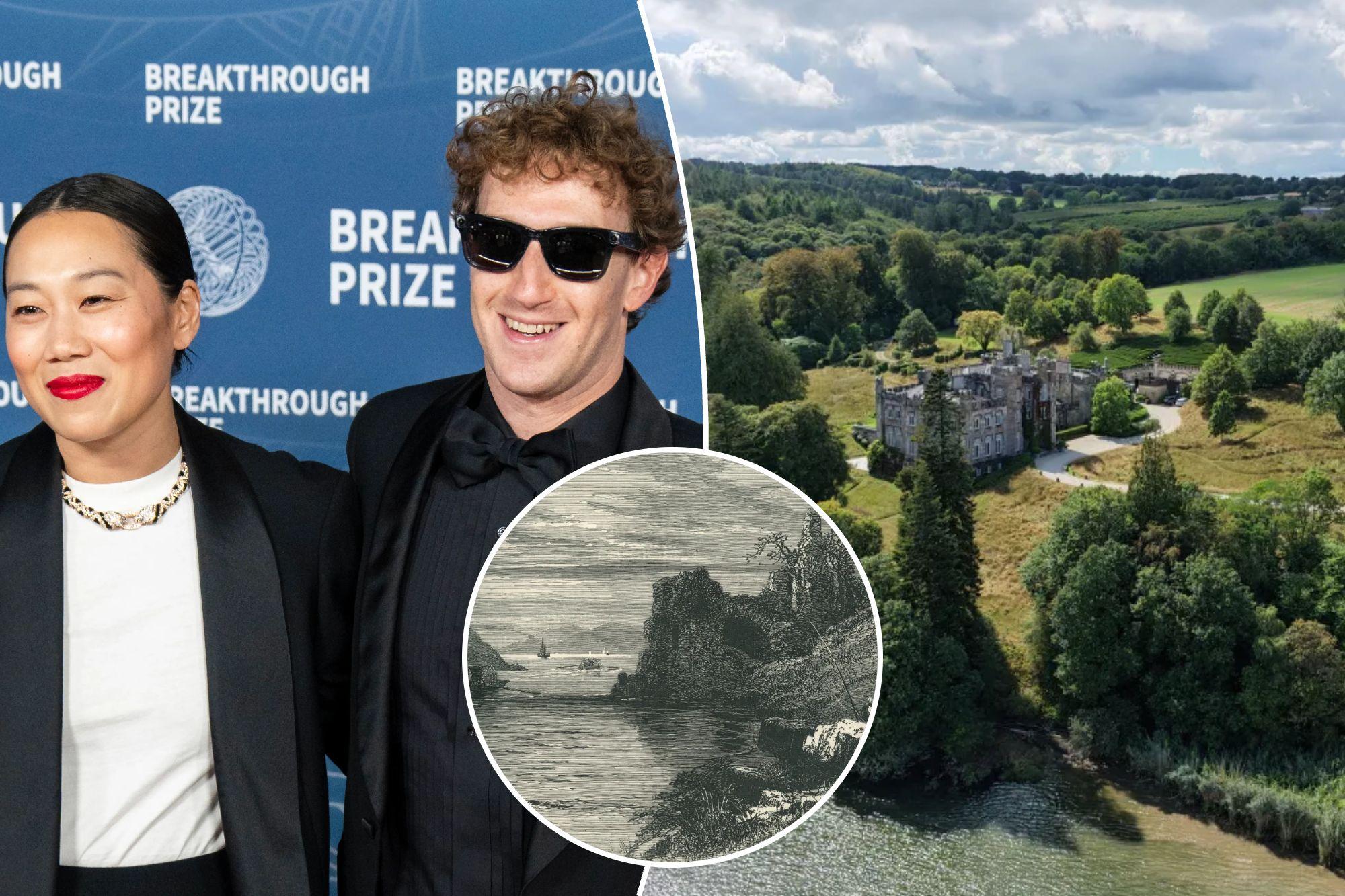
The Meta mogul and his wife, Priscilla Chan, quietly closed on Strancally Castle, a 440-acre Gothic-revival estate in County Waterford, Ireland, in an off-market deal valued between $23 and $35 million, according to the Irish Times, which broke the story.
But long before the Facebook founder set his sights on the riverside pile, the ground it sits on was the stuff of nightmares.
The original Strancally Castle, situated about 2 miles from the current structure, was reportedly the site of a medieval killing floor known as the “murder hole,” where unsuspecting guests were said to be trapped, bound and dropped to their deaths.
Legend has it the original castle was once seized by Spanish occupiers who lured local landowners inside under the guise of a banquet, only to drop them through a hidden trapdoor into a flooded cave below. Word of the slaughter eventually got out, and the occupiers were driven off and the castle torn down.
English writer William Howitt immortalized the legend nearly two centuries ago in his 1847 book “Homes and Haunts of the Most Eminent British Poets,” describing how victims met their grisly end.
“The unwary, when decoyed within the castle, were tied hand and foot, and hung down the murder-hole,” Howitt wrote. “The rapid river hurried by, and soon carried away their gasping shrieks, and the dead told no tales.”
Howitt himself was skeptical of the lore, chalking it up to local legend, but not before adding his own eerie caveat.
The castle standing today bears no resemblance to that blood-soaked ruin. It was built around 1830 for John Keily, a Tory member of parliament, and designed by brothers James and George Richard Pain, the same architects behind Dromoland Castle in County Clare and Blackrock Castle in Cork.
The three-story, 16,000-square-foot mansion was constructed on such an extravagant scale that it reportedly took a 4.5-minute walk just to get from the kitchen to the dining room.
The estate changed hands over the following century, passing to the Whitelocke-Lloyd family around 1855 before eventually landing with the Irish Land Commission.
It was purchased 25 years ago by Michael Alen-Buckley, a co-founder of London investment firm RAB Capital, and his wife Giancarla, who poured two decades into restoring the property before handing over the keys to Silicon Valley’s most famous billionaire.
The sellers said goodbye to their longtime home with a statement to the Irish Times.
“We leave our home of 25 years fondly and are grateful for the opportunity we have been given to save and restore Strancally Castle,” the Alen-Buckleys said.
“We are delighted that Mark and his family intend to build on our stewardship by continuing to invest in maintaining and enhancing the property and grounds as their home in a sustainable manner. We wish them and their family much happiness in this unique and blessed place.”
A rep for Zuckerberg confirmed the purchase and struck a decidedly cheerier tone than the castle’s bloody backstory might suggest.
“Mark and his family are excited to continue caring for this historic home and look forward to spending time in Ireland, where Meta maintains its international headquarters,” the spokesperson said.
Zuckerberg and Chan plan to keep their primary residence in the US and use Strancally as a landing pad when doing business in Ireland, where Meta has run its international headquarters since 2009 and employs roughly 1,500 people.
The Meta chief isn’t the first tech titan to go castle shopping along the River Blackwater.
Strancally sits near Ballynatray House, snapped up by Dyson founder James Dyson for about $34 million in 2024, and Lismore Castle and Salterbridge House, owned by British property magnate Stephen Vernon. Stripe co-founder John Collison also grabbed the 1,100-acre Abbey Leix estate in County Laois for roughly $23 million back in 2021, making Zuckerberg at least the third tech billionaire to plant an Irish flag in five years.
It’s also not Zuckerberg’s first swing at Irish real estate.
Last year, Liberty Media chairman John Malone told the Wall Street Journal that Zuckerberg had made a play for his Castlemartin House and Estate in County Kildare, once home to the late businessman Tony O’Reilly. That deal never materialized.