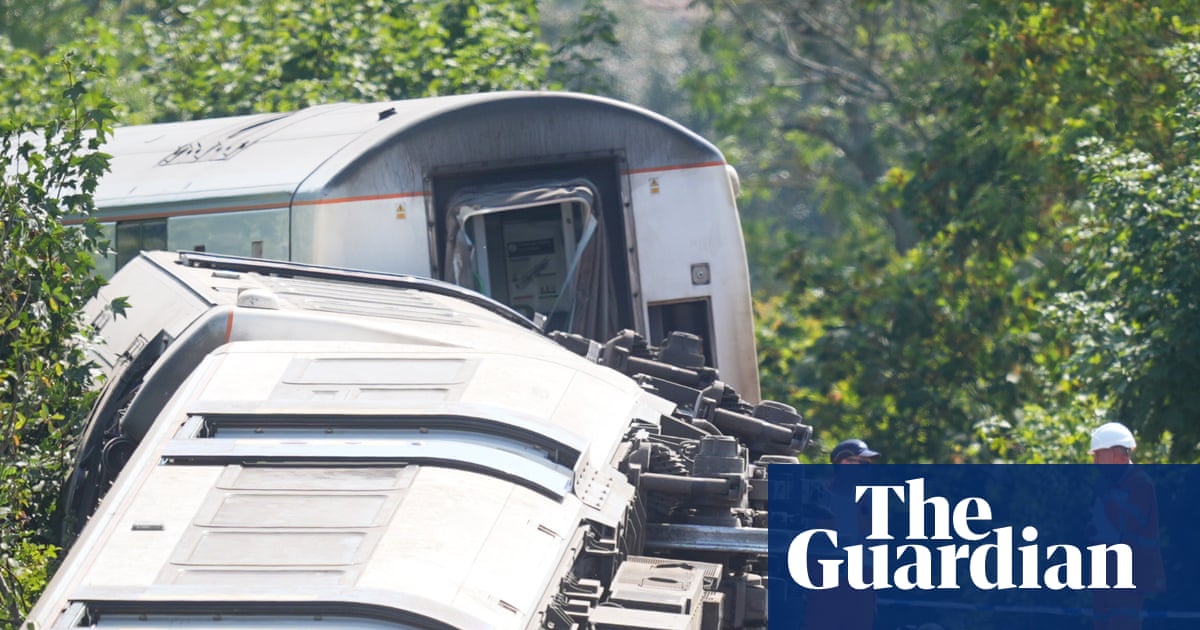
The RAIB investigation published an image that appeared to show that the track near Lewes, East Sussex, had buckled – something that can happen in high temperatures. Photograph: James Manning/PAView image in fullscreenThe RAIB investigation published an image that appeared to show that the track near Lewes, East Sussex, had buckled – something that can happen in high temperatures. Photograph: James Manning/PALewes derailment: images show track defect before incident on hottest dayNetwork Rail and Southern owner GTR apologise after investigators reveal picture of possible heat-buckled track
Rail operators have apologised after a report into last Thursday’s train derailment in East Sussex found a “track geometry irregularity” on the approach to the site where the train derailed on the hottest day of the year so far.
An interim report by the Rail Accident Investigation Branch (RAIB) said CCTV images showed the fault existed before the incident occurred near Lewes, injuring 30 people.
The watchdog published an image that appeared to show the track had buckled – something that can happen in high temperatures.
View image in fullscreenRear-facing CCTV image from a train which passed the location of the accident at about 14:04 on 13 August 2026, shows the track irregularity visible near the white ballast bags. Photograph: courtesy of Greater Thameslink RailwayThe report said there had been “a sustained period of hot and dry weather” and that the ambient air temperature at the time was about 27C, according to the nearest weather station to the site.
In a joint statement, Network Rail and GTR, the company which operates Southern, said they were “very sorry that this happened on our railway”.
“We also recognise the ongoing impact the incident has had on customers, local communities and railway colleagues,” said Lucy McAuliffe, Sussex route director at Network Rail, and John Whitehurst, chief executive at GTR.
“Safety is and will always remain our highest priority. While Britain’s railway is one of the safest in the world, when incidents like this occur it is essential that we understand exactly what happened and identify any lessons that can be learned.”
The stretch of railway between Lewes and Haywards Heath is set to remain closed until at least the end of service on 26 August.
That will give time for the train to be recovered – a complex job involving the derailed carriages being lifted by crane – and for recovery teams to make sure evidence is preserved.
The incident happened on 13 August during the UK’s fifth heatwave of the summer, during which two trains derailed in less than 24 hours. The second incident occurred on Friday when the rear carriages of a Greater Anglia train came off the track “in an upright position” at Wickford railway station in Essex, with no reported injuries.
View image in fullscreenRail workers pictured at the scene of a Greater Anglia train derailment, south of Wickford railway station in Essex. The accident happened a day after the Lewes incident. Photograph: Jonathan Brady/PAThe embankment on which the railway sits near the Lewes derailment site is made of clay, meaning it is “sensitive to variations in water content and may undergo movement as moisture levels change”, the RAIB said.
It added that “although, at this stage, there is no evidence to indicate that a significant embankment slip occurred before the accident, there is evidence that some movement had previously taken place”.
RAIB investigators said they had received “several reports of rough riding” from passengers on other trains in the same location.
The train was travelling at about 65mph – within the 70mph speed limit – as it approached the site of the incident, with about 150 people onboard.
Three carriages ended up on their side, trapping passengers and leaving 30 people injured, including 20 who required hospital treatment, the RAIB said.
“Significant damage was caused to the train and to railway infrastructure,” the watchdog said.
The RAIB said its investigation was taking weather conditions into account, as well as the status of the track, embankment, condition of the train and the effectiveness of any measures taken to mitigate the hot weather.