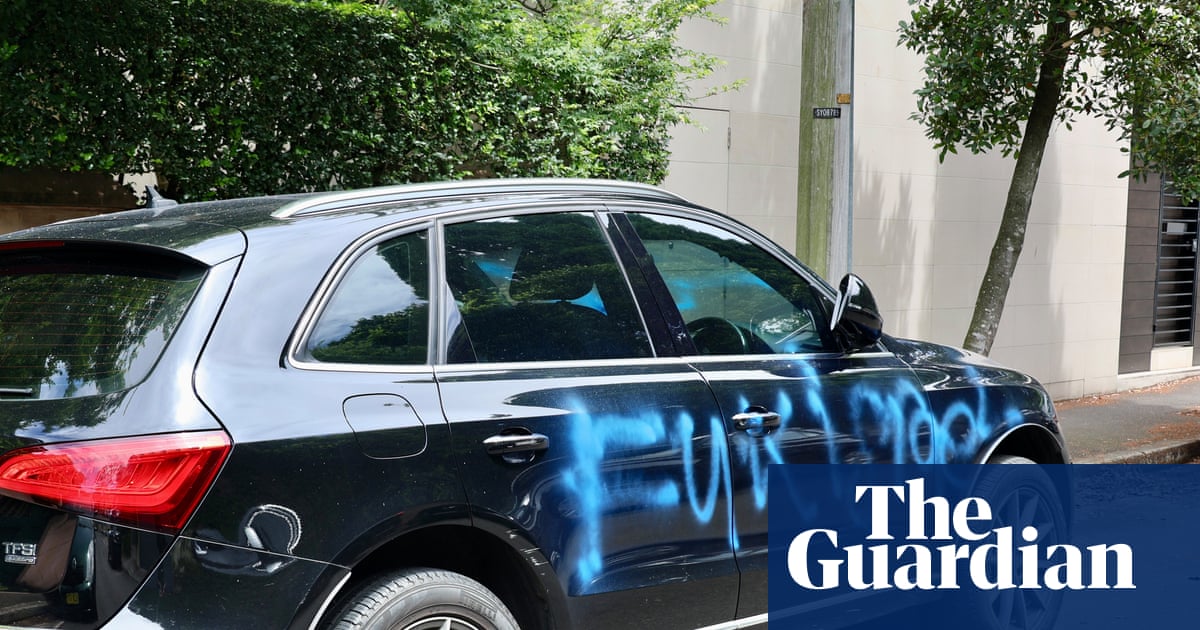
A vandalised car in Woollahra in November 2024. Mohommed Farhat defaced cars and walls with slogans including ‘PKK coming’ and ‘Fuk Israel’. Photograph: Neve Brissenden/AAPView image in fullscreenA vandalised car in Woollahra in November 2024. Mohommed Farhat defaced cars and walls with slogans including ‘PKK coming’ and ‘Fuk Israel’. Photograph: Neve Brissenden/AAPNSW judge says anti-Israel graffiti case went ‘haywire’ when vandalism was labelled antisemiticMohommed Farhat spray-painted slogans and torched a car in Woollahra. He pleaded guilty but supreme court judge says case appears to be a ‘miscarriage of justice’
Get our breaking news email, free app or daily news podcast
For almost two years, Mohommed Farhat has been in prison after he pleaded guilty to 15 offences in connection with property damage, including spray-painting “Fuk Israel” on cars in Sydney’s east and setting another vehicle alight in late 2024.
This week, the New South Wales supreme court justice Desmond Fagan ruled that police, lower courts and various state agencies all incorrectly labelled Farhat’s actions antisemitic, meaning he was treated more harshly.
Fagan wrote in his judgment, released on Tuesday, that “Fuk Israel” was “a curse against a foreign state”. He also criticised the controversial IHRA definition of antisemitism as “detached from reality” and “inept”.
Farhat’s case came before Fagan this year when the state tried and failed to cast him as a future terror threat based on what Fagan called the same “misconception” about his motivation.
Read moreDuring a July hearing, Fagan told the parties: “This proceeding against this man seems to me to have been derailed and gone completely haywire right from the beginning by the police representation to the magistrate and submissions to the magistrate and again to the district court judge that this content was antisemitic. And it’s erroneous.”
On Wednesday, Fagan said that the case appeared to be a “serious miscarriage of justice”.
Farhat, then 20, was remanded in custody in November 2024. He and a co-offender had spray-painted slogans on cars, defaced buildings and set alight a vehicle that was destroyed in Woollahra. The graffiti included “Fuk Israel” and “PKK coming” – a reference to the Kurdistan Workers Party.
Farhat pleaded guilty to the property damage offences but insisted he was recruited to do the graffiti by an unknown person. He said he was told what to write and was paid money and promised drugs.
The incident was the first of a spate of graffiti and arson attacks in Sydney’s eastern suburbs that summer which the Australian federal police later determined were carried out by paid criminals and orchestrated by organised crime figures.
The magistrate determined the property offences were antisemitic and handed Farhat an aggravated sentence – 20 months in jail with a non-parole period of 10 months.
He was due to be released on parole from early December 2025. The magistrate set the parole period with a note that Farhat would be “better served with an extended period of supervision on parole, particularly around drug and alcohol and mental health interventions”.
But the parole order was later revoked after a successful application by the commissioner of corrective services and the crown.
The state then applied for a one-year extended supervision order (ESO) under the Terrorism Act, which would have subjected Farhat to 55 conditions on his release from jail.
In the hearing regarding that application in July, the supreme court was provided intelligence which showed counterterrorism police had accepted, three weeks after Farhat’s arrest, that he had been recruited and was not ideologically motivated.
But police had not shared that information with the prosecution or the magistrate who sentenced Farhat.
Fagan this week ruled that key evidence was also not tendered to the magistrate, including a page of Farhat’s bank statements which showed money had been transferred to his account, which Fagan accepted was proof of his recruitment.
Fagan ruled the magistrate had erred in deeming the offences antisemitic.
View image in fullscreenNSW supreme court justice Desmond Fagan Photograph: NSW supreme courtFagan found the crown solicitor, in their submissions to revoke the parole order, continued to wrongly conflate “political comment” with antisemitism. He found the intervention by the commissioner of corrective services was “most unusual” – he was not aware of any other such interventions.
Farhat unsuccessfully appealed the severity of his sentence in the district court in January 2026.
Fagan found that during the appeal, a representative from the director of public prosecution had continued “merging” political speech with antisemitism “to the extreme” and had made “extravagant and untenable” submissions.
That same month, the state lodged its application for a terrorism protection order, again arguing that “Fuk Israel” conveyed an antisemitic message.
View image in fullscreenA car vandalised in Woollahra in November 2024. Photograph: Luca Ittimani/The GuardianIHRA definition of antisemitism criticisedFagan dedicated a significant portion of this week’s written judgment to distinguishing anti-Israel speech from antisemitic speech.
“For decades Jewish people have been amongst the most forceful critics of Israel’s conduct towards the Palestinians and have been the source of insistent pleas for the rights of the Palestinians,” he said.
“How can it be antisemitic – in the established sense of the word – to disparage Israel when doing so accords with the words and beliefs of many Jews?”
He rejected the argument that it was antisemitic. Fagan noted the state also claimed that because the slogans were spray-painted in an area with a concentration of Jewish residents and there was criminal damage the words “Fuk Israel” took on an antisemitic meaning “in context”.
“I do not accept that,” he said. “The political nature of the curse was not changed by the circumstances.”
Fagan was heavily critical of the controversial International Holocaust Remembrance Alliance (IHRA) definition of antisemitism, which has been formally endorsed by the Australian government and is the accepted definition of the ongoing royal commission into antisemitism established after December’s Bondi beach terror attack that killed 15 people during a Hanukah festival.
“The IHRA proposal is detached from the reality of the common usage and understanding of antisemitism in this countr,” Fagan wrote, noting he was “not the first to have criticised the inept drafting of the IHRA formulation”.
The judge referred to a June 2026 poll from the Pew Research Center, which found 79% of Australian respondents viewed Israel unfavourably with a similar disapproval rate in other countries.
“It would be preposterous to suggest that 79% of Australians are antisemitic because they disapprove of Israel’s treatment of the Palestinians,” Fagan said.
“Australians who strongly disapprove of Israel’s treatment of the Palestinians have freedom to express their views.”
To grant the request for an extended supervision order, Fagan had to be satisfied there was a “high degree of probability that the [defendant] poses an unacceptable risk of committing a serious terrorism offence” if not supervised when released from prison.
The state argued there was evidence of this risk, including that Farhat had a Hezbollah tattoo on his neck, had attended a protest against Israel’s attacks on Lebanon, and had exchanged text messages with family members about attacks in southern Lebanon. But Fagan rejected the argument and knocked back the ESO application. He ordered the state to pay Farhat’s legal costs.
Read moreThe judge noted that members of Farhat’s family had strong ties to the Shia Muslim community of Lebanon. He got the tattoo in the months before he was arrested and had no “past fealty to Hezbollah”.
“Whatever judgment others might make of right and wrong in the conflict between Israel and Hezbollah, it is understandable that people of Lebanese Shia Muslim heritage would follow closely the military conflict that commenced in late September 2024 and that they would have sympathy for Hezbollah,” Fagan wrote this week.
“It is understandable that such people would feel hostility towards Israel, based on the long communal history of disruption to their society since Israel was established.
“Australian citizens with less connection to Lebanon … might reasonably express similar upset at the loss of human life and the destruction of villages.”
While in prison, a Jewish religion teacher began to meet with Farhat, Fagan noted.
When he was sentenced in November 2025, the teacher provided a letter of support and she did the same during the supreme court hearing regarding a potential ESO.
“During my time in custody, I have had contact from Ms Ellie Nagel who is a part of the Jewish community,” Farhat wrote in a letter submitted to the local court a year ago.
“Her and I discussed Judaism and the holocaust and other religions and history. Ellie also spoke to me about the feelings of the Jewish community when people like me commit such acts. This really opened my eyes and allowed me to look at matters from other people’s perspectives.”
Farhat’s solicitor, Abdul Reslan, said his legal team was considering the options regarding “any miscarriage of justice that has arisen”.
“There has been unease with respect to the approach of authorities throughout this matter,” Reslan said.
“The failure to disclose and investigate information known to the authorities at a very early stage, and proceed to prosecute the matter in a one-dimensional format, has caused unnecessary harm.”
The Labor MP Stephen Lawrence, a former barrister, said in response to Fagan’s ruling that “searing truth on a contentious social policy issue in a judicial judgment” was rare but “the unique factual and legal context absolutely demanded it”.
“It’s a case of fearless high-level legal analysis colliding with politicised narratives that are being continually deployed in aid of conflating criticism of Israel with antisemitism,” Lawrence said. “The politicised narratives lost out, and so they should have.”
Lawrence was one of a handful of government MPs who defied the NSW premier to march across the Sydney Harbour Bridge in August 2025 to protest Israel’s killing in Gaza.
On Wednesday, the day after Fagan’s ruling was published, there was a supreme court hearing to determine when Farhat might be released from prison. Fagan indicated he would write to the chairman of the state parole authority, but the crown prosecutor questioned Fagan’s authority to “compel” the authority to release the 22-year-old. Fagan said he was “simply” asking if the state planned to “do something” to “correct the evident injustice”. He addressed police not sharing crucial information that might have reduced Farhat’s sentence, stating while he hadn’t apportioned fault to anyone, the magistrate hearing the intial case had been “misled”. Fagan said the case appeared “to be a serious miscarriage of justice”.