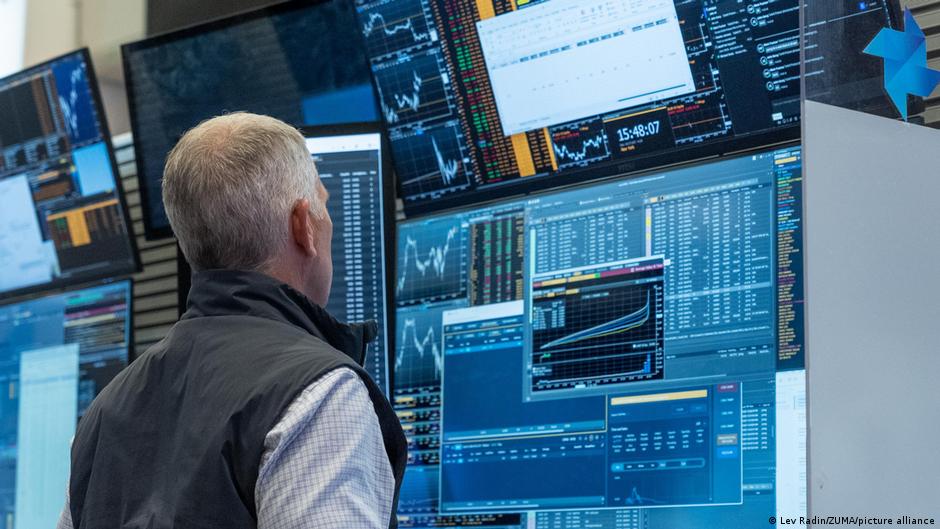
The head of Norway's sovereign wealth fund has warned that soaring AI-driven stock valuations could trigger a sharp correction. How exposed is the world's largest sovereign wealth fund to a market downturn?
https://p.dw.com/p/5IklnSome global investors are warning of a bubble in artificial intelligence (AI) stocks as valuations surgeImage: Lev Radin/ZUMA/picture allianceAdvertisementAs if the vast scale of artificial intelligence (AI) investments wasn't scary enough, the head of the world's largest sovereign wealth fund is also sounding the alarm.
Nicolai Tangen, CEO of Norway's Government Pension Fund Global (GPFG), warned last week that, in an extreme market collapse, a massive loss to its $2.4 trillion (€2.07 trillion) portfolio is "not completely improbable."
The fund, created to invest the Nordic country's vast oil and gas revenues, delivered a record profit of 1,753 billion Norwegian kroner ($186 billion, €161 billion) in the first six months of the year.
Yet, Tangen warned that the AI-chip trade — whose lofty valuations helped drive those gains — now poses a serious risk. A sharp correction, he warned, could potentially erase much of the massive wealth built up over the past 30 years.
During what Tangen called an "abnormal" period of low taxes, low inflation and low interest rates, the investments now finance roughly a quarter of the Norwegian government's budget.
While Tangen might sound overly alarmist, Bill Megginson, a leading researcher on sovereign wealth funds, believes many established fund managers share his cautious stance on stock valuations, but are "staying the course, queasily."
"Few managers are inclined to take profits when such a fundamental technology buildout, fueled by literally unprecedented levels of capital spending, shows little evidence of brittleness," Megginson, a finance professor at the University of Oklahoma, told DW.
Major technology companies are expected to invest more than $1 trillion in AI-related infrastructure like chips, data centers and power infrastructure in the race to match or beat human intelligence.
AI is watching you: tracking, traps and surveillanceTo view this video please enable JavaScript, and consider upgrading to a web browser that supports HTML5 video
China, meanwhile, is developing capable AI models at a fraction of the cost of their rivals in the United States.
The Bank for International Settlements warned in June that AI "exuberance" risks ending in a bust if returns fall short of expectations.
Unlike Saudi Arabia or Singapore's sovereign wealth funds, which make large investments in private equity, infrastructure and real estate, Norway largely follows a benchmark-based investment strategy by buying index funds that track major global markets.
Technology accounts for roughly a third of the fund's stock investments.
"The oil fund follows a very passive, broadly diversified global index strategy," Karin Thorburn, research chair in finance at the Norwegian School of Economics, told DW.
Although this approach "eliminates a lot of the uncertainty of picking individual stocks," Thorburn said GPFG fund managers have "almost no room to deviate from the index or actively hedge."
A strict government mandate means the Norwegian fund cannot take significant protective positions, including holding large amounts of cash.
Most institutional investors, on the other hand, hedge by buying options or futures, which rise in value when regular investments like stocks drop, offsetting some of the declines.
Thorburn, who served on a 2022 Norwegian government panel probing the growing geopolitical risks to the fund, said portfolio managers trust in the collective knowledge of the financial markets.
"If you were to start betting against the markets, you could be right 50% of the time, but also wrong 50% of the time," she said. "So wisely, the government has decided that we don't do that."
Javier Capape, a Madrid-based sovereign wealth fund specialist, thinks Norway is "unusually exposed" through its investment strategy of roughly 70% equities and 30% bonds.
"I would not describe Norway as literally 'unhedged,'" Capape said, noting that Norges Bank Investment Management, a unit at the central bank that manages the country's sovereign wealth fund, also uses currency, interest-rate and equity derivatives to protect against a crash.
Norway's strategy also contrasts sharply with that of Berkshire Hathaway, until last year run by one of the world's most successful investors, Warren Buffett.
Berkshire is currently sitting on around $365 billion in cash and short-term Treasuries.
Norway's fund does, however, benefit from continuous inflows of oil and gas revenues from its North Sea fields. In 2026, this is projected to be the equivalent of €63 billion.
While its Asian and Middle Eastern peers are more diversified, they face similar risks in their alternative investments.
Some private equity funds have temporarily suspended or limited investor withdrawals due to a severe liquidity squeeze. Commercial real estate has underperformed since the COVID-19 pandemic, especially the office sector.
Capape noted how globally, these alternative investments now account for 24% of sovereign wealth fund portfolios.
According to the Sovereign Wealth Funds Report 2026, these funds now manage more than $15 trillion in assets worldwide, up from roughly $3-4 trillion during the 2008/09 financial crisis.
They are now "the single most important global source of investment capital for both private equity funds and direct investment in public companies," Megginson said.
After a sharp pullback in June and July, many AI-related stocks have rebounded, with Nvidia, Amazon and Microsoft rising in the double digits in recent weeks.
Some analysts now expect AI stocks to reach new all-time highs by the end of the year. Though what follows is anyone's guess.
"Norges Bank Investment Management itself has stress-tested an AI correction, estimating that such a scenario could reduce the value of the entire fund by around 18%," Capape said.
This would represent around €432 billion being wiped off the fund's value, the equivalent of nearly seven years of Norway's energy revenues.