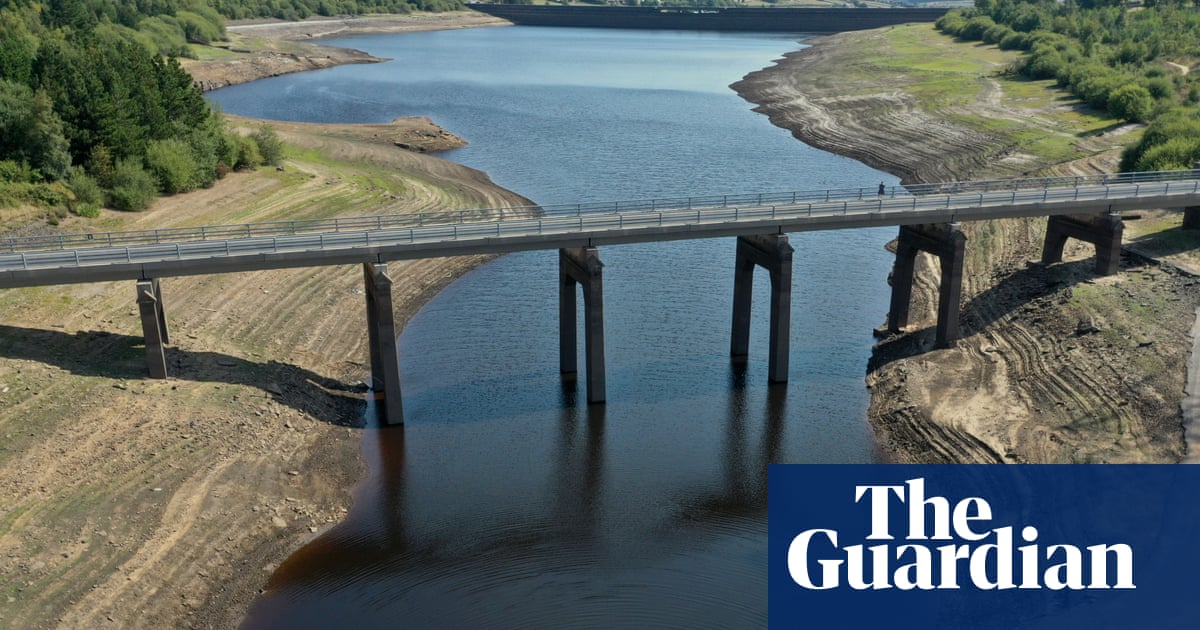
Alongside statutory drought plans, water companies must produce emergency drought plans, details of which are kept secret to ‘avoid alarming the public’. Photograph: Jon Super/APView image in fullscreenAlongside statutory drought plans, water companies must produce emergency drought plans, details of which are kept secret to ‘avoid alarming the public’. Photograph: Jon Super/APUK government ‘irresponsible’ for not publishing emergency drought plansCampaigners demand greater transparency into water companies’ plans not made public due to ‘security reasons’
The UK government has been accused of a lack of transparency and of acting irresponsibly for refusing to publish the emergency drought plans that are produced by water companies.
Water firms are required to publish statutory drought plans every five years to detail the actions needed to ensure public water supply is maintained and the environment is protected during drought.
Water levels at five key reservoirs in England and Wales are now “exceptionally low” and three-quarters of England and the whole of Wales are in drought.
The 2027-32 drought plans, which are under consultation, detail what will happen in different scenarios, with the most extreme actions ranging from standpipes in the street to rota cuts, where water is limited to a few hours each day.
Alongside these publicly available plans, water companies are required to produce separate emergency drought plans.
A water industry source said these plans were not published to avoid alarming the public. The government said the plans were not published for security reasons.
Alastair Chisholm, the water, policy, regulation and governance lead at the consultancy firm Arup, said that in the “new normal” of the climate crisis causing droughts to become more frequent and more extreme, there would probably be situations where “some quite difficult decisions need to be taken with some quite significant imposition’s on people’s lifestyles”.
He pointed to Day Zero in Cape Town, South Africa, in 2018, when millions of households faced drastic water shortages after the worst drought to hit the city in almost a century.
“People do genuinely start to be scared that they’re not going to be able to get water to drink, and that has got all manner of sort of social connotations which is going to need to be very carefully managed,” Chisholm said.
Prof Liz Bentley, the chief executive of the Royal Meteorological Society, said it made sense not to publish these plans because drought could lead to widespread impacts on certain critical industries. For example, recent drought and extreme heat in Europe forced several nuclear power plants to shut down.
“If you start to see significant shortages of water that impact major industries then these are the kind of things you want to keep confidential because that could have widespread effects on the security of the country,” Bentley said.
In some areas of England, the impact of water shortages is already being felt. Sussex, Cambridgeshire, Suffolk and Norfolk have all seen housing and business development delayed due to water supply availability and ageing or inadequate water infrastructure.
Water shortages are also affecting food security, with global food prices at a three-year high as heatwaves, drought and war push up the cost of crops.
With water increasingly becoming a scarce commodity and as demand for water increases due to the rapid growth of water-hungry industries such as datacentres, the trade body Water UK recently told the Guardian it had asked the government to publish a drought hierarchy to set out which sectors would be prioritised in times of water shortages, but that ministers had yet to do so.
“Without this there will be a trade-off across society,” said Jon Chappell, Water UK’s deputy director.
Ollie Hayes, the head of big tech and campaigns at the campaign group Global Action Plan, said that amid increasing concern that datacentres could be prioritised over other sectors for water, it was irresponsible for the government to keep its emergency drought plans from the public.
“People are deeply anxious about dwindling water supplies and want to know what the plan is. Will water-hungry AI datacentres be prioritised in a drought emergency? The secrecy only adds to a sense that controversial decisions like this may have already been made,” he said.
The Green party leader, Zack Polanski, said it was “deeply worrying that emergency drought plans are being hidden from the public”. “People deserve to know what plans – if any – are in place to protect our water supply,” he said.
Polanski said full nationalisation of water companies must be at the top of the government’s agenda to “prevent catastrophic water shortages in the years ahead”.
On Sunday it was reported that the industry regulator, Ofwat, was considering allowing water companies to raise bills during periods of drought.
Amy Fairman, the head of campaigns at campaign group River Action, criticised the government’s overall lack of transparency over how the country will deal with drought as the climate crisis intensifies.
“My key concern is around the lack of a holistic plan to deal with water shortages going forward. There is no more precious resource than water, and yet there isn’t a national water security plan in place,” she said.
The Department for Environment, Food and Rural Affairs said emergency drought plans were in addition to publicly available statutory drought plans and would not be published for security reasons.
A Water UK spokesperson said: “Each water company publishes a drought plan, which is consulted on publicly and sets out the actions the company will take at each stage of a drought. Planning for a severe drought sits under a separate framework, and publication is a matter for government. We support calls from the House of Lords environment and climate change committee for the government to decide how water should be prioritised in a severe drought.”