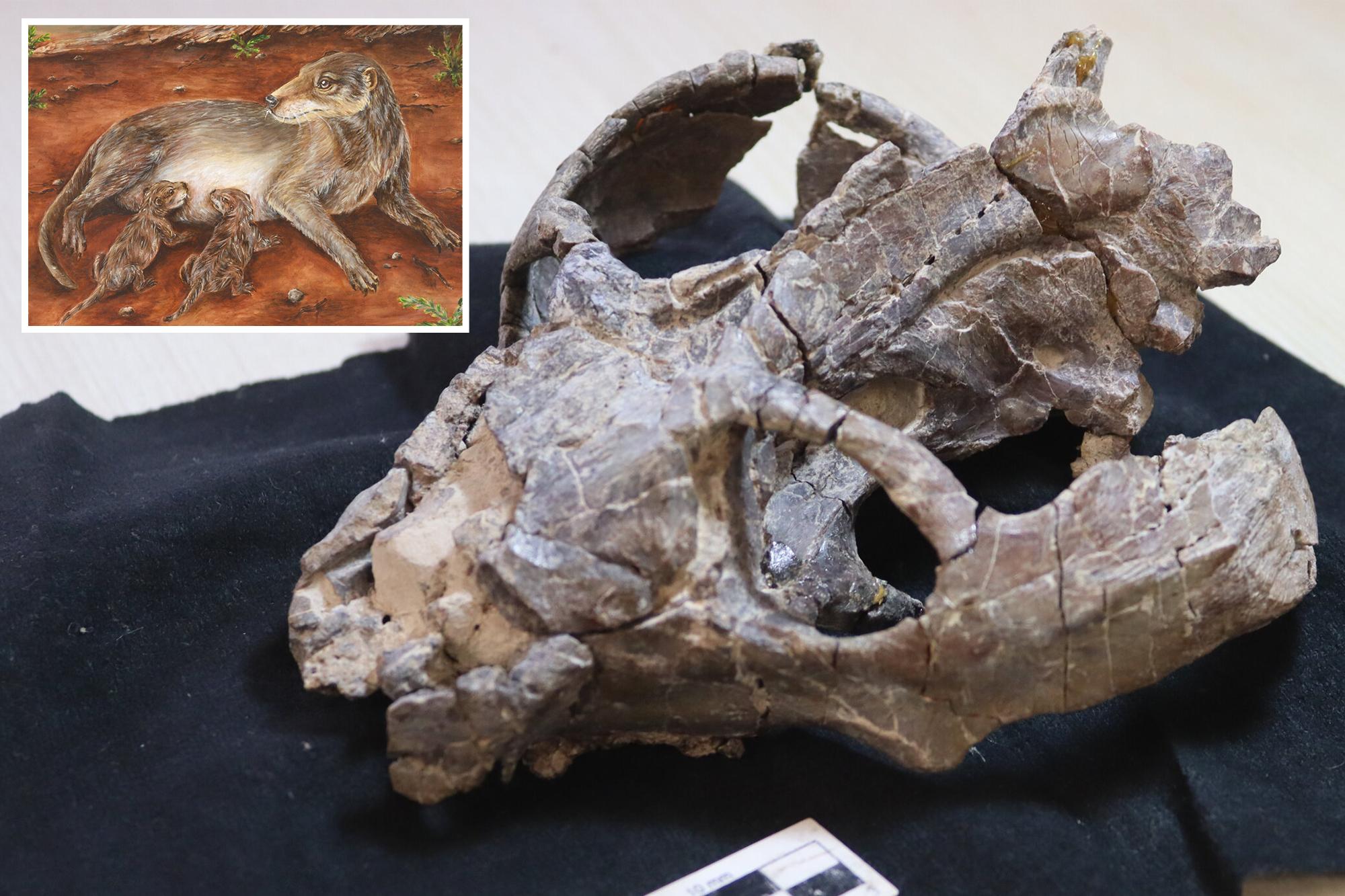
Analysis of bones belonging to a 236-million-year old mammal ancestor proves that we could've been giving live birth 95 million years earlier than previously thought. María de los Ángeles Miceli Baro. See more of our coverage in your search results.
Add The New York Post on Google Our understanding of mammalian reproduction is being reborn.
Analysis of a 236-million-year old fossil could completely rewrite our understanding of how mammals gave birth, per a study in the journal Frontiers in Mammal Science.
The groundbreaking remains belong to Chiniquodon theotonicus, a species of cynodont — prehistoric reptiles that were likely the ancestor of modern mammals, Phys.org reported.
The fossilized skull of a cynodont, a mammal-like reptile that likely gave rise to modern mammals. Leandro Gaetano For years, scientists believed that our evolutionary forebear laid eggs much like other reptiles, but direct evidence of how they reproduced remained inconclusive — until now.
However, by analyzing the bones of a Chiniquodon theotonicus individual — which lived during the late Triassic period — scientists determined that they likely birthed live young, winding the clocks back on this reproductive adaptation by a staggering 95 million years.
“It looks like some cynodonts were in fact very similar to present-day mammals,” exclaimed lead author Dr. Leandro Gaetano, a paleontologist at the National Scientific and Technical Research Council (CONICET) in Argentina.
The researchers came upon this revelation by accident while examining the bones of a fully grown C. theotonicus, and finding that they had “embryonic tissue,” Gaetano told Gizmodo.
“This is very weird, I have never seen this,” he said.
By analyzing data from living species, the scientists deduced that the mark was a neonatal line, a distinct growth ring found in bones or teeth that forms following the post-birth growth spurt.
This post-natal stretch mark gave researchers a novel idea on how to test whether cynodonts laid eggs — by comparing their body mass at birth to their adult size.
“It looks like some cynodonts were in fact very similar to present-day mammals,” exclaimed lead author Dr. Leandro Gaetano, a paleontologist at the National Scientific and Technical Research Council (CONICET) in Argentina. Gaetano et al., 2026. They then compared this ratio to that of several thousand species of modern birds, mammals and reptiles.
“If mammalian ancestors were egg-laying or viviparous (live birth-giving) has been considered an inscrutable mystery,” said Gaetano. “We came up with a somewhat ingenious set of methods to get at something very difficult to analyze in the fossil record.”
They found it weighed 3.7 pounds at birth and 26.5 pounds when full-grown — a 14% increase — which was most similar to the newborn-adult body mass ratio of mammals that give live birth.
These placental critters, which comprise 95% of mammals, can weigh between 17.6 pounds and 33.1 pounds as adults but give birth to babies tipping the scales at 35.5 grams and 4.1 pounds (1.87 kg), which translates to a ratio of 18.77%.
Meanwhile, bay duiker antelope of Africa weighs approximately the same as a newborn C. theotonicus. Coincidentally, relatives of this primeval species were also displaying lactation, body hair, and brain size similar to modern-day placental mammals, leading researchers to believe that this live birth adaptation could’ve emerged around the same time.
What was the advantage of giving live birth, which was previously seen as a fairly modern acquisition in the mammalian kingdom?
Senior author Adriana Mancuso, a researcher at CONICET who specializes in terrestrial ecosystem evolution, believes that the adaptation helped them adapt to a harsh environment.
“Cynodonts thrived in the Triassic, a period of recovery and restructuring of ecosystems after one of the most devastating mass extinctions in life history,” she said. “This meant high competition for resources and strong predatory pressures.”
Due to the increasingly dry conditions and seasonality, embryos of live birth-giving animals “would be better protected than those of egg-laying species,” she explained.
Researchers hope more research to shed light on whether C. theotonicus’ reproductive mechanism was an anomaly or representative of a major trend toward giving live birth among mammal ancestors.