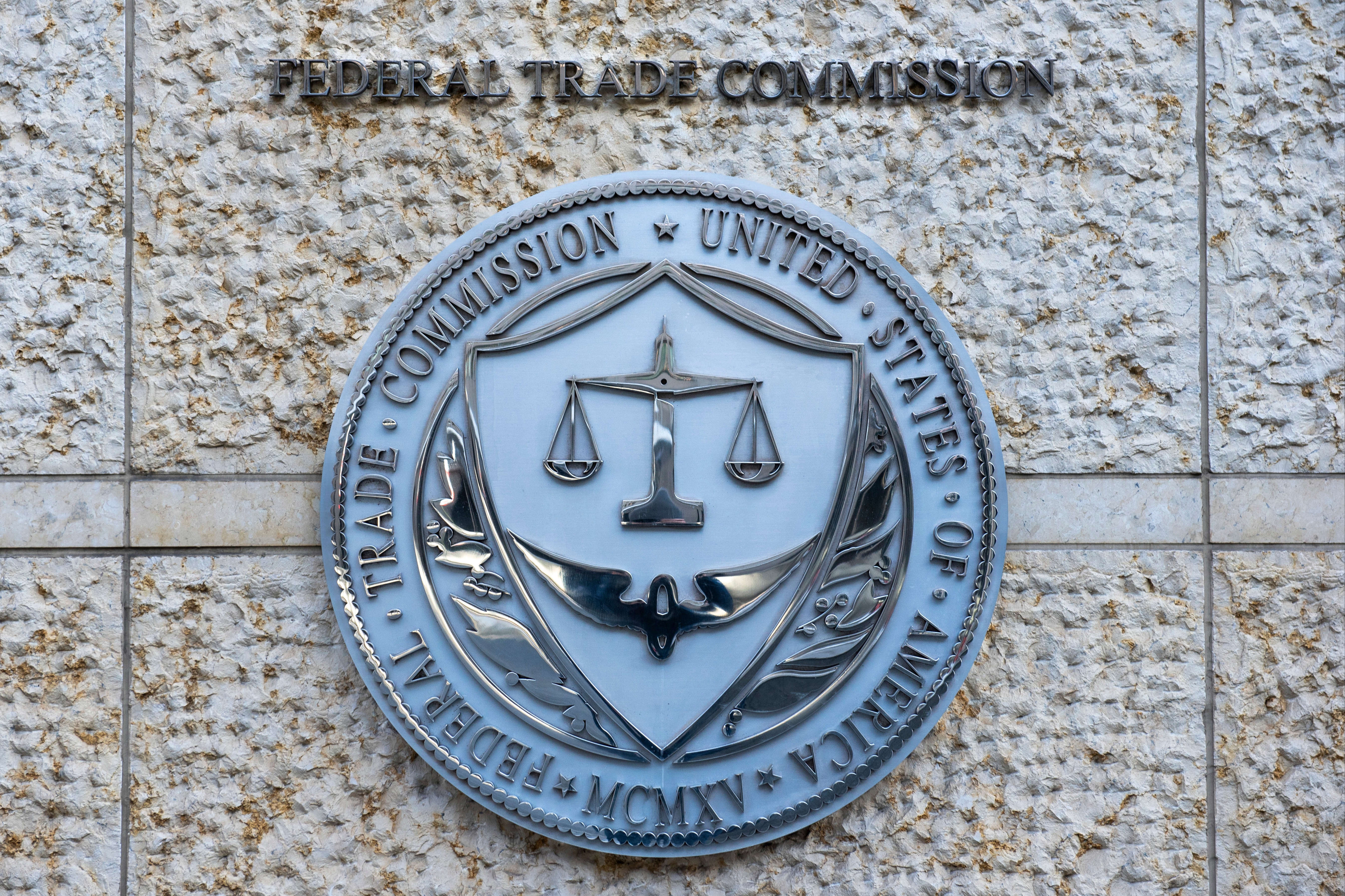
The official seal of the Federal Trade Commission is seen on an office building in Washington, Friday, Feb. 13, 2026. AP Every politician in Washington is promising to alleviate the “affordability crisis.”
But nobody told that to the trial lawyers and federal regulators — who have dusted off a century-old law to sue companies for the high crime of lowering consumer prices.
We’re referring to an all-but-forgotten legal relic from the 1930s called the Robinson-Patman Act.
That law prohibits a seller from charging lower prices for the same products to different retail merchants.
Under Robinson-Patman, discounts for bulk purchasing may be illegal if they cause “competitive injury” to rival companies, or if they “tend to create a monopoly in lines of commerce.”
Antitrust laws are supposed to rein in monopolies and keep them from raising prices, but under this bizarre act, companies could be sued for bringing prices down.
The Robinson-Patman law had not been invoked for nearly three decades, but it was given a new breath of life in the final days of Joe Biden’s presidency.
As Biden’s Federal Trade Commission chair, Lina Khan saw an antitrust conspiracy behind the doors of every corporate boardroom.
Khan, now a top adviser to New York City Mayor Zohran Mamdani, began to accuse sellers of colluding with superstore retailers that set prices below what smaller retailers can charge.
On her way out the door, Khan issued multiple Robinson-Patman Act complaints against such companies as Southern Glazer’s Wine and Spirits (filed in December 2024) and PepsiCo (filed in January 2025), for offering volume discounts to large chain-store sellers like Walmart, Costco and Total Wine & More.
But under President Donald Trump, regulators haven’t taken a strong position one way or the other — and there’s a growing worry among major retailers that allowing any of these cases to go forward will open up a floodgate of lawsuits against them.
There’s a good reason why this law had faded away: It has no relevance to 21st century commerce.
Fierce price competition among local merchants and dozens of national superstore chains mean lower consumer prices for nearly every product on the market, from groceries to furniture to home appliances to clothing to sporting goods.
Superstore retailers buy and sell in bulk, which puts competitive downward pressure on prices.
Their low prices explain why superstore parking lots across the country are typically crammed with cars and trucks seven days a week.
Now these stores and their suppliers could face a blizzard of lawsuits as federal regulators team with trial lawyers to declare their model of slashing prices through volume purchases and sales illegal under this 90-year-old law.
In one recent case, California wholesalers alleged that Living Essentials, which sells and distributes the popular drink 5-hour Energy, violated Robinson-Patman by providing Costco with unfair discounts.
After years of litigation, a federal district court rejected that claim — but the Pandora’s box has been opened.
The lawyers haven’t won in court yet, but if or when they do, regulators and trial lawyers will have the green light to launch swarms of antitrust lawsuits against superstores that “unfairly lower prices.”
Never mind that no consumer has ever been harmed by paying less in one store than in another.
Khan’s legal doctrine is an assault against the modern retail model perfected by Sam Walton decades ago.
Big-box stores like Walton’s Walmart use scale and efficiency gains to provide “everyday low prices” to consumers.
Volume discounts are supposed to be allowed under Robinson-Patman — but that’s not the way the Lina Khan trust-busters see it.
The sad irony is that if this retail model is ever declared illegal, it’s low-income and middle-income families that will be hurt the most.
One of us, Vedder, conducted a landmark economic study that found the superstore retailing model has saved families multiple hundreds of billions of dollars over the last 30 years.
These price discounts have done more to reduce inequality and material deprivation than any anti-poverty program in history.
The good news is that a pro-business, anti-regulation president like Trump can defend consumers against this insanity.
Trump’s FTC chair Andrew Ferguson has put a stop to most of the Biden-era Robinson-Patman suits — but some of them are still working their way through the courts.
It’s time to make an unequivocal case against this anti-discounter crusade.
Ferguson understands that suing companies for lowering prices is no way to make America more affordable.
He should protect our consumers — and cancel these cases for good.
Stephen Moore is co-founder of Unleash Prosperity and a former senior Trump economic adviser. Richard K. Vedder is a distinguished professor of economics emeritus at Ohio University.