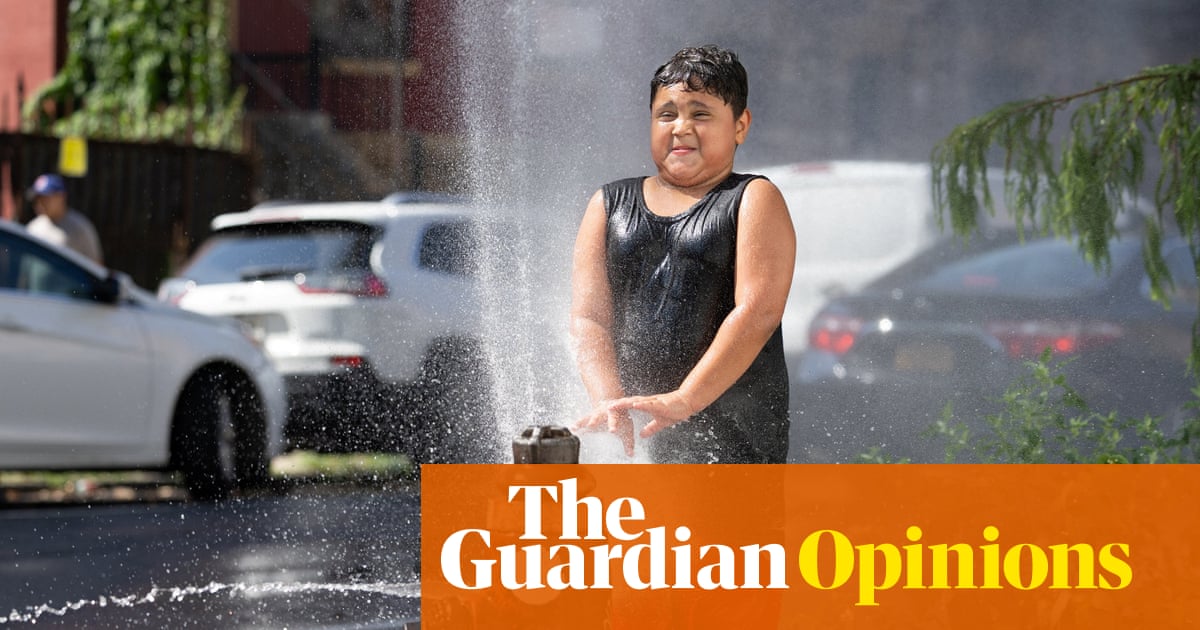
A boy cools off during a heatwave in New York City. Photograph: Jordan Tovin/ReutersView image in fullscreenA boy cools off during a heatwave in New York City. Photograph: Jordan Tovin/ReutersDigested week: Humid New York or London’s oven-blast heat? Tough one to callEmma BrockesPlus, heartbreakingly brilliant Cats: the Jellicle Ball, summer reads and Taylor Swift’s low-key wedding
I’ve been in New York for two weeks, where the unthinkable has happened: even for a city accustomed to extremes, it is so hot, so humid, so reminiscent of Mobile, Alabama, or Mumbai, that all over the city, New Yorkers have been forced to break persona to talk about the weather. “Was it always like this?” (No.) “Can you believe this?” (No.) “Are you having a stroke?” (Possibly.)
Received wisdom has it that heatwaves in Britain and Europe are worse than in the US because we don’t have air conditioning, but as I write this, on my first day back in heatwave London, it’s a tough one to call.
If the south of England feels like Riyadh, with its oven-blast of dry heat, the heat in New York comes with total humidity and is so dense, so impenetrable, so vastly more furnace-like than in any previous summer, it makes you angry as you walk down the street.
Air conditioning takes the edge off, but it’s like trying to disguise medicine with a mouthful of Coke; it only goes so far. Meanwhile, the sweat pours down your back and the sky burns white.
New Yorkers are about as keen to complain about the weather as they are to point out a celebrity, but in these conditions you can’t not talk about it. While the mayor’s office discusses plans to extend cooling systems to subway platforms, individuals devise strategies to be outside for as little time as possible – like Minnesotans planning a trip across town in a snow storm.
At least the hospitals are temperature controlled. In Britain, where nurses keel over with heat exhaustion, it can feel, at times, as if the single, adequately air-conditioned space is the Apple Store; only the iPhones stay cool.
View image in fullscreenThe cast of Cats: The Jellicle Ball perform at the Tony awards in New York City. Photograph: CBS Photo Archive/GettyCurrent trends in New York that may or may not make it over here: frozen yoghurt is having a resurgence but it’s the posh kind – Greek not Pinkberry; the newest snack craze is “dot cake”, an $11 cube of dry sponge topped with icing and hundreds and thousands and served in a cup, which, according to the New York Times, New Yorkers have been lining up at 6am all summer to buy (not at our local Gourmet Garage, I will say).
Beyond food, two things worth mentioning: “dog Crocs”, seen on several pets in the street to protect their paws from the punishing heat of the pavement and, as the name implies, tiny canine versions of their owner’s shoes, only these come in a four-pack.
And on Broadway, Cats: The Jellicle Ball, a heartbreakingly brilliant interpretation of the original show in which a tired-seeming vehicle, badly damaged by the terrible film version, gets a radical makeover. Jellicle Ball is set in the Black and Latino drag pageants of the 1980s ballroom scene and is led by two legendary performers, André De Shields, who at 80 still brings it, and Junior LaBeija, who many will recognise from the classic 1991 documentary Paris Is Burning. The costumes, by Qween Jean, and choreography by Omari Wiles and Arturo Lyons, all rightfully won Tony’s.
As Andrew Lloyd Webber says, it’s criminal the show closed early last week. It’s the best thing I’ve seen for years. Anyway we went, we screamed, we clacked the massive Jellicle Ball fans and at intermission, the theatre played DJ Murphy’s ballroom remixes of Lloyd Webber’s songs while people lost their minds. Pray it comes to London.
How did you eclipse? We were circling Heathrow in the air with the sun behind us when the sky became marginally less sunny. I will add it to the drawer of memories of other, underwhelming eclipse experiences, including that big one in 1999, when I was stuck on a motorway in France and everyone pulled over, looked up at the sky, then got back into their cars. And the Great American Eclipse of two years ago when I stood in a big crowd and everyone turned to one another and said: “Is that it?” It’s worse than bird watching.
After it’s all over, there is a lot of anticlimactic posting on social media, although a friend in Spain sends a video and they seem to have enjoyed the real thing. As with so many things, I think the enjoyment is chiefly in the anticipation and the pretext it gives everyone to hang out, however briefly, in a single, unifying experience, and the opportunity to do crafts.
View image in fullscreenParliament Hill, Hampstead Heath. The eclipse was a chance to hang out and do crafts. Photograph: Denise Baker/GettyThursdayMy summer reading is haphazard but heartfelt and I’m flipping between Playworld, Adam Ross’s excellent, coming-of-age novel set in Great Neck, New York; Once the Deed Is Done by Rachel Seiffert, a brilliant examination of camps for displaced people in Germany after the second world war; and Caroline Fraser’s biography of Laura Ingalls Wilder. The book I’ve loved most so far this summer, however, is a reread of Elizabeth Jane Howard’s memoir, Slipstream, and now I’ve gone down the wormhole and want to read everything she ever wrote.
The writer died in 2014, at the age of 90, and is best known for the Cazalet Chronicles, but Slipstream is a piece of social and literary history it’s hard to match. Given how a great central theme of the book is Howard’s low self-esteem, what’s interesting is how bold she was, insisting on a life that met none of the requirements of her time and class; despite a very well-to-do background which ensures the book is stuffed with cameos by people called Minky and dinner-party guests who, she might add casually, “was home secretary at the time”, Howard bolted out of three marriages, left her child in the care of others, and lived for many years a rackety, bohemian existence characterised by lack of funds and adventurous, penniless travel. Quite apart from her writing talent, it’s a study in courage and resolve.
View image in fullscreenElizabeth Jane Howard in 1962. Photograph: Ronald Dumont/GettyFridayIt’s been six weeks since the wedding of Taylor Swift to Travis Kelce and, amazingly, no one has cracked. All the NDA’s are holding! The only public utterance about the event has been from Kelce himself, who said the wedding had been “the best night of my life”, which was “full of a lot of celebration”. Perhaps this is what happens when so many of the guests are near-strangers who simply feel grateful for the invite.
None of the rest of us, meanwhile, will ever forget it; the spectacle of people who’d met the bride and groom once, if at all, dropping everything to scurry across the country/the Atlantic to celebrate the big, celebrity wedding next to Penn Station. It’s hard, in hindsight, to put your finger on who the most embarrassing attendee was, but I’d say Hugh Grant was right up there, as well as Tom Hanks, and Andrew Scott, most of whom seem to have met Swift backstage at the Eras tour in 2024 – or possibly the Toy Story 5 premiere in 2026 – since when, I guess, they’d forged meaningful friendships. Oh, to be world famous, and have this as your life.