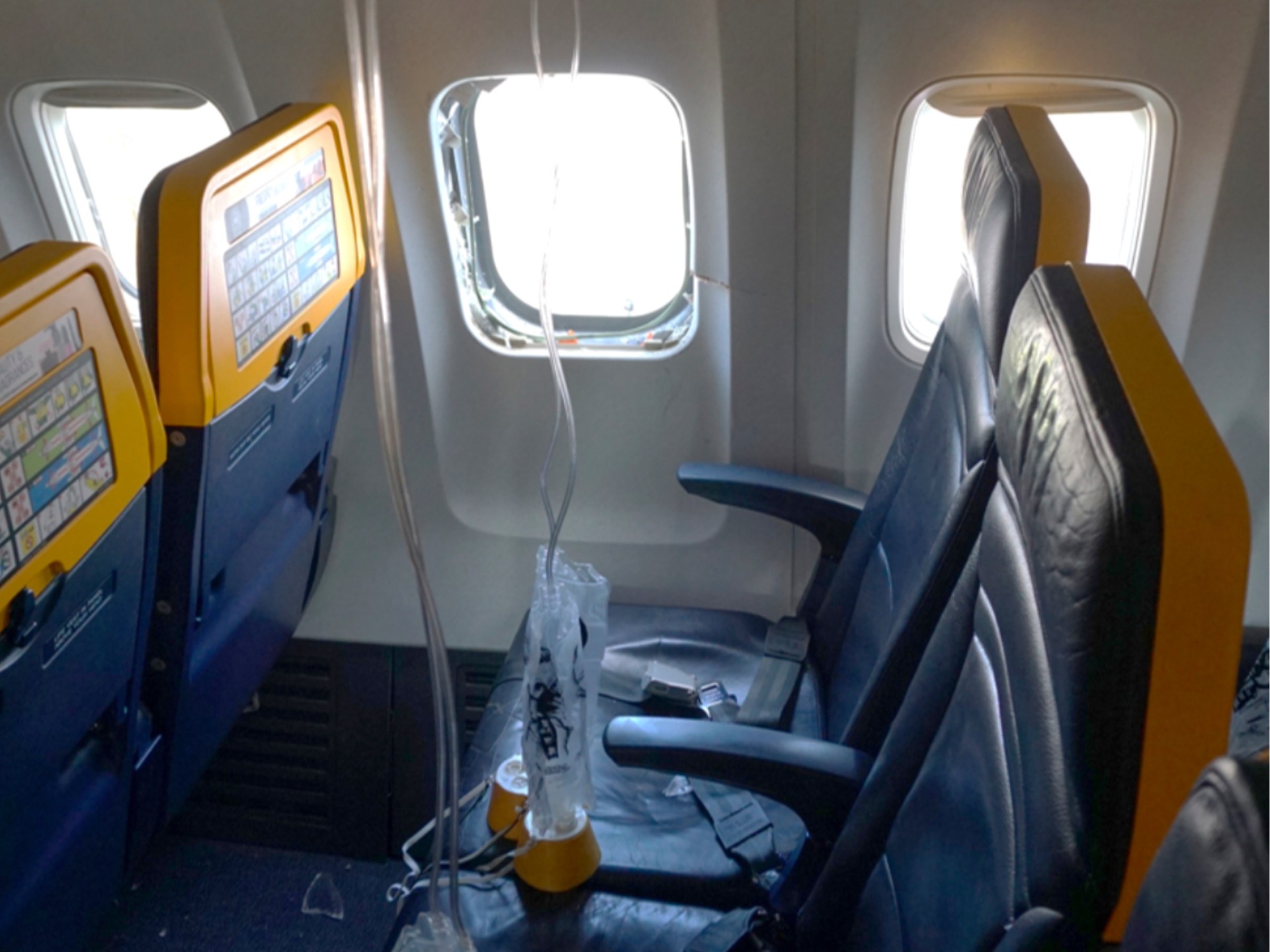
The shattered window on the Ryanair plane. Photograph: National Transportation Safety Board/APView image in fullscreenThe shattered window on the Ryanair plane. Photograph: National Transportation Safety Board/APEngine parts shattered Ryanair window that passenger was partly sucked out of, report saysPreliminary findings show fan blade broke off shortly after takeoff on 10 July flight from Greece to Germany
Broken engine parts were responsible for shattering a window on a Ryanair plane, causing a passenger to be partly sucked out mid-flight in July, US investigators have said.
A preliminary report by the National Transportation Safety Board (NTSB) found an engine fan blade broke off shortly after takeoff on the 10 July flight from Greece to Germany.
The Serbian entrepreneur Ljubisa Karović, sitting by the window in seat 11F, had his head and right arm sucked out of the broken window in the incident.
Karović was saved from being completely sucked out of the window by other passengers, who grabbed hold of him.
The 61-year-old told the Guardian he was lucky to be alive after the incident on Ryanair flight FR1879 and said his wife, Svetlana, told him he fainted several times, including after he had been pulled back inside the cabin.
The NTSB said the flight, which was scheduled to fly from Thessaloniki in Greece to Memmingen near Munich, “experienced a No 2 (right) engine fan-blade-out (FBO) failure during climb out from the Thessaloniki international airport (SKG), Thessaloniki, Greece”. The flight was operated by the budget airline’s subsidiary Malta Air.
Investigators found the cabin depressurised, and the two pilots decided to return to Thessaloniki airport, where they “made an uneventful landing”.
The NTSB was “delegated the investigation in full” by the Greek authorities a few days after the incident.
The flight crew’s timeline of the event was set out by the NTSB, detailing how they experienced a “high vibration” engine alert during the flight climb. They reduced the engine power in response and carried out a series of checks.
The engine vibration reduced and the crew continued the climb on autopilot. However, the vibrations then increased significantly and the crew heard a loud bang.
The flight crew put on their oxygen masks, declared an emergency and began an immediate descent.
The flight attendants reported “hearing and feeling a loud continuous vibration and seeing a small amount of fog/smoke before the oxygen masks dropped”, the report found.
Four bird strikes to the plane’s right engine were reported by flight crews in the 12 months preceding the incident, the report found, adding that bird remains were reportedly found in two of the cases. The fan blades had undergone ultrasonic inspections in recent months with “no findings”.
Karović told the Guardian less than a fortnight after the incident that he did not remember much, but had a painful head and neck. “It could have been the seatbelt, the fact that I was still strapped in. But maybe it is fate. I believe in God and I thank him every day,” he said.
The Boeing 737-800 plane had 149 passengers and four flight attendants on board.