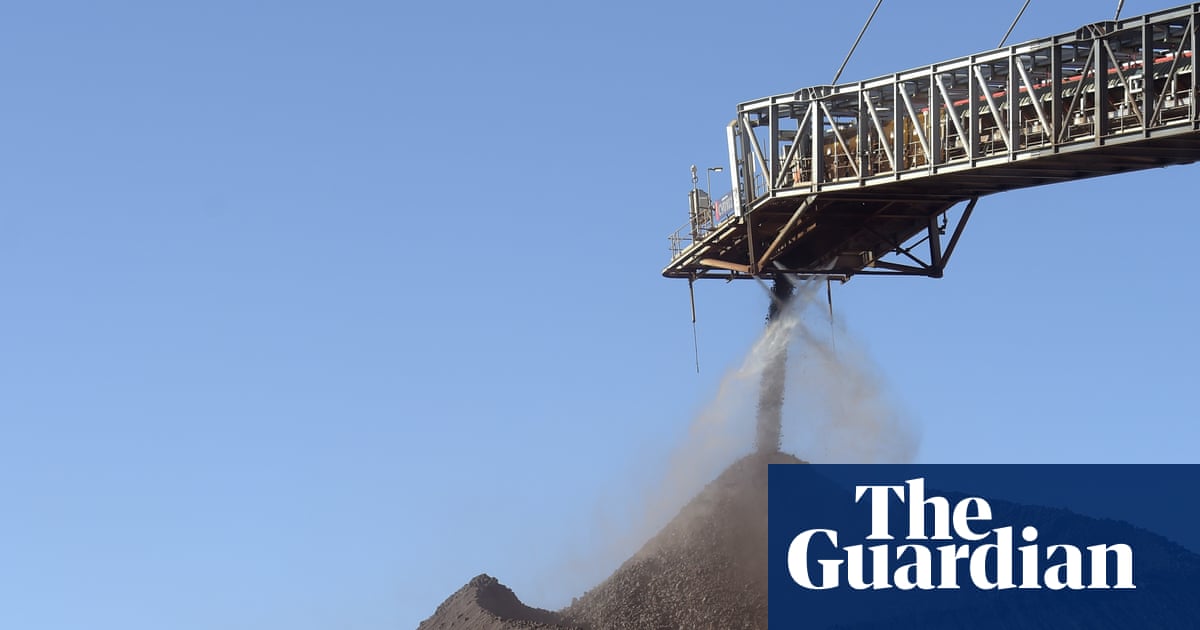
Experts say Western Australia is the only beneficiary of the 2018 GST bill and that if iron ore prices or production volumes rise, the cost to taxpayers in other states could rise even higher. Photograph: Bloomberg/Getty ImagesView image in fullscreenExperts say Western Australia is the only beneficiary of the 2018 GST bill and that if iron ore prices or production volumes rise, the cost to taxpayers in other states could rise even higher. Photograph: Bloomberg/Getty ImagesMorrison-era GST deal with WA a multi-billion dollar mistake that should be reversed, Productivity Commission findsInterim report calls for carve-up deal that has only benefited Western Australia to be ‘reshaped’ as it has achieved almost none of its objectives
Follow our Australia news live blog for latest updates
Get our breaking news email, free app or daily news podcast
The Productivity Commission (PC) has criticised the controversial GST deal with Western Australia as a costly mistake that should be reversed, saying tens of billions of dollars of taxpayer money has since gone to the country’s richest state.
An interim report from a PC review of the deal said the reform – requested by WA and implemented under the former Morrison government with Labor’s support – had achieved almost none of its objectives and had made the system less equitable.
Alex Robson, the PC’s deputy chair, said the deal had “reshaped a system that needed targeted reform, leaving taxpayers with a large and growing bill”.
Read more“The system should be brought back to its core purpose: ensuring that all states and territories are able to offer Australians a similar standard of services and infrastructure no matter where they live,” Robson said.
States and territories receive a greater or smaller share of the roughly $100bn annual GST pool on a per person basis depending on their fiscal capacity, as judged annually by the independent Commonwealth Grants Commission.
But the 2018 deal– struck after WA’s share of the GST pool had plummeted as a result of the mining boom – placed an effective floor under any individual state’s share. Currently, no state can receive a lower per-person share than New South Wales or Victoria.
Making sure no other state or territory is left worse off as a result of the WA deal was previously forecast to cost the federal government about $5bn by 2024-25.
But the changes have ended up costing taxpayers nearly $23bn, with the PC concluding that only WA has benefited from the change.
Based on budget forecasts, the total cost of the deal will reach $60bn by 2029-30.
Angela Jackson, a commissioner at the PC, said the deal has created perverse outcomes.
“If a state like South Australia improves its fiscal position, they get less GST because they are considered to need it less,” Jackson said.
“If Western Australia improves its fiscal position, they either don’t lose any GST or potentially receive even more”.
The damning report adds to fierce criticism from leading economists such as Saul Eslake, who has labeled the 2018 reforms as “the worst public policy decision of the 21st century”.
Jackson outlined a situation where a devastating bushfire in NSW could mean WA would also receive more GST revenue – for a natural disaster it didn’t have.
The interim report was released immediately after a meeting of the state and federal treasurers, with all jurisdictions bar Western Australia in favour of a major overhaul of the current system – although each has their own grievances.
David Janetzki, the Queensland treasurer, said the PC had recognised the need to overhaul the “unfair” GST distribution system, particularly to address concerns around the treatment of resource-rich states.
“Jim Chalmers now has a clear choice – he can continue to defend a broken system or finally stick up for his home state and the national interest,” Janetzki said.
The PC recommended, as the third and least desirable option, that if the government did not want to change the WA deal, it should at least recognise this commitment by making the no-worse-off payments permanent.
View image in fullscreenAnthony Albanese in early 2024 pledging to maintain the GST deal by signing a promise on a West Australian journalist’s arm. Photograph: Richard Wainwright/AAPBut the clamour for change is unlikely to sway the government or opposition, who know their political fortunes are tied to winning votes in the country’s west.
Anthony Albanese in early 2024 pledged to maintain the deal by signing a promise on a West Australian journalist’s arm. On Friday, the prime minister said WA “deserves a fair deal” as the state was “a driver of our national economy”.
No-worse-off payments associated with the 2018 deal cost taxpayers $6.4bn in 2024-25 alone – an amount the PC said could have paid for a tax cut of more than $450 for every taxpayer.
“If iron ore prices or production volumes rise, they [the no-worse-off payments] could reach $12bn per year,’ Robson said.
The PC will do further consultation ahead of a final report due by the end of the year.