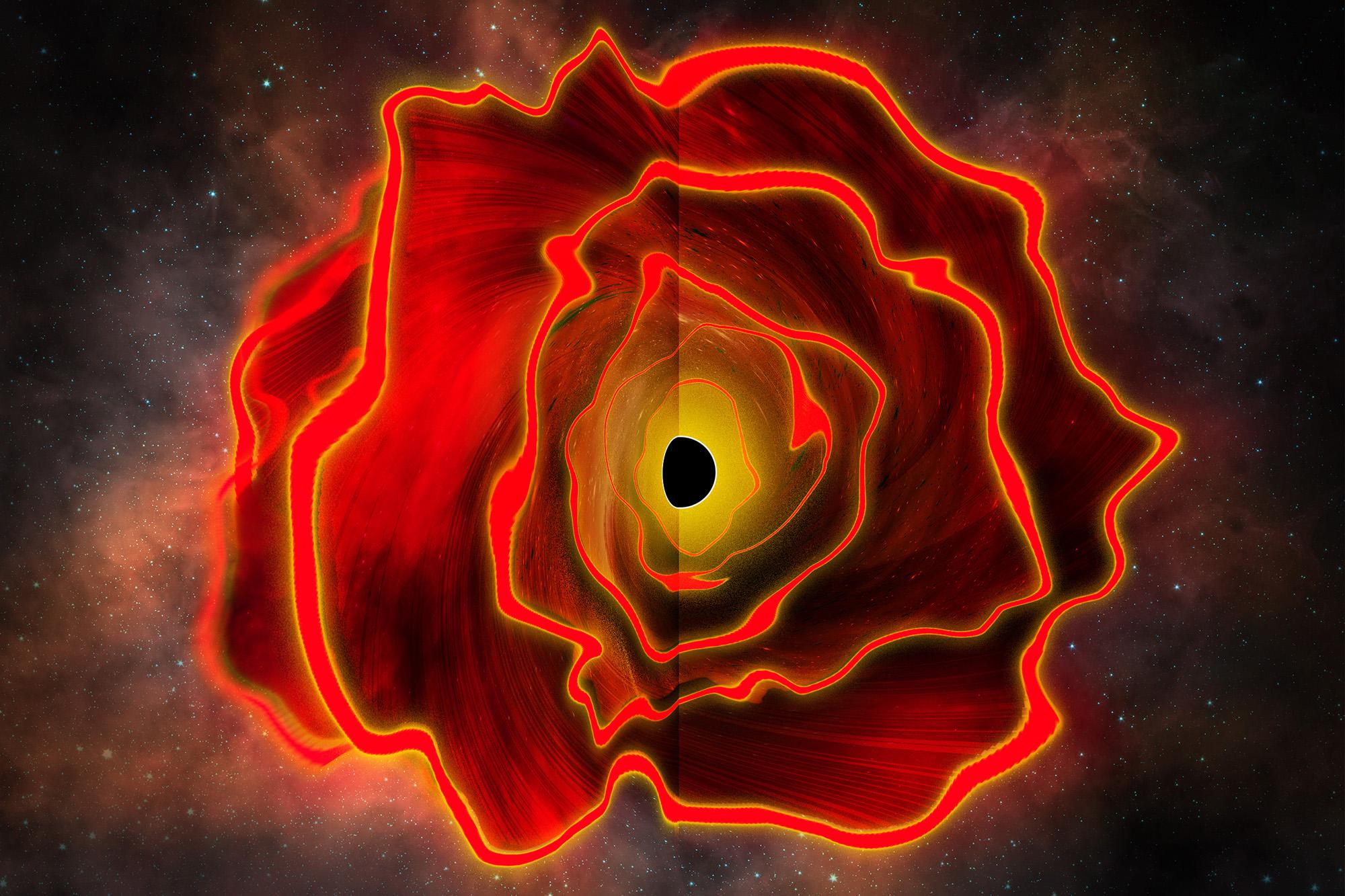
Astronomers have happened across what could potentially be the first recorded black-hole star, dubbed MoM-BH*-1, which they hope will shed light on the dawn of the universe. See more of our coverage in your search results.
Add The New York Post on Google There’s a literal fault in our stars.
Astronomers might’ve finally solved one of the universe’s most enduring mysteries after discovering a new, super energetic entity that’s being billed as a cross between a black hole and a star. They detailed this heavenly hybrid, fittingly dubbed a black-hole star, in a mind-blowing study in the journal Nature.
“Our picture of this object is evolving very rapidly,” study author Rohan Naidu, an astrophysicist at MIT, said in a statement regarding the find.
An illustration compares stars (left), black holes (center), and black hole stars (right). iStock; Jose-Luis Olivares, MIT They identified the object accidentally while using the James Webb Space Telescope to identify the furthest, oldest galaxies in the universe — a project they labeled the Mirage or Miracle (MoM) survey.
The cosmic anomaly, called MoM-BH*-1, is a bright red dot from our early universe whose star-like gas cloud is the size of our solar system, according to Popular Science.
However, this celestial chimera also has a black hole component that’s 100,000 times the size of the sun, and, much like this intergalactic void, emits 100 times as much energy as any known stellar formation.
The MoM-BH*-1 is also 100 billion times brighter than the average star — so luminous that it outshined its host galaxy, such that researchers were seeing unadulterated black hole light.
A black hole star stands out as a little red dot in these James Webb Space Telescope (JWST) images. Courtesy of the researchers “It is a very special thing to find an object with no comparison given the vast stores of data on billions of stars, galaxies, and black holes that we have in our archival databases,” exclaimed Naidu. “MoM-BH*-1 is one in a billion!”
Most importantly, this black-hole star could potentially shed light on the identity of little red dots, mysterious crimson speckles captured by the JWST that were ubiquitous during the dawn of time— within the first two billion years following the Big Bang.
Researchers have theorized that these interstellar freckles could be everything from supermassive stars to galaxies to supermassive black holes shrouded in dense envelopes of gas — the most plausible theory.
This latest discovery suggests that they could be black hole stars as well. MoM-BH*-1’s existence suggests that their scarlet hue is the result of gas, not dust as previously thought, which would explain why the earliest supermassive black holes are far bigger than cosmological models suggest.
Naidu and his team hope to probe further into the black hole star phenomenon.
Starting in December, they will be using the JWST to answer other questions surrounding these luminous vortexes, including their actual size and the composition of their atmospheres.
Naidu said the discovery of MoM-BH*-1 made him wonder if they “were seeing a new kind of ‘stellar atmosphere,’ but on a spectacular scale.”