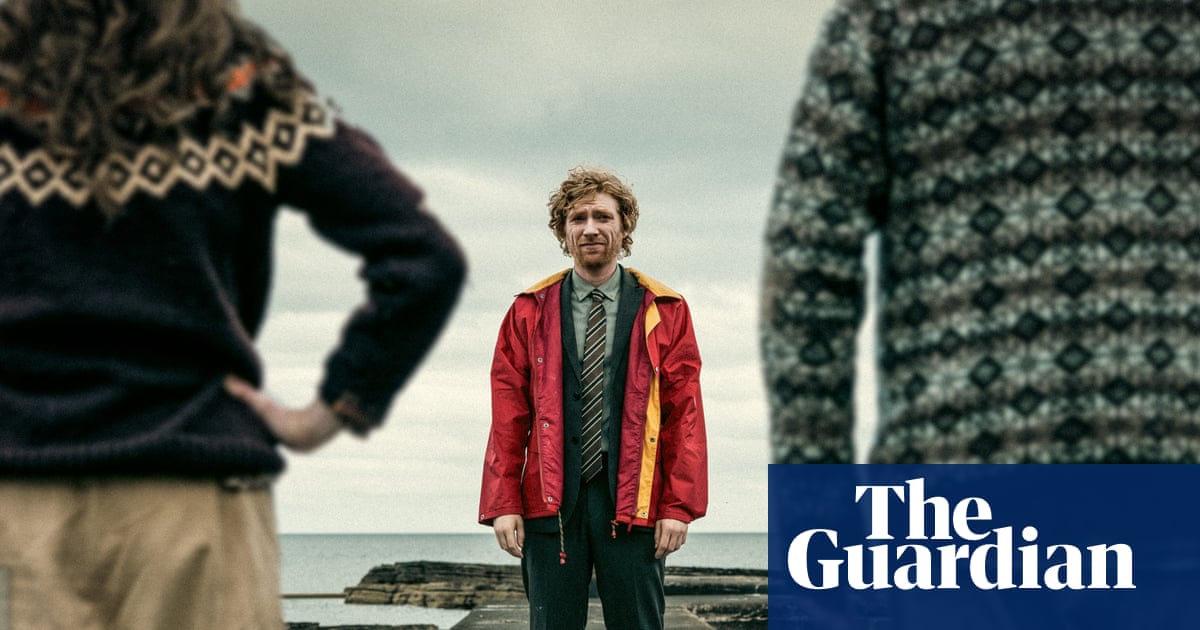
Part of a strong clutch… Domnhall Gleeson in The Incomer Photograph: Courtesy of EIFFView image in fullscreenPart of a strong clutch… Domnhall Gleeson in The Incomer Photograph: Courtesy of EIFFEdinburgh international film festival showcases a Scottish industry in rude healthThis year’s festival is superpowered by a strong year for Scottish cinema, showing it can thrive under the ‘four dimensional perpetual catch-22’ of global ambitions
Borges, ballet and BDSM: Peter Bradshaw’s 10 must-see movies at Edinburgh international film festival
Now that its disastrous collapse and speedy rebirth is a trauma slowly receding in the rear-view mirror, the Edinburgh international film festival can set its sights on bigger things. Apart from its traditional role providing a showcase for the best of current world cinema, the festival has an ace up its sleeve for 2026: the undeniable confidence and conspicuous achievement of its home film industry in Scotland. Just as Cannes likes to give a decent amount of houseroom to favoured French directors, and Sundance sees at least part of its job to talk up US independent cinema, Edinburgh acts as a vector for Scottish film-makers to gain valuable exposure and get their work in front of significant festival audiences. Inevitably, some years are harder than others, but Edinburgh’s 2026 edition feels stronger than it has been for years.
The festival’s opening gala slot, traditionally a local film, has been given to The Incomer, a surreal comedy starring Domhnall Gleeson and set Scotland’s far north, and which picked up a major award at the Sundance festival earlier this year. Among a clutch of strong films are Borges and Me, based on Jay Parini’s memoir of escorting author Jorge Luis Borges on a trip around the Highlands; Sunny Dancer, a “chemo camp” comedy filmed in Loch Lomond, starring Bella Ramsay as a teenager dealing with the aftermath of cancer; and The Education of Jane Cumming, the extraordinary true life story of the 19th-century Edinburgh schoolkeeper who inspired The Children’s Hour. Scottish artist Douglas Gordon is the focus of a new documentary, Douglas Gordon by Douglas Gordon, while Scottish Ballet perform in These Violent Delights, a film rendering their dance version of Romeo and Juliet. Past glories are due to live again with a 30th anniversary screening of junkie classic Trainspotting (with the added bonus of a live club night featuring a DJ set from Irvine Welsh).
View image in fullscreenThe Education of Jane Cumming Photograph: © HeimatfilmPaul Ridd, the festival director, is aware of the potential minefield of sticking up for Scottish cinema. “It’s great to have all those movies in the mix, these films deserve to be at the big table. But we never want to think we’ve got to promote this stuff. What we want to avoid is the sense that there’s any film in our lineup that is in there for any other reason than it’s just top quality. We’re not quota driven. It’s always about the quality. And I’m just very happy that there’s such a wealth of great Scottish work to showcase.”
Ridd points to the influence of Screen Scotland, the state-and-lottery funded agency founded in 2018 that was designed to act as a specialist funding unit for Scottish film. “All these great films are testament to what the whole organisation has been doing to put those film-makers and those films on the map.” The recent appointment of Screen Scotland’s executive director Isabel Davis as head of the British Film Institute’s £20m film-making fund – itself seen as a vote of confidence in the way the Scottish film industry has evolved.
Davis, who takes up her new post in October, is clear that increased and targeted project development has been vital. “We were put together with the notion that really good creative development support was going to be the key to all of that film-making success, and it has paid off. It takes years, project by project. It means giving tough love to people on scripts, saying that things could be better, pushing people to be more ambitious – and then backing that up with more development support and then production support.”
Festival success is a major marker, and the fact that seven Scottish films were selected for Sundance earlier this year was a major cause for celebration; as well as The Incomer, the picks included and The Story of Documentary Film (The 1980s), the newest in a stream of film-history essays from critic-turned-film-maker Mark Cousins – who is described by Davis as “the gift that keeps on giving” as far as the Scottish film industry is concerned. Conversely the recent Scottish film that appears to elicit the most fervent admiration from across the Scottish industry is the most hyperlocal of all: Everybody to Kenmure Street, documentary about the mobilisation of local activists to prevent the arrest of two men by immigration enforcement officials. Davis says “it’s just connected to people so far beyond Scotland, it’s unbelievable.”
Sunny Dancer producer Ken Petrie is one of the new generation of Scottish film-makers who have benefited from Screen Scotland’s involvement, but says the going is still tough. “You know, it’s always been a hard business. It’s never been so hard or expensive to make something that has so little financial reward. The whole value chain of the film industry at the moment is a challenge, especially for independent producers.”
View image in fullscreenHighlands tale … Borges and Me. Photograph: Courtesy EIFF 2026Petrie, who started out as a special effects technician on projects such as The Wolfman, Robin Hood and World War Z, says that, for him at least, the challenge is to avoid staying too close to home. “Scotland is in a good place, but I think we need to have a bit more courage to try to really blossom on to the global stage. The question for me is: how do you make that stuff that’s going to travel internationally, entertain Scotland and the UK, but also the rest of the world?”
He adds: “The ugly fact is the UK film business is centred in London. I don’t know if it’s possible that people can live and work in Scotland in isolation and be able to build global companies. I’m trying to make stuff for global audiences, so surely you have to go and find out what the global marketplace is saying.”
On the other hand, Petrie is concerned that Scotland’s record as an international production base – which has seen projects of the calibre of Spiderman: Brand New Day, The Odyssey, Frankenstein and The Buccaneers shoot in the country – may be hampered by Westminster over the level of subsidy it can offer to attract these productions. “Should we be trying to grow more in Scotland? It’s like a kind of four-dimensional perpetual catch-22.
“I mean, Scotland’s an exciting place. Everybody loves the Scots. Certainly when I’m out in the marketplace that’s what comes across. There’s a lot of goodwill out there towards Scotland. I try to always be an optimistic realist and I think that’s what we need to be in Scotland at the moment.”