Exceptionally high revenues, particularly from war aid for Russia, are consolidating the power of North Korea's autocratic leader. A small number of people in the country are benefiting from an economic boom.
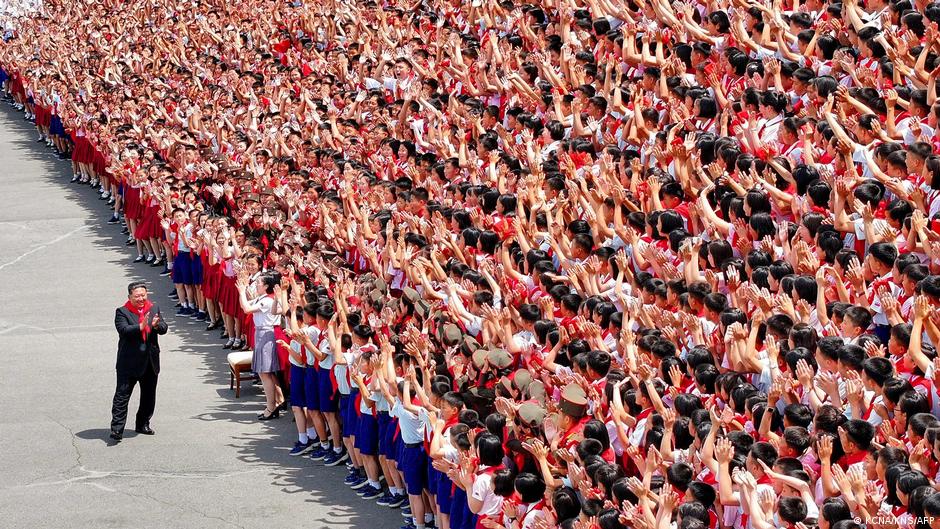
https://p.dw.com/p/5IjBhNorth Korean leader Kim Jong Un (left) has profited greatly from cooperation with RussiaImage: KCNA/KNS/AFPAdvertisementFor years, satellite images of North Korea at night showed only a few small patches of light. Electricity shortages meant that even cities remained dark. In the six years since April 2020, however, the illuminated area in the center of Pyongyang has tripled in size.
The information portal NK News sees the increased illumination of the urban area as evidence that the regime has prioritized the supply of electricity to new streets and houses in the center to showcase its achievements.
At the last party congress in 2021, Kim Jong Un, North Korea's leader, announced that he would build 50,000 new apartments in the capital. And he did embark on the plan: in the new neighborhood of Hwasong, for example, with the construction of two 40-story apartment blocks shaped like Hwasong intercontinental ballistic missiles.
Why North Korea is now Europe's problemTo view this video please enable JavaScript, and consider upgrading to a web browser that supports HTML5 video
The new high-rise districts are not the only sign of North Korea's improved prosperity. People who have been visiting Pyongyang for a long time report that the city now appears more modern.
There are many imported cars, including electric cars from China, smartphone apps with QR codes to make payments or to call taxis, and department stores that stock Western fashion brands and cosmetics.
The regime has completed construction in Pyongyang of the biggest hospital in the country and a hothouse the size of New York's Central Park. In June 2025, Kim officially opened the five-kilometer-long (3.3 miles) beach resort of Wonsan-Kalma on the east coast, with space for 20,000 guests.
In June, the Wall Street Journal described North Korea as the "world's most unlikely growth story."
The dictatorship is presumably able to finance this sudden upturn thanks to the substantial income from its involvement in Russia's war against Ukraine.
According to a report by the South Korean Institute for National Security Strategy (INSS) in March, North Korea earns between $7.7 billion and $14.4 billion (€6.7 billion and €12.5 billion) from the sale of munitions to Moscow and the deployment of troops. Bloomberg Economics recently estimated that between 2022 and 2025, North Korea earned more than $14 billion by providing military support for Russia.
North Korea expands its role in Russia's war against UkraineTo view this video please enable JavaScript, and consider upgrading to a web browser that supports HTML5 video
Furthermore, it brought in another $8 billion through trade with China, the provision of North Korean workers to other countries, export business and online criminality. The hacking of the ByBit platform in February 2025 was one of the world's biggest cryptocurrency heists. Suspected North Korean hackers made off with $1.5 billion worth of Ethereum, a network with its own virtual currency. In comparison: the previous year, North Korea's entire GDP was $27 billion.
It is unclear whether it was Russia or North Korea who first had the idea of using the impoverished country's massive stockpiles of munitions in Russia's war against Ukraine.
Kyiv estimates that in 2024 and 2025, North Korea supplied half the munitions Russia used at the front, as well as self-propelled guns, multiple rocket launchers and ballistic missiles. Ukraine says North Korea is currently planning to transfer a missile unit to Russia to fight against Ukraine, consisting of 90 soldiers, six launch pads and up to 120 missiles.
Between 16,000 and 22,000 North Korean soldiers are already helping Russia to drive Ukraine out of the border province of Kursk and clear the area of mines afterward. According to Ukrainian President Volodymyr Zelenskyy, Kim now intends to station a further 30,000 to 50,000 soldiers in Russia.
Kim hails troops returning from RussiaTo view this video please enable JavaScript, and consider upgrading to a web browser that supports HTML5 video
The business is a lucrative one: The INSS report says that, every month, Kim receives $2,800 per North Korean soldier, $3,000 for an officer and $6,000 to $10,000 for every soldier killed in action.
As in Soviet times, the reciprocal arrangement is conducted primarily through exchange transactions. In exchange for munitions, arms and soldiers, Russia supplies North Korea with crude oil and oil products, grain and military goods from anti-aircraft systems to the technologies for building drones, missiles and submarines.
Kim's new role as Russia's supporter has given him greater political importance and military power, as demonstrated by the launch of two 5,000-ton destroyers. In all 15 of the years he has been in power, the autocratic leader has never had this much influence, or this much money.
North Korea gains critical intel by aiding Russia in UkraineTo view this video please enable JavaScript, and consider upgrading to a web browser that supports HTML5 video
It's an astonishing turnaround. Kim noticeably lost weight during the COVID-19 pandemic, and at the Workers' Party congress in 202,1 he shed tears as he admitted that the national economic development strategy had fallen "far short in almost all sectors."
At the next party congress five years later, with seven rows of artillery pieces lined up outside the building, Kim crowed, "Everything has fundamentally changed."
The partnership with Russia has allowed North Korea to shed its status as a pariah of world politics and overcome its isolation. In June 2024, the Russian President Vladimir Putin visited Kim in Pyongyang. Chinese leader Xi Jinping came in June of this year, three months after the Belarusian dictator Alexander Lukashenko. In September 2025, Kim was in attendance at the celebrations in Beijing, alongside Xi and Putin, to mark the 80th anniversary of the end of World War II.
However, observers say this economic upswing is not benefiting the majority of the population.
Many households already in a precarious situation and without access to foreign currency have been hit hard by rising food prices and the devaluation of the won, the national currency. In many families, the women, too, must now go out to work in order to maintain living standards.
In the spring of 2024, Kim promoted a "20x10" development program for regions beyond the well-supplied capital Pyongyang. Presumably, he intends to finance this with the new additional revenue. The plan foresees that modern factories will be built in 20 cities or regions annually, creating 200 regional industrial projects over 10 years.
But according to Andrei Lankov, a professor and North Korea expert at Kookmin University in Seoul, the majority of the 20x10 projects fail.
"This is because not only do the factories have no infrastructure, they also do not take into account the mechanisms for supplying electricity, equipment, and raw materials," he said.
The factories are operated according to the principles of a planned economy, which is unsuited to small and medium-sized businesses.
"Unlike the economic growth that took place in North Korea in the mid-2010s, the current growth was based not on internal economic reforms, but only on international good fortune," Lankov said.
How North Korea uses Christianity to protect Kim dynastyTo view this video please enable JavaScript, and consider upgrading to a web browser that supports HTML5 video
This article was originally published in German.