Video Tyrus calls WNBA player Carrington a ‘hateful person’ after foul on Cunningham Fox News contributor Tyrus discusses WNBA player DiJonai Carrington’s ‘white privilege’ post after she was ejected from a game for a foul on Sophie Cunningham on ‘America Reports.’
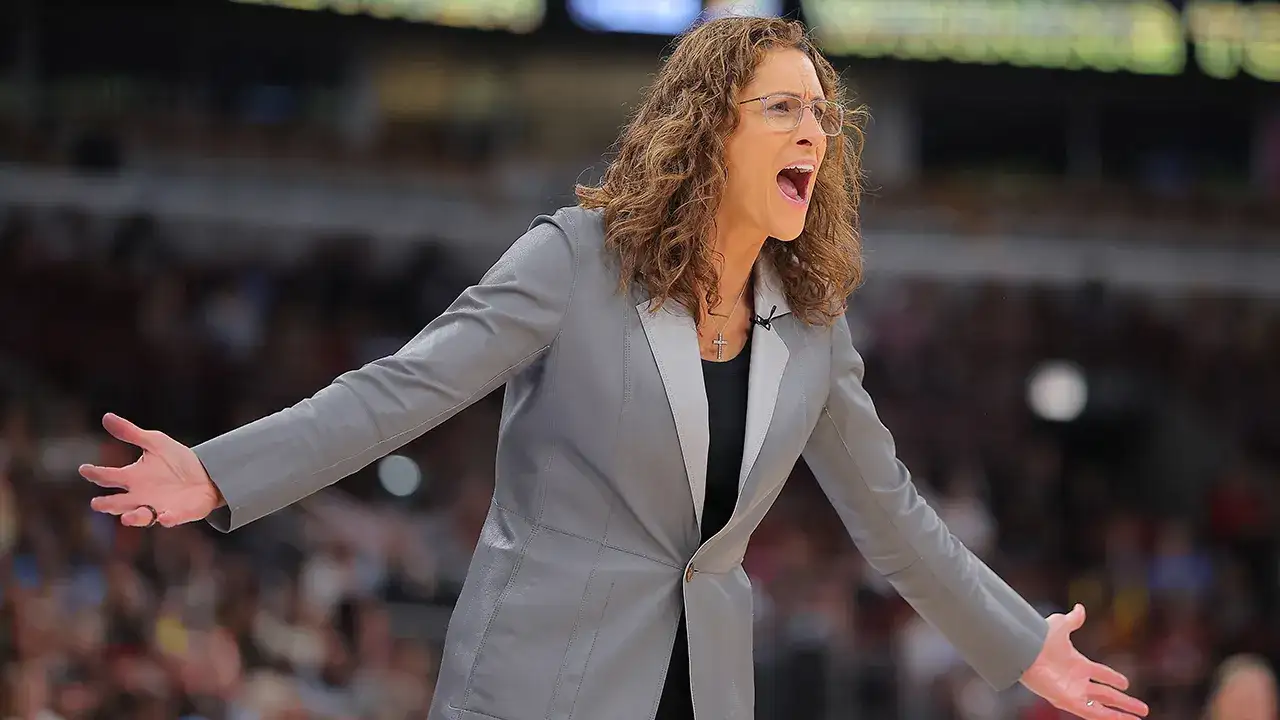
Fever head coach Stephanie White opened her pregame press conference Tuesday night before Indiana’s game against the New York Liberty by reading a lengthy prepared statement about the "hate," "fear mongering" and "divisiveness" that she believes is trying to "hijack" the WNBA.
The statement included profanity, White literally banging on the table in front of her and even ended with what appeared to be a staged walk out of the press conference room without taking any questions.
Stephanie White's prepared pregame rant about hate and divisiveness hijacking the WNBA drew immediate praise from ESPN analysts and reporters alike. (Icon Sportswire via Getty Images)
That's why the reaction from the WNBA's media cheerleaders was so fascinating.
Within minutes, reporters and outlets began describing White's remarks as "passionate," "important," "impassioned" and "scathing." ESPN took the framing even further, with analysts praising White's vulnerability, honesty and commitment to love while suggesting that some of the people criticizing her are "fueled by hatred."
WNBA SUDDENLY WANTS TO STICK TO BASKETBALL AFTER YEARS OF MAKING POLITICS PART OF THE PRODUCT
White was heavily criticized for her reaction to DiJonai Carrington's hard foul on Fever guard Sophie Cunningham during Indiana's game against Chicago on Saturday. It seemed, to many, that White spent more energy defending an opponent who had committed a flagrant foul against her player than her own player who was left with a bloody mouth.
White explained Tuesday that she didn't see the play in real time and went directly to her postgame press conference. White said she thought the officials got the call right and said she didn't believe Carrington intentionally went for Cunningham's neck. The Fever coach said that after she watched the replay, she changed her assessment.
"Was it egregious? Absolutely," White said. "When you have a chance to watch that over and over and over on replay, you can see that. I didn't have that in real time."
It's reasonable to believe that White didn't have access to multiple replays of the play during the game and didn't see them until after she spoke to the media. Explaining that on Tuesday night made perfect sense.
Chicago Sky guard DiJonai Carrington commits a flagrant 2 foul against Indiana Fever guard Sophie Cunningham. (Kamil Krzaczynski/Imagn Images)
White said she took any suggestion that she does not have her players’ backs personally before pivoting into a broader attack on an "online community" that she accused of creating false narratives about who she is and what she represents.
"The hate, the fear mongering, the divisiveness, the stuff that's trying to hijack our league will not win," White said. "It won't win. We are united. We are connected. We will not be divided."
White then borrowed Michelle Obama's famous "when they go low, we go high" line and declared that "love," "grace," "humility" and "kindness" would prevail. She followed all those calls for kindness by saying, "Everybody else can go to hell."
We could spend an entire column on the irony of that juxtaposition, but let's continue because watching the video added another layer.
White wasn't speaking extemporaneously or reacting emotionally to a question. She was clearly reading a prepared statement, repeatedly looking down at her remarks and, to my eye, trying to inject the appropriate emotion into different portions of the speech.
I didn't find her speech particularly convincing. It came across as rehearsed and performative, especially when the emotional delivery didn't seem to match the words she was reading. That's subjective, though. Anyone can watch the video and reach a different conclusion.
That's why it's borderline comical that the WNBA media ecosystem seemed to reach the exact opposite conclusion.
Underdog WNBA called White's statement "passionate." Chicago Sun-Times reporter Annie Costabile labeled it an "Important statement from Indiana Fever coach Stephanie White." ESPN's Alexa Philippou went with "impassioned," as did The Sporting News, while Meghan Hall described White's remarks as "scathing."
Individually, none of those descriptions is especially noteworthy. Taken together, though, they establish a remarkably consistent framing: White hadn't simply read a prepared statement. She had delivered something important, emotional and powerful.
JEMELE HILL IS RIGHT: WNBA FANS EXPECT JOURNALISTS TO BE 'CHEERLEADERS,' AND THAT'S NOT HOW THIS WORKS
That didn't change during ESPN's pregame coverage on "WNBA Countdown." It only became more clear that the media cheerleaders had their narrative and they were ready to roll.
Chiney Ogwumike said she saw White as someone operating under "immense pressure" and talked about how frightening it can be to show vulnerability when everyone is watching. She praised White for continuing to "speak your truth" and said the Fever coach was making an "impassioned plea" to get back to basketball and "center it around love."
That's an incredibly charitable reading of what happened. White read a prepared statement accusing unnamed people of spreading hate, fear and division, then told those people they could go to hell. ESPN turned that into a courageous display of vulnerability centered around love.
ESPN WNBA analyst Chiney Ogwumike immediately rushed to the defense of Stephanie White. (Kirby Lee-Imagn Images)
Andraya Carter then went further by questioning whether people calling for White's job had even watched enough Fever basketball to fairly judge her performance as a coach. That's a legitimate question. Social media routinely takes one clip, strips away context and turns it into a referendum on someone's entire career.
But Carter didn't stop with questioning whether the criticism was informed.
"Are you calling for her job because you watched one clip and you're piling on and you are fueled by hatred?" Carter asked.
ZERO BS. JUST DAKICH. TAKE THE DON'T @ ME PODCAST ON THE ROAD. DOWNLOAD NOW!
White had complained broadly about hate infiltrating the league without identifying the people she meant. Carter effectively filled in the blank, suggesting that at least some of White's critics weren't merely wrong, uninformed or overly emotional, but possibly "fueled by hatred."
What evidence established that? None was offered during the segment.
And, by the way, calling out White for not appropriately defending her own player during a postgame news conference is well within the bounds of normal sports criticism. Any male head coach would face the same critiques in a men's professional league were the situation comparable. Blurring legitimate criticism together with hatred and divisiveness shifts attention away from the actual issue.
Malika Andrews then praised White's "honesty and transparency," said ESPN believed it was "important" to show the statement and complimented Carter and Ogwumike for steering the network's WNBA conversations "so well and so gracefully."
Think about the progression here: a head coach makes a sweeping accusation about unnamed people spreading hatred and division on the internet. One ESPN analyst describes her as vulnerable and speaking her truth. Another wonders aloud whether the people criticizing her are actually fueled by hatred. The host then praises the coach's honesty and the panel's grace.
At no point does anyone seem especially interested in asking whether White’s central claim is actually true.
Who exactly is trying to "hijack" the WNBA? What criticism qualifies as fear mongering? Where does legitimate criticism end and harassment begin? Does disagreeing with White's handling of the Cunningham incident make someone part of the divisiveness she is condemning?
Those would seem like natural questions for people whose job is to cover the league.
Instead, ESPN did the opposite. It didn't just report White's accusation, it adopted it as the premise for its own coverage.
During the first quarter of the Fever-Liberty game, the ESPN broadcast played White's rant again.
Then reporter Holly Rowe framed the statement as a "response to the online vitriol and harassment that she and the Fever have faced" following the Chicago game. Rowe twice characterized White's remarks as "strong" and also called them "very emotional."
ESPN BURIES DIJONAI CARRINGTON DIRTY FOUL ON SOPHIE CUNNINGHAM, 'WHITE PRIVILEGE' POST
"I've been around this league since the beginning as a former player, as a mother, as a human being," Lobo said. "My heart breaks for the players and coaches in this league right now. And the online harassment they have to deal with every day. At some point, enough is enough."
Ryan Ruocco responded, "Well said, partner," before saying everyone was looking forward to focusing more on what he called the "objectively incredible product" on the floor.
Ruocco calling the basketball "objectively" incredible is a fun rhetorical trick. Whether the quality of play is incredible is obviously a matter of opinion. Adding "objectively" doesn't make it a fact.
ESPN WNBA reporter Holly Rowe, like her colleagues, framed Stephanie White's scripted pregame rant as a "strong" and "emotional" speech. (NBAE via Getty Images)
More importantly, ESPN had already moved past reporting White's comments and into validating the premise behind them. Remember that White vaguely referred to hate, fear mongering and divisiveness. Rowe defined the controversy for viewers as "vitriol and harassment," Lobo said her heart broke for the people dealing with it and Ruocco immediately endorsed her response.
Yes, online trolls exist. This isn't breaking news. Dealing with that can be difficult and frustrating, and I do speak from experience on that subject.
But criticism isn't automatically harassment. Calling for a coach to be fired, even if the criticism is stupid or uninformed, isn't proof that the person is trying to "hijack" a professional sports league.
If anything, it shows that the WNBA has entered normal American sports discourse, where fans criticize coaches, overreact to press conferences and call for people to be fired.
There was another theme running through all of this. White lamented that people weren't talking enough about the "great basketball" her players were playing. Ogwumike said White wanted to get back to the game everyone loves. Carter complained that "you can't just talk about basketball," while Andrews promised that the remainder of the show would focus on basketball.
Ruocco made essentially the same point during the game broadcast, saying everyone looked forward to focusing more on the product on the court.
The WNBA and its media defenders have spent years celebrating players and coaches for speaking about subjects far beyond basketball. Politics, race, gender, social justice and culture were not treated as annoying distractions from the sport. They were presented as central features of what made the league and its players important.
The WNBA has always embraced being about "more than basketball" but the league is suddenly reversing course because conservatives entered the conversation. (NBAE via Getty Images)
Now, after White delivers a prepared speech invoking hatred, fear mongering, divisiveness, love, grace, humility and Michelle Obama, the media reaction is that everyone really wishes outsiders would stop bringing non-basketball issues into the WNBA.
When the WNBA’s non-basketball messaging largely aligned with progressive causes, its friendly media rarely treated those conversations as an unwelcome distraction. Suddenly, though, the WNBA is in "stick to basketball" mode.
White is free to defend herself, defend her players and criticize people she believes have treated them unfairly. ESPN analysts are free to agree with her. Reporters are free to think her speech was passionate or important.
But journalists are also supposed to maintain enough distance from the people they cover to examine their claims rather than simply reinforce them.
CLICK HERE TO DOWNLOAD THE FOX NEWS APP
The WNBA's friendly media ecosystem didn't merely report what Stephanie White said. It immediately validated what she said, supplied motives for the people she was attacking and elevated a rehearsed pregame rant into an "important" emotional flashpoint.
White said love, grace, humility and kindness would win.
And everybody who doesn't buy it can apparently go to hell.