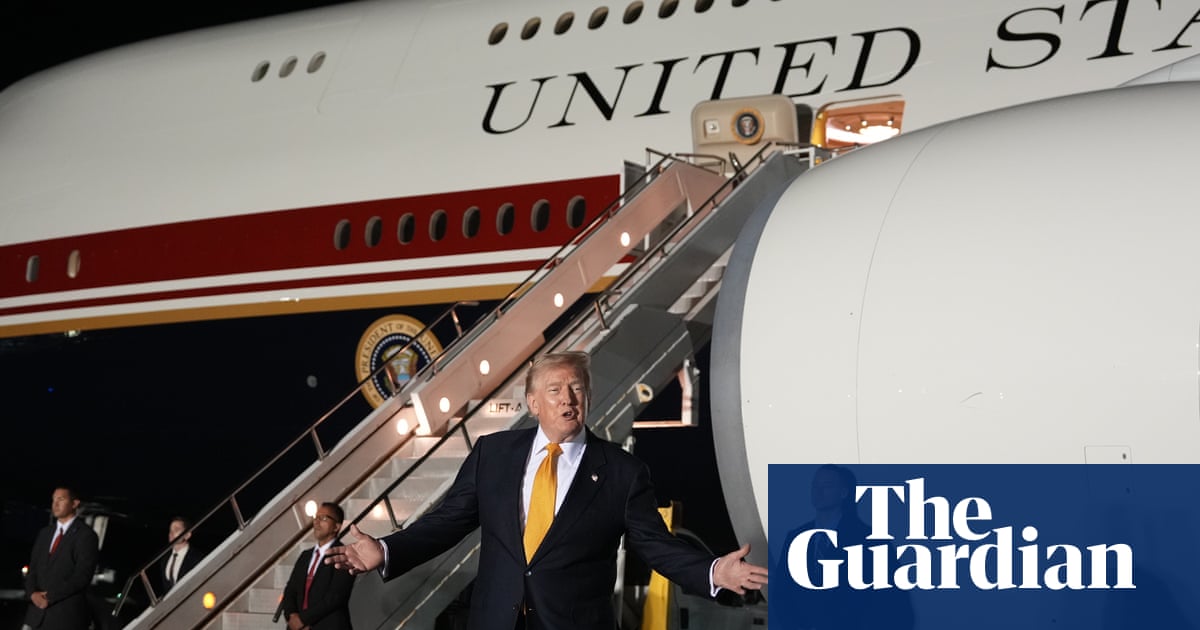
Trump switches planes at RAF Mildenhall in Suffolk Eastern England, on his way back to US from the Nato summit in Ankara, Turkey, on 8 July 2026. Photograph: Alex Brandon/APView image in fullscreenTrump switches planes at RAF Mildenhall in Suffolk Eastern England, on his way back to US from the Nato summit in Ankara, Turkey, on 8 July 2026. Photograph: Alex Brandon/APTrump’s secret flight switch indicates severity of assassination threat by IranIran lost top leaders in the war and US ‘humiliation ... a form of revenge’, say experts, after administration’s flight ruse
Since the joint US-Israeli strikes in February that killed Iran’s supreme leader Ayatollah Ali Khamenei and scores of other senior Iranian officials on the first day of the war, a revenge plot to kill Donald Trump should not have appeared far-fetched.
But the US administration’s elaborate ruse to spirit Trump off of Air Force One in Turkey last month indicates a credibility to the Iranian threat that has surprised many in Washington – including the Trump aides and journalists left on the jet that may have remained the target of an Iranian missile strike.
These are not the first assassination attempts to have been reported against Trump or officials and family members close to him – but experts such as Colin P Clarke, the executive director of The Soufan Center, have said that the unusual lengths taken to protect the president while potentially leaving others in harm’s way were “not a good look” and risked making him look “weak”.
Those threats go back to before the war, added Clarke, noting decisions from Trump’s first administration including approving the strike that killed Qassem Suleimani, the Islamic Revolutionary Guard Corps commander. Even a ceasefire or peace deal ending the war, he said, would “not obviate their desire to kill Trump”.
“I think the threat for Trump, as long as he’s alive, whether he’s in office or out, will remain,” he said. “And you know they haven’t been able to pull anything off on US soil, but it doesn’t mean that they’re not determined to to do it.”
US officials for years have accused Iran of seeking to assassinate Trump.
In 2024, Manhattan federal prosecutors said the Iranian government had ordered an operative to kill Trump, who was then running for president, for his part in the killing of Suleimani. In July of this year, Israel shared intelligence with the US that said Iran had hatched a new plan to kill Trump. And an Iraqi militant arrested earlier this year was alleged to have close ties with Iranian officials and was alleged to be considering targeting Ivanka, his daughter.
Senior officials including Mike Pompeo, Trump’s former secretary of state, and John Bolton, national security adviser, were also said to have been under threat.
“For Iran, revenge is something that’s taken very seriously, and the killing of Suleimani … has set in motion very serious threats,” said Bruce Hoffman, a senior fellow on counterterrorism and homeland security at the Council on Foreign Relations.
View image in fullscreenTrump steps off Marine One as he arrives at the 2026 Patriot Games on 11 August 2026 in Geneva, Ohio. Photograph: Anna Moneymaker/Getty Images“And from the Iranian point of view … humiliation is also a form of revenge,” he added. Given the reports of Trump being taken off Air Force One on a food delivery truck, “regardless of of how imminent or how serious the plot was from the Iranian point of view, this is you know they’re making hay out of this and they find it enormously satisfying.”
Hoffman pointed to a “long pattern” of Iran using terrorism as a core element of its foreign policy. Following Israel’s assassination of Abbas al-Musawi, the secretary general of Hezbollah, in 1992, Iran detonated a car bomb by the Israeli embassy in Buenos Aires, killing 29. It then followed up two year later with a bombing attack on a Jewish community centre in the same city, killing 85 and leaving more than 300 people injured.
The threat of terrorism directed or prompted by Iran and its intelligence operatives has been considered a major risk since the beginning of the war. Iran’s IRGC had warned on the third day of the war that Americans would “no longer be safe anywhere, not even home”, and US law enforcement have warned of threats ranging from sleeper cells, to cyberattacks, to drone strikes in California.
But in an essay written for War on the Rocks in May, Matthew Levitt, a senior fellow at The Washington Institute for Near East Policy, noted that authorities had yet to report a single homeland plot specifically tied to Iran. While lone attackers angered by the war had killed Americans, those had not been directly linked to Iranian intelligence or security agencies.
He argued that while Iran may see a growing desire to bring the war home to the American public, the country’s capability to execute attacks may have been “somewhat diminished by the extent of damage inflicted on the Iranian security and intelligence agencies tasked with carrying out or overseeing such operations”.
In particular, he pointed to the airstrikes that have targeted key figures who carry out Iran’s external operations, including Rahman Moqadam, who heads the special operations division of the Revolutionary Guards’ Intelligence Organization, as well as Majid Khademi, the head of the Revolutionary Guard Intelligence Organization.
Still, Iran’s apparent determination to create a credible threat against Trump sends a message that politically Tehran is still ready to escalate the conflict in the interest of revenge.
“I think you know in the the minds of a lot of Americans, we’re looking at this conflict, and some people are saying, ‘Oh, it’s really winding down,’ but I don’t think we’re anywhere close to this being over,” said Clarke, noting Iran’s past patience in putting together attacks similar to the one on the Jewish community centre in Argentina in 1994. “I think we also need to consider the Iranians’ capabilities writ large and also the fact that they’ve been patient in the past.”
Iran’s readiness to withstand Washington’s response to the assassination of a US president also may shake up the White House’s calculations of how to end the war.
“I think this has lots of implications for the negotiations for the war,” said Hoffman. “It shows that Iran is not backing down at the height of this war, they’re basically saying: ‘Bring it on.’”
Noting that Iran remained “emboldened” to try to kill a sitting US president, he added, Iran was “certainly not cowed or deterred, so that’s very worrisome”.