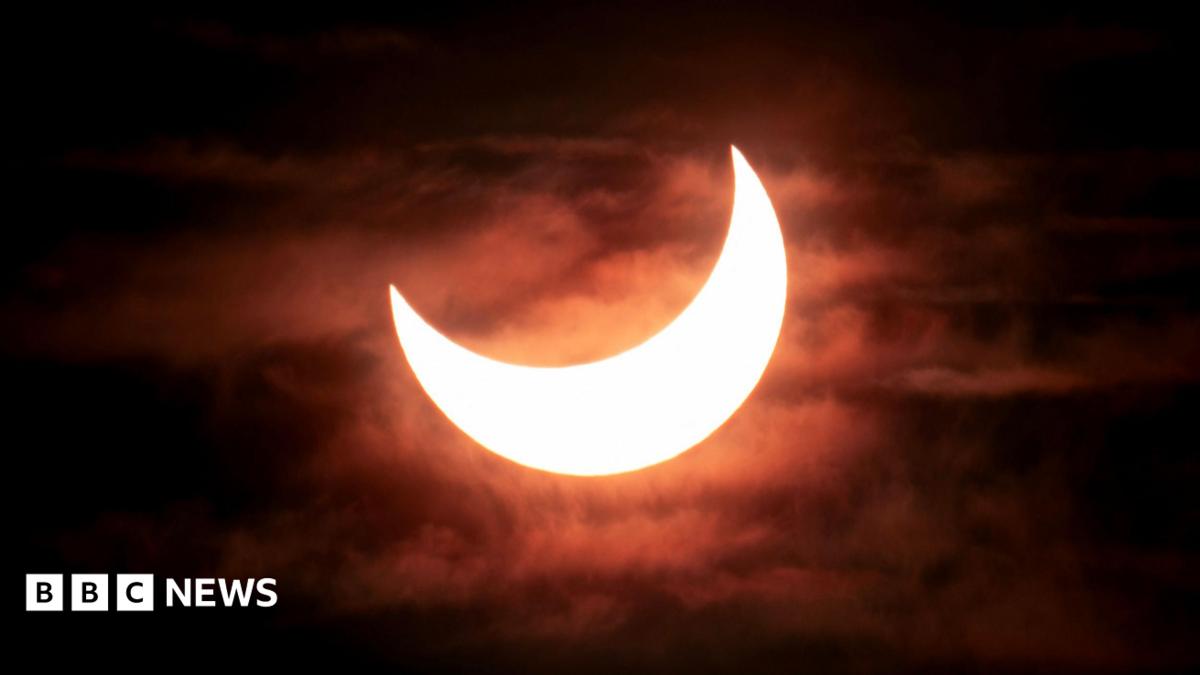
The UK will be treated to its fullest solar eclipse since 1999 - and the best the country will see for the next 50 years - on Wednesday evening.
It will be visible across the whole of the UK, with up to 96% of the Sun's disc covered by the Moon, depending on your location.
Other parts of the world will get to witness a total eclipse. This includes northern Spain, where hundreds of thousands of people have travelled for the astronomical spectacle.
The total eclipse will also be visible in Russia, Greenland, Iceland and Portugal.
Immersive: How to watch the UK and Europe's best eclipse in 27 years
In the UK, more than 90% of the Sun will be obscured by the Moon at the peak, which will fall between 18:58 and 19.15 BST, depending on where you are in the country.
Devon, Cornwall and the western parts of Pembrokeshire in Wales are set to see the eclipse at its fullest, with 94% to 96% of the Sun obscured by the Moon.
The rest of Wales, Northern Ireland, parts of the West Midlands and the South West, and the westernmost parts of Scotland can expect to see 92% to 94% solar coverage.
People across the UK have been scrambling for eclipse glasses - the specialist glasses used to watch the eclipse safely - with a staff member at a bakery in central London saying they had sold about 100 on Tuesday morning.
Eclipse chasers scramble for glasses as stocks run low
Image source, EPAImage caption, Experts urge people not to look directly at the Sun and to seek specialist glasses instead
But when it comes to the weather, fortunes will be mixed. In much of the UK, clear skies should give many a good view of the eclipse. However, across some parts of north Wales, northern England and especially Scotland and Northern Ireland, areas of cloud could move in between 18:00 and 19:00.
Across some parts of western Scotland and in towards the north and west of Northern Ireland, cloud could bring outbreaks of rain.
For those lucky enough to be in Spain, there will be clear skies for people to see a total eclipse in Bilbao, Valencia and Palma, Mallorca, while both Barcelona and Madrid will see more than 99% coverage.
Depending on the location, the total eclipse will peak between 20:26 and 20:33 local time (19:26 to 19:33 BST).
Crowds have been flocking from all over the world to northern Spain for the event with half a million visitors expected, according to the finance ministry.
Julie who travelled with her family from Brest, France, to the Spanish city of Burgos, said she was "very excited".
"We came from very far to see it in totality. I have seen [it] once and it was beautiful and amazing - I am so happy to have the chance to see one again."
Leonor Aguilar from Jaén, Spain, said: "During that minute and a half, what I hope to see is the grandeur of nature and to experience it with my family.
"We often spend money on trivial things instead of investing in something as beautiful as witnessing such a marvellous sight."
Martin Griffith, the director of Brecon Beacons Observatory, in Wales, described the eclipse as "one of the great phenomena of nature".
"It is going to be a fantastic eclipse in Spain, we are right on the path of totality," he said. "What they will see is about a minute and 40 seconds of totality. It will be dark, the Moon will completely cover the Sun.
"Although we know they happen quite often we're not always in the path of totality - they could be over the Pacific Ocean, but to have it over land is just incredible," he said.
The next time the Moon obscures as much of the Sun on the British Isles will be in 2081, and the next total solar eclipse in the UK will be in 2090.
To play this video you need to enable JavaScript in your browser.This video can not be played
A solar eclipse happens when the Earth, Moon and the Sun align - or almost align. The Moon sits between the earth and the Sun, blocking the amount of light we receive from our star.
A total solar eclipse happens somewhere on Earth roughly every 18 months.
But you have to be on the narrow path of the Moon's shadow to see it - the Moon's shadow traces a line called the path of totality as the Earth rotates and the Moon's position changes.
Anyone outside the path of totality, such as in the UK will see a partial eclipse – where the Moon blocks only part of the Sun.
Those who witness a total eclipse will first see the sky darken. Then, as the Sun is completely blocked, a pearly-white rim will appear around it. This is the Sun's atmosphere - called the corona.
It is a vast halo of superheated plasma extending millions of miles into space. The most dramatic sight of any total eclipse.
It is more than one million times fainter than the Sun's surface, which is why it is invisible in normal daylight.
And just above the visible surface sits a thin, pinkish layer called the chromosphere - only a few thousand kilometres thick.
During the first seconds of a total eclipse you see it as a narrow pink-red ring around the Moon's edge.
Watching a solar eclipse without eye protection could permanently damage your eyes.
Wearing sunglasses, welding goggles, or watching through your phone will not offer protection either.
You can only use binoculars or telescopes if they have a special solar filter.
The safest way is to use certified solar glasses or create a pinhole viewer.
Make a 3mm hole in one piece of paper or card. With your back to the Sun, you can project the eclipse as it happens on to another piece of white paper or card. Paper plates are ideal.
Other things in your kitchen can also make good eclipse viewers. A colander or a draining spoon will give you lots of mini-eclipses, with the images projected on to the ground while you stand with your back to the Sun.
Three ways to watch the solar eclipse safely without glasses
Could I see a meteor during the solar eclipse?During an eclipse, the sky darkens offering a short window to see the Perseid meteor shower, which also peaks on Wednesday evening.
Perseid meteor shower reaches peak: When and where to catch a glimpse
But this will only be in the areas witnessing a total eclipse - like Spain - and not in the UK where only a partial eclipse will be visible.
But even there, the chances are extremely slim. "You would have to get very, very lucky to see a shooting star during the total eclipse," Royal Astronomical Society research fellow Dr Becky Smethurst said.
Remember, for a solar eclipse you must use certified solar glasses - looking directly at the Sun without proper eye protection can cause permanent eye damage.
Where to enjoy the partial eclipse spectacle across the South West and the Channel Islands
Where to view the solar eclipse in the East Midlands
When and where to see the solar eclipse in Scotland
Solar eclipse: Where and when you can see it across North West England
When to see the eclipse in the North East and Cumbria