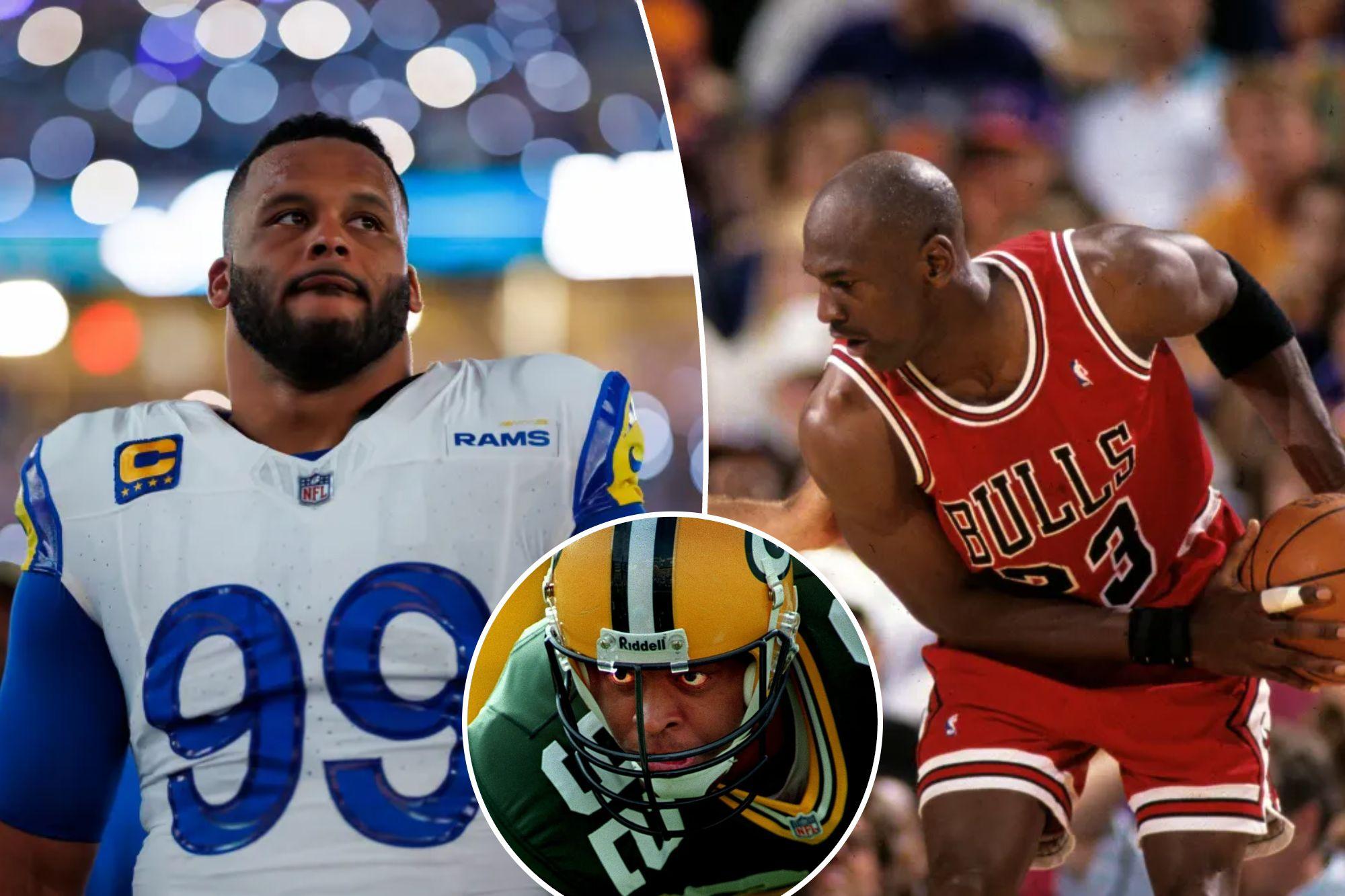
Add The California Post on Google The pull Aaron Donald is feeling to unretire and chase football greatness again is hardly unique. Sports history is littered with legends who walked away, only to hear, and ultimately heed, the same call.
Some, like Michael Jordan and Mario Lemieux, discovered that shaking off the rust was little more than a formality. They returned and quickly reclaimed their place among the best in their sport.
Others, like Deion Sanders and Randy Moss, never recaptured their previous greatness but still found ways to become valuable pieces on championship-caliber teams.
And then there are the cautionary tales — icons like Muhammad Ali and Reggie White whose comebacks offered a painful reminder that eventually even the greatest athletes meet an opponent they can’t beat: Father Time.
The 35-year-old Donald is about to find out where he belongs on that spectrum.
The good news is the Rams aren’t asking him to be the Aaron Donald who terrorized the NFL for a decade. They don’t need him playing 90 percent of the defensive snaps or chasing another Defensive Player of the Year award.
With Myles Garrett now wearing the Superman cape and commanding the kind of attention a player of his caliber demands, Donald will likely be asked to play 25 to 30 snaps per game, at least initially, with obvious passing downs and late-game situations serving as his primary calling cards.
And maybe that’s the most compelling argument for Donald to try this.
He doesn’t have to prove he can still be the best defensive player in football. The Rams don’t need him to be.
Provided everyone keeps that perspective, the floor for Donald should be high enough for him to remain a meaningful contributor. And given how special he has always been, it would be foolish to assume his ceiling isn’t considerably higher.
Jordan actually unretired twice during his illustrious career, producing two very different outcomes.
His first comeback was overwhelmingly successful. After retiring at 30 in 1993, Jordan spent roughly 18 months away from the NBA before returning late in the 1994-95 season.
Jordan and the Bulls eventually won three more championships, with Jordan claiming three Finals MVPs and two league MVP awards.
The important Donald parallel: Jordan was still physically capable of being Jordan. The layoff refreshed him rather than diminished him.
His second comeback, with Washington at 38, provides the cautionary side of the same story. Jordan remained a very good player. He just wasn’t the unstoppable force everyone remembered.
If you’re looking for the most optimistic Donald comparison, Lemieux might be it.
He was 31 when he retired in 1997 and stayed away for three-and-a-half years. He was already in the Hockey Hall of Fame when he returned in December 2000, and it took almost no time for him to resume playing at an elite level.
Lemieux ultimately played into 2006, offering compelling evidence that generational talents can disappear for years and return with extraordinary skills that simply don’t erode the way they do for ordinary players.
Arguably the greatest cornerback of all time, Sanders retired after the 2000 season and spent three full seasons away before returning with the Baltimore Ravens in 2004 at 37.
Sanders became an effective situational defensive back in nickel and dime packages, which might make him one of the more relevant comparisons for Donald. The Rams won’t need Donald to be a down-in, down-out anchor. They need him to make an impact when the situation demands it.
Twenty-five great snaps can be more valuable than 60 ordinary ones.
White is a fascinating comparison because he occupies the same rarefied defensive-line neighborhood as Donald.
There is one significant distinction: White was 38 when he initially retired in 1998 and 39 when he returned with the Carolina Panthers in 2000. That four-year age difference from Donald matters.
White started all 16 games but recorded only 5.5 sacks. After the season, he retired again, this time for good.
White provides the obvious warning: No matter how great you are, and no matter how badly you want it, greatness versus age eventually becomes a one-sided fight.
Moss retired after the 2010 season, sat out 2011 and returned with the 49ers in 2012 at 35.
He caught only 28 passes for 434 yards, a fraction of what he produced during his prime. But he contributed to a team that reached the Super Bowl.
That raises another intriguing question for Donald: What if success isn’t measured by whether he still looks like the old Aaron Donald?
What if it’s simply whether this version of Aaron Donald helps the Rams win another championship?
If the answer is yes, nobody will care what the snap count or sack total says.
Foreman represents one of the most remarkable comeback stories in sports history — and perhaps the ultimate age-defying success story.
After retiring from boxing in 1977 at 28, Foreman stayed away for a decade before returning at 38. Seven years later, at 45, he remarkably reclaimed the heavyweight championship.
Foreman is obviously an extreme example. But his story provides perhaps the greatest evidence that truly generational athletes sometimes operate by different rules.
Donald has spent his entire career proving he belongs in that category.
Ali retired at 37, only to return a year later. He lost badly to Larry Holmes and then lost again to Trevor Berbick before finally walking away for good.
None of it erased what Ali had accomplished or diminished his place among the greatest athletes who ever lived.
But anyone who watched the proud champion absorb punishment from Holmes could never completely unsee it.
His legacy is secure. Nothing that happens during a comeback can erase the decade of dominance that made him one of the greatest defensive players in NFL history.
Donald is betting that his will look a lot more like Jordan, Lemieux or Foreman than Ali or White.
And perhaps the biggest thing working in his favor is that he doesn’t need to turn back the clock.
He only needs to stop it for 25 or 30 snaps at a time.