Five years after the Taliban returned to power, millions of Afghan girls remain excluded from secondary education. UNESCO warns of lasting social and economic consequences.
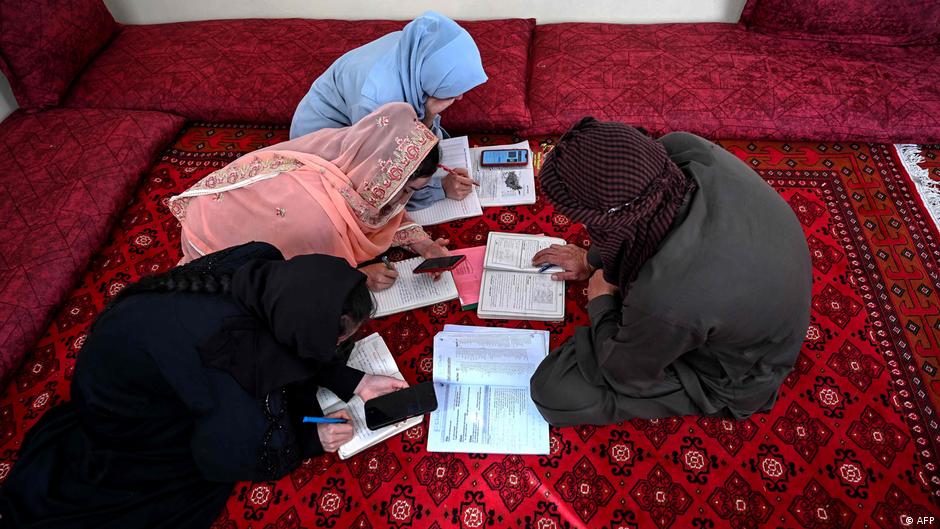
https://p.dw.com/p/5IevmA father teaches his children at home in Afghanistan, where access to education remains severely restricted for girls [FILE: August 6, 2026]Image: AFPAdvertisementAround 2.4 million girls in Afghanistan have been denied access to secondary education since the Taliban returned to power in 2021, UNESCO said Tuesday.
The figure has risen by about 200,000 since last year and could reach nearly four million by 2030 if the ban remains in place.
"Afghanistan remains the only country in the world where girls and women are formally banned from secondary and higher education," Hoda Jaberian, UNESCO’s program coordinator for education in emergencies, said.
"Five years is not a temporary interruption in a child’s education. It is clearly almost an entire secondary school cycle."
The Taliban seized power on August 15, 2021, as US and NATO forces withdrew after two decades of war.
They initially assured the international community that women would be allowed to continue studying.
But secondary schools were closed to girls in March 2022. Women were barred from universities in December that year.
The Taliban described both measures as temporary, but they remain in force.
The authorities say they respect women's rights in line with their interpretation of Islamic law and Afghan culture. They have also insisted the issue is a domestic matter.
Restrictions extend beyond education. Women face limits on employment and movement and have been barred from public parks, gyms and beauty salons.
The UN has described the broader system of restrictions as “gender apartheid.” Russia is the only country to formally recognize the Taliban administration.
UNESCO says the restrictions have reversed two decades of progress.
Girls had very limited access to schooling in 2001. By 2021, nearly one million were enrolled in secondary education.
"Afghanistan had made really major progress in expanding girls’ access to education," Jaberian said. "But unfortunately, much of that progress now has been completely reversed."
UNESCO has called for the immediate and unconditional restoration of girls' and women's right to secondary and higher education.
The agency continues to support community-based education as well as literacy and skills programs, often held in community spaces or facilitators' homes.
UNESCO estimates that excluding women from secondary and higher education could push around 600,000 women out of the workforce by 2066.
The restrictions could also cause cumulative income losses of 9.6 billion US dollars and increase the risk of early marriage.
The ban is also worsening a shortage of female teachers. UNESCO expects Afghanistan to face a deficit of more than 11,000 qualified female teachers by 2030.
"Many teachers have left the country and those who were in the system are banned from continuing teaching," Jaberian said.
She added that restrictions on women teaching boys had left some pupils with unqualified male teachers or no teachers at all.
Afghanistan's education system is facing problems far beyond the ban on girls.
More than two million primary school children are already out of school for other reasons. More than 90% of 10-year-olds cannot read a simple text, while the national literacy rate stands at 37%.
Many schools are overcrowded and poorly equipped. Nearly half lack water, sanitation or heating.
The system is also under pressure from people returning to Afghanistan.
Three million people returned in 2025 alone, either voluntarily or forcibly. More than seven million have returned or been forced back since 2023.
Natural disasters have added to the crisis. Earthquakes, floods and other disasters have forced around 1,000 schools to close since 2021, UNESCO said.
Don't let the algorithm hide the news. If you rely on our team for trusted reporting, please take a moment to select us as your Preferred Source on Google by clicking here and hitting the "star" or "preferred" button, so you'll always see our verified news first.