Hungary's parliament has overwhelmingly confirmed Andras Baka, formerly the head of the Supreme Court, to the largely ceremonial role of president. New Prime Minister Peter Magyar controversially removed his predecessor.
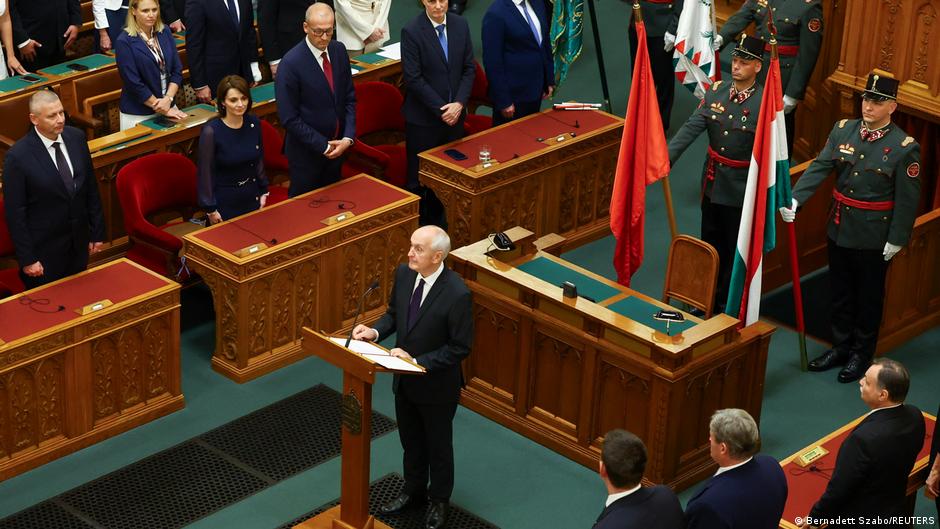
https://p.dw.com/p/5Ie3xAndras Baka was ousted by Orban as head of the Supreme Court in 2011, but now replaces a president whose term was cut short by Orban's successorImage: Bernadett Szabo/REUTERSAdvertisementHungary's parliament voted in Andras Baka, formerly the head of the Supreme Court, as the country's next president on Tuesday.
The symbolic step is part of new Prime Minister Peter Magyar's sweeping efforts to dismantle the legacy of former premier Viktor Orban after winning April's general elections.
Baka was a staunch critic of Orban who was removed from his Supreme Court role during the former PM's tenure.
Now, he will replace Tamas Sulyok, a president appointed by Orban, whose term in office was shortened via constitutional amendment in order to remove him from the largely ceremonial role.
The vote in parliament to appoint Baka was always likely to be a formality, given the massive majority that Magyar's conservative, pro-European TISZA party holds in the chamber.
It went almost entirely along party lines, 140 lawmakers voted in favor and six voted against. TISZA holds 141 seats.
Orban's right-wing populist Fidesz party, which has 52 lawmakers, boycotted the vote in protest — but did so knowing it would be powerless to prevent Baka's appointment.
Baka, 73, is a jurist and politician who was briefly a member of parliament from 1990 to 1991.
He spent almost 20 years as a judge at the European Court of Human Rights (ECHR), before returning to Hungary in 2009 to become president of its Supreme Court.
In December 2011, not long after Orban returned to power as prime minister after a stint in opposition, he was removed from his role three years before his term was set to expire and sidelined from public life in Hungary.
Magyar said Baka's life served "as an example of commitment to the democratic rule of law and constitutional principles" as the central European country needs to be "guided back onto the path of the rule of law and constitutional governance."
Baka's appointment prompted protests from Fidesz, but also some critical comments elsewhere in Hungary, with some rights watchdogs likening the removal of Tamas Sulyok to the "illiberal" practices of the Orban-era.
Sulyok, appointed in 2024, was deemed an Orban ally.
Magyar used his two-thirds majority in parliament — which he holds thanks to Hungary's winner-takes-all first-past-the-post electoral system, as Orban used to — to amend the constitution and bring his term to an early end.
Fidesz and their nationalist KDNP allies in parliament had called this "tyrannical" and "illegitimate," while Magyar argued it was necessary to pursue the "system change" he promised amid April's landslide election victory.
Magyar briefly tapped Hungarian national treasure and chess superstar Judit Polgar as a possible replacement president, but she quickly declined, saying she did not feel she had "the strength to take on the historic responsibility of uniting a divided nation," but pledging to do "everything in my power" to support a new, independent and respected president.
Baka himself had not criticized Sulyok's removal, despite the echoes of the mechanisms used to oust him in 2011.
"In a country governed by the rule of law, such extraordinary measures cannot be used, but Hungary became a captured state under Orban," he told the AFP news agency last month. He said that state officials like Sulyok "were appointed not to restrain the government's power, but to ensure the political survival of the former system even after an electoral defeat."
However, speaking in parliament on Tuesday, Baka seemed to strike a conciliatory tone, even for supporters of the old regime.
"There is one thing we certainly cannot do: we cannot build the new Hungary on revenge," he told parliament, vowing to "encourage public and professional debate, uphold [parliament's] openness and impartiality, and consistently insist that constitution-making must never again become the exclusive project of a single political force."
If you rely on our team for trusted reporting, please take a moment to select us as your Preferred Source on Google, so you'll always see our verified news first.
Hungary new PM lifts lid on Orban-era government luxuryTo view this video please enable JavaScript, and consider upgrading to a web browser that supports HTML5 video