Economic recovery, youth turnout, women's representation and judicial independence are among the issues shaping Zambia's vote on Thursday.
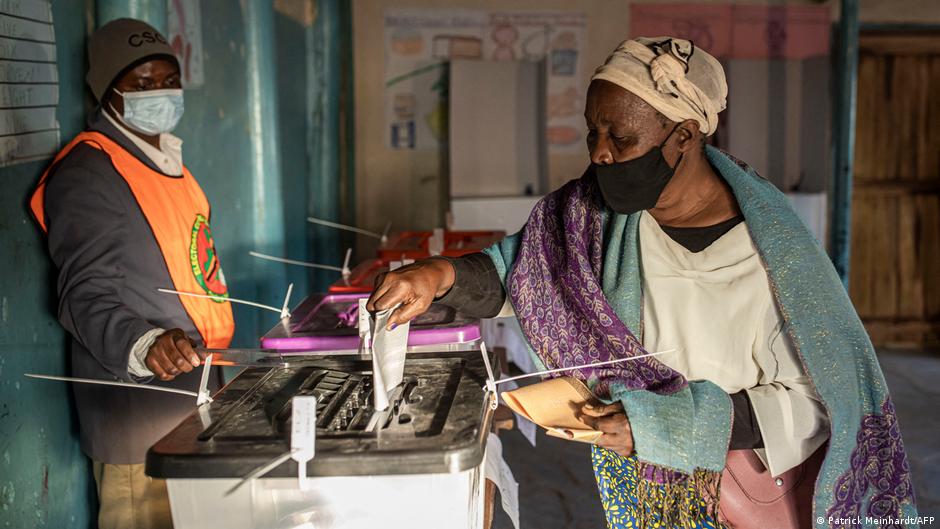
https://p.dw.com/p/5IcdDUp to 8.7 million voters will decide whether Hichilema's economic reforms deserve another term Image: Patrick Meinhardt/AFPAdvertisementZambia's general election on Thursday will be fought on economic recovery, governance reforms and a sweeping change to the country's parliamentary map.
Incumbent President Hakainde Hichilema, leader of the United Party for National Development (UPND), is seeking a second term against 14 opponents.
His principal challenger is Brian Mundubile, a former ally of the late President Edgar Lungu, who has surged to the front of a fragmented opposition after being backed by a coalition of rival parties.
The Electoral Commission announced in April that 70 new constituencies would be added, raising the number of parliamentary seats from 156 to 226, creating smaller, more local voting districts. Up to 8.7 million voters are expected to take part in the elections, a majority of whom are women.
Economic issues dominate voters' concerns. Official data shows that over 70% of the population lives on less than three dollars a day, and many households survive on salaries between $60 and $100 a month while grocery prices keep rising.
"I would like the new government to increase our salaries. Mealie meal (maize meal) is very expensive. Everything is expensive," said security guard Lucky Mutelo.
Rebecca, a market shopper, echoes the sentiment, noting that "the cost of living is still too high."
The government has been making significant gains on these issues.
Hichilema's government has secured a landmark debt restructuring agreement, restoring an International Monetary Fund program and supporting economic growth. Inflation fell to 6.5% in June this year.
The administration has also rolled out free education and an expanded Constituency Development Fund, which allocates public money directly to each of the country's constituencies to finance community-driven local development projects and infrastructure.
Nevertheless, a historic drought that crippled agriculture and forced severe hydro‑power load‑shedding has strained household finances.
To get elected president, a candidate must secure 50% plus one of the total votes cast. If no contender reaches this threshold, the two highest‑scoring candidates will face off in a second round — a mechanism designed to ensure that the president enjoys a clear popular mandate.
Because there are 14 names on the ballot, even small swings in support across the ten provinces could determine whether the election goes to a second round.
Our time is now: Zambia's youth running in electionsTo view this video please enable JavaScript, and consider upgrading to a web browser that supports HTML5 video
Analysts say the election's outcome would hinge on urban centers such as Lusaka and the Copperbelt, where cost‑of‑living pressures are most acute, while rural provinces traditionally follow established party loyalties.
Rural voters in the Southern, Western and North‑Western provinces historically back the UPND, whereas the opposition targets the Northern, Luapula and Eastern provinces.
Agence France-Presse (AFP) reported that the high youth turnout that propelled the current president Hakainde Hichilema to a landslide victory in 2021 is expected to be a decisive factor again, especially in the densely populated urban districts.
Nearly half of registered voters are aged between 18 and 35, making young people a potentially pivotal bloc, Institute for Security Studies researcher Zenge Simakoloyi told AFP.
Gender representation is another prominent theme. In this election, there is one female candidate for president, and four female running mates.
Mwaka Nyirenda is one of a handful of women contesting for a parliamentary seat.
"Politics is still a man's world. People doubt you, underestimate you and try to intimidate you," she told DW, noting that the financial bias still favors male candidates.
Women comprise roughly 51% of Zambia's population but hold only about 15% of parliamentary seats, and fewer than 20% of political leadership positions.
Leah Diana Mitaba, publicity secretary of the Non‑Governmental Coordinating Council, warns that these figures "demonstrate that Zambia remains far from achieving the 50:50 gender representation envisaged in the Constitution, the SADC Protocol on Gender and Development, the African Union Agenda 2063 and the UN Sustainable Development Goals."
Girls Gone Political, a civil‑society group, campaigns for greater female participation. Its leader, Dorothy Mtanga, thinks more civic education is needed. "There's the need for sustained democratic civic education to ensure that more women are elected into office," she said.
This election also raises questions about the independence of Zambia's judiciary.
Can Zambia trust election referee?To view this video please enable JavaScript, and consider upgrading to a web browser that supports HTML5 video
In 2024, President Hichilema suspended three Constitutional Court judges who ruled in favor of his rival, former President Edgar Lungu.
Lawyer Linda Kasonde argued that "judicial independence is the ability to adjudicate on any matter, without fear or favor, regardless of the stakes involved in the case." In practice, opposition lawyers think the executive is trying to interfere with justice delivery.
Kasonde identifies two recent concerns. First, an executive‑approved salary increase for judges that bypassed the constitutional emoluments commission.
"The government increased salaries for judicial officers in 2025 outside the proper procedure, raising questions about whether the process was independent," she told DW.
Second, the appointment of 16 new judges in early 2026, many of whom hail from the incumbent's strongholds.
"These appointments call into question whether any decisions that will be made regarding the elections will be done independently," lawyer Kasonde concluded.
Amnesty International says Zambian laws including the Public Order Act and cybercrime legislation have been weaponized to restrict dissent, opposition gatherings and freedom of expression. It also warns that the increasing use of criminal charges against government critics could have a chilling effect on political expression.
Chief Justice Mumba Malila recently reassured the public.
"The judiciary stands ready to discharge its constitutional responsibility, independently, professionally and within the strict timelines established by the law," he said. Critics, however, maintain that true independence requires full structural and financial autonomy from the executive.
Zambia's status as one of the region's stable multi‑party democracies in the Southern African Development Community (SADC) means that this election will influence regional democratic norms.
The country's ability to host a peaceful transition or renewal of power is a barometer for neighboring states, especially after recent defeats of incumbents in Botswana and Malawi.
Polls will be open from 6:00 a.m. to 6:00 p.m. Zambians will elect a president, National Assembly members, mayors, councilors, and council chairs.
This election holds the potential to either consolidate President Hichilema's reform agenda or usher in a new administration.
This article was compiled from several DW video reports covering Zambia's 2026 general election