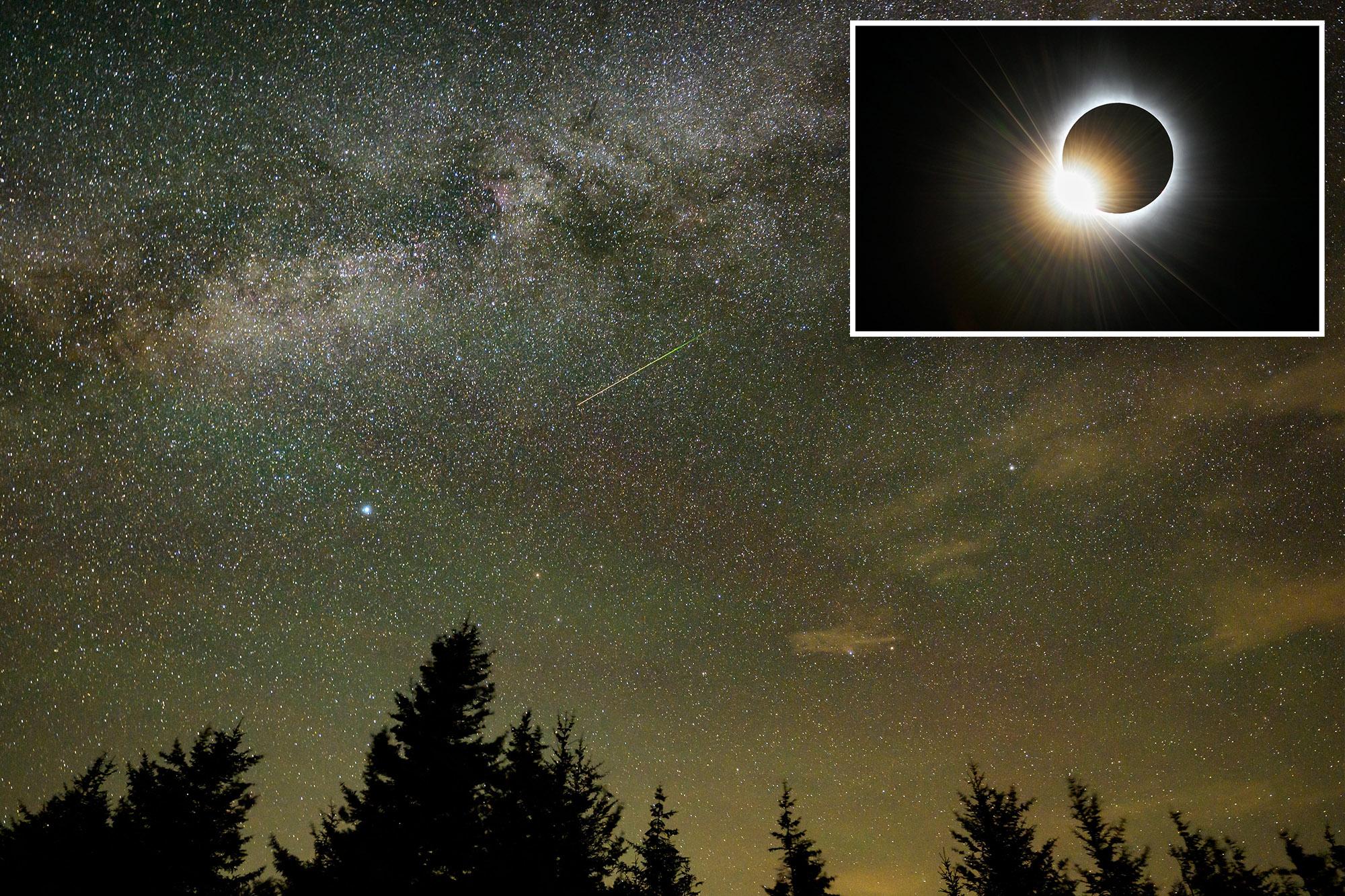
On August 12, the skies will be graced by a planetary parade, meteor shower, new moon and a solar eclipse. USA TODAY Network via Reuters Connect See more of our coverage in your search results.
Add The New York Post on Google The stars will align on Wednesday.
Stargazers should prepare for a series of space spectacles on August 12, as a solar eclipse, meteor shower, and a planetary parade are all gracing the skies on the same night.
“It’s a very exciting opportunity for amateur astronomy observers, or really anyone who can get a shot at the clear sky,” Darryl Seligman, an astronomy professor at Michigan State University, told the Post.
Kicking off this cosmic decathlon is the planetary alignment, in which Saturn, Mars, Mercury, Jupiter, Uranus and Neptune will appear in the sky simultaneously, Fox News reported.
Skywatchers can catch the celestial sextet by looking toward the Eastern horizon around 30 minutes to an hour before sunrise.
Saturn and Mars will be easiest to spot, followed by Mars and Mercury, although the latter two will sit low on the horizon and therefore clear, unobstructed view to catch them before they get lost in the sun’s glare.
Meanwhile, viewing Uranus will require binoculars, while a telescope will likely be necessary to see Neptune, according to Seligman.
Stargazers don’t need to wait until August 12 to see the show. “The arrangement won’t change much in the next few days,” Qicheng Zhang, of the Lowell Observatory in Flagstaff, Arizona, told the Post. “So you should be able to basically see it now, with the further addition of a crescent moon that won’t be there by/after the 12th.”
Despite their peculiar formation, the planets aren’t actually aligned. The event is an optical illusion that occurs when the cosmic bodies appear in the sky simultaneously, even though they’re really millions to billions of miles apart and orbiting the Sun’s ecliptic plane at different speeds and distances.
This heavenly happy hour will also see the arrival of a solar eclipse, in which the moon passes between the sun and the Earth.
Unfortunately, the total version — when the sun is completely blotted out, seemingly turning day into night — will only shroud certain parts of Europe. However, parts of North America will have the opportunity to witness a partial eclipse, when the moon only overlaps a small portion of the Sun, meaning we won’t get the eerie twilight effect.
In New York, the partial eclipse will last for roughly an hour and a half, beginning at 1:07 p.m., peaking at 1:54 p.m. and ending at 2:38 p.m.
Despite the muted effect, New Yorkers will still need to don special certified eclipse glasses — and not regular sun shades — to avoid permanent retinal damage.
What better way to end this skywatching extravaganza than by glimpsing what NASA calls the “best meteor shower of the year.”
Dubbed the Perseid Meteor Shower, this annual spectacle occurs when the Earth passes through the Comet Swift-Tuttle’s debris stream, causing “tiny bits of comet dust” to hit our atmosphere at high speed and burn up as streaks of light.
There can be 50 to 100 meteors per hour during this interstellar fireworks display, making the Perseids the most prolific of all annual meteor showers.
“If you go stargazing for 10 minutes you should be able to see 10-20 shooting stars!” exclaimed Professor Seligman.
Along with the volume, this shower is also known for creating “fireballs,” bursts of light and color that last longer than the average meteor.
While this pyrotechnic phenomenon lasts until August 24th, it will reach its peak “on the night of Aug. 12 into the early morning of Aug. 13,” according to NASA.
For optimal viewing, stargazers are advised to look to the Northeast for the constellation Perseus — after which the shower is named — when it’s fully dark.
Fortunately, finding this star cluster is not a must, as the “meteors can appear anywhere overhead,” per NASA.
“The best way to watch the Perseid meteor shower is to find a location with dark skies, give your eyes 20 to 30 minutes to adjust to the darkness, and simply look up,” the org advises. “Then sit back, be patient, and enjoy one of the year’s premier celestial shows.”
Fortunately, viewing of the Perseids will be especially good to this year due to the new moon, which will make “the sky much darker and easier to see,” according to Seligman.
Although, as Zhang explained to the Post, the new moon “isn’t out of the ordinary” as they always coincide with “solar eclipses” like the one on August 12.