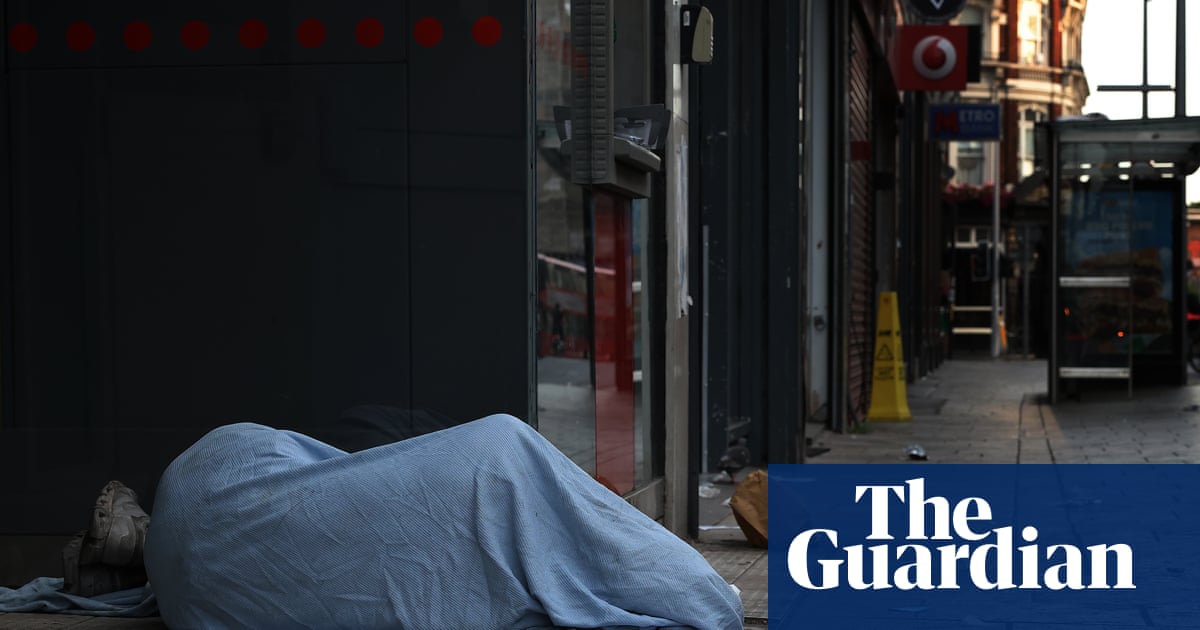
A rough sleeper in south London. In 2025-26, 15,155 people freed from prison were without housing – an 18% increase on the previous year. Photograph: Martin Godwin/The GuardianView image in fullscreenA rough sleeper in south London. In 2025-26, 15,155 people freed from prison were without housing – an 18% increase on the previous year. Photograph: Martin Godwin/The GuardianBurnham rough-sleeper pledge at risk from failures in housing ex-prisoners, charity warnsAnalysis finds nearly one in six people leaving jail last year in England and Wales were released into homelessness
Andy Burnham’s pledge to end rough sleeping is under threat from a failure to find accommodation for a growing number of newly released prisoners, a charity has warned.
An analysis by the social justice charity Nacro has found that nearly one in six people leaving jail in England and Wales last year were released into homelessness, reaching the highest rate for five years.
Between April 2025 and March 2026, 15,155 people freed from prison were without housing – equivalent to 300 people every week and an 18% increase on the previous year.
In a bold first pledge in his first speech as prime minister, Burnham promised to eradicate rough sleeping in England, allocating an extra £340m of funding over three years.
But since then, he has been forced to sign off the early release from October of about 5,000 prisoners including domestic abusers and two of the killers of PC Andrew Harper.
Enver Solomon, the chief executive of Nacro, said the proportion of prison leavers released without accommodation had increased every year for five years, rising from 10.6% in 2021-22 to 15.9% this year.
“To deliver on the prime minister’s pledge to end rough sleeping, there must be an urgent focus on reducing homelessness after prison,” he said.
“The consequences are clear: three in four people released to rough sleeping reoffend within a year, compared with just over a third of those released into accommodation. A safe home isn’t just somewhere to sleep – it’s one of the strongest foundations for reducing reoffending and keeping communities safe.”
Prisons and the probation service have a duty to refer offenders to a local authority if they are at risk of homelessness, which means either living on the streets, squatting or relying on night shelters.
The total number of people released from prison has been rising, in part because of early release schemes, but the proportion released into homelessness has outpaced this.
In 2021-22, the proportion of prison leavers released into homelessness was 10.6%; this grew to 11.6% in 2022-23, 13.2% in 2023-24, and 14.9% in 2024-25. This year it stands at 15.9%.
More than 1,300 women were released homeless or to rough sleeping in 2025-26, a 27% increase on the previous year.
Read moreGovernment figures also provide a regional breakdown of the number of prisoners released into homelessness.
These show that south-central England – which covers Hampshire, the Isle of Wight, Berkshire, Oxfordshire and Buckinghamshire – has the highest rate, at 20.7%, followed by the East Midlands at 19.1% and the east of England at 18.4%. Wales has the lowest percentage released into homelessness, at 11.1%.
The reasons for the rise were documented by the prisons watchdog’s annual report last month.
Charlie Taylor, the chief inspector of prisons, found that many prisons reported up to 30% of prisoners had no settled address, that prisoners were often released directly from court without access to services, and that short sentences and recalls often lasting 14 days had made housing planning difficult.
A report in December by the Ministry of Housing, Communities and Local Government found there was inadequate training and awareness of prisoners’ needs among housing staff, that support was often fragmented and that much of the available accommodation was substandard.
Government sources confirmed on Monday night that officials were still examining whether they could block the release of Harper’s killers.
They are looking at ways to keep Jessie Cole and Albert Bowers in prison. The pair were jailed for 13 years in 2020 for manslaughter. Henry Long, the main perpetrator, will not be subject to early release.
Burnham announced last week that rapists, groomers and those who had committed serious child sexual offences would be excluded from the policy.
In the national plan to end homelessness, published last December, the government committed to halving the proportion of offenders on probation who became homeless on their first night out of prison.
A government spokesperson said: “This government inherited a prison system on the brink of collapse and a homelessness crisis, with rough sleeping having more than doubled since 2010.
“We know that reoffending rates among homeless offenders are roughly twice those in stable accommodation, which is why we’re working with local councils and charities to halve prison leaver homelessness by 2029.
“More broadly, the prime minister has announced a new national effort to end rough sleeping, backed by investment of an additional £340m – taking overall funding to record levels.”