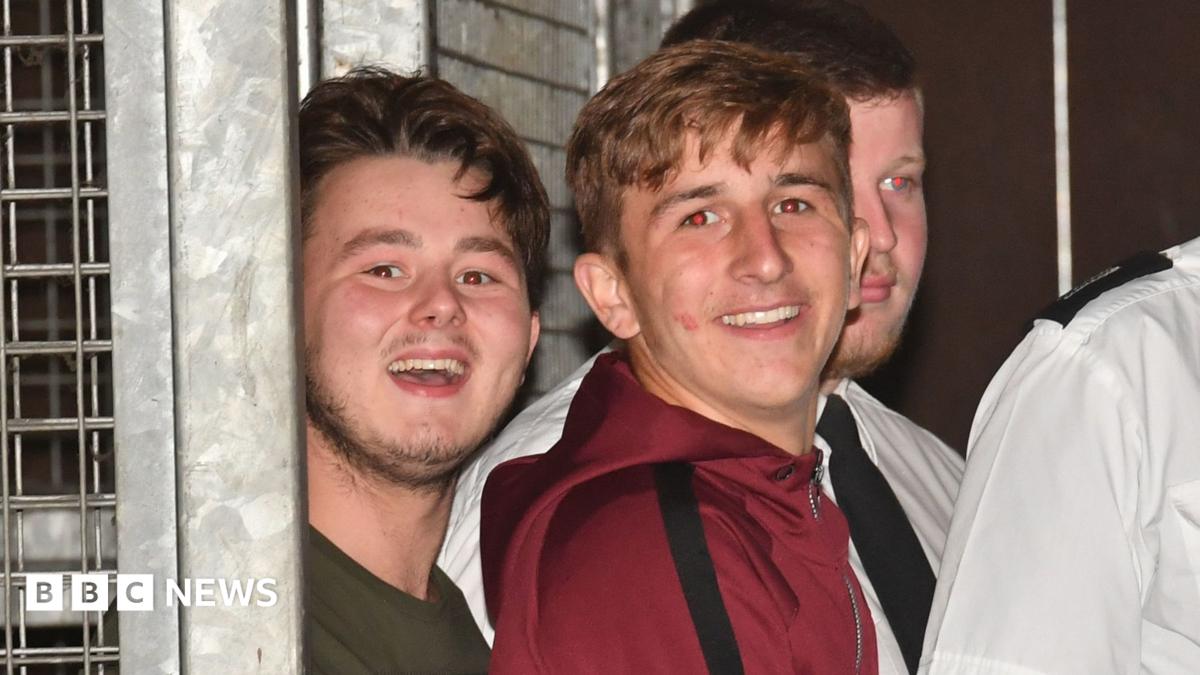
Image source, PA MediaImage caption, Albert Bowers (left) and Jessie Cole (centre), seen leaving court in 2019, are eligible to be freed under the early release scheme
Prime Minister Andy Burnham has told his justice secretary to find a way to exclude PC Andrew Harper's killers from an early release scheme designed to ease prison overcrowding.
Burnham is confident a solution can be found to remove Jessie Cole and Albert Bowers, who were sentenced to 13 years for manslaughter in 2020, from the government plan, the BBC has been told.
Downing Street had earlier warned that it would not be possible to exclude "one or two offenders" convicted of manslaughter from the early release of prisoners.
PC Harper, 28, from Wallingford, Oxfordshire, died in 2019 when he was dragged behind the getaway car of three teenagers who had fled the scene of a quad bike theft in Berkshire.
Under changes to the Sentencing Act made this year, Cole and Bowers, who were found not guilty of murder, will become eligible for release from custody next January after serving half of their sentences.
They are in a category of prisoners - those who have committed certain serious violent or sexual crimes - who until now would have had to serve at least two-thirds of their sentence in jail before being considered for release.
It is not yet clear how the government will prevent Cole and Bowers from being treated the same as other prisoners with similar sentences.
If ministers said, for example, that prisoners with manslaughter convictions could not be considered for the scheme, that would have an instant impact on many other inmates.
A government spokesperson told the BBC: "The prime minister has asked the Justice Secretary to work through further options to keep a greater number of the most serious offenders in prison, including the killers of PC Harper."
A source said the Justice Secretary Alex Norris would set out "in due course" how the government would exclude Cole and Bowers from early release.
The prime minister has been making daily calls while on holiday to find a solution, sources told the BBC.
Around 5,000 people are expected to be released under the sentencing changes, down from 6,000 after exemptions were previously announced for those convicted of the most serious crimes including rape, child sex offences and grooming.
The third man jailed for the manslaughter of PC Harper - the vehicle driver Henry Long - was given a longer 16-year jail term. Because he received what is called an extended determinate sentence at the time, he cannot be considered for this early release scheme.
Image source, PA MediaImage caption, PC Andrew Harper married Lissie just four weeks before he was killed
PC Harper's widow, Lissie Harper, has been among a growing number calling for Cole and Bowers to be denied early release. She and PC Harper had been married for just a month when he was killed in the line of duty.
Lissie Harper previously led a successful campaign for Harper's Law, which introduced mandatory life sentences for anyone convicted of killing an emergency worker whilst committing a crime.
Former police dog handler Chris Bushnell, who was at the scene of PC Harper's death, said he was "shaking" when he heard that two of the officer's killers might be released early from prison.
Bushnell was waiting in a lay-by near Sulhamstead, west Berkshire, in August 2019 when the teenagers' vehicle appeared, dragging PC Harper along the ground.
The former constable gave chase until he was ordered to stop and remain where he was. He said: "I've seen people die before. I've seen suicides. This was beyond brutal. It was awful."
"To think they could be released early is absolutely outrageous," Bushnell said.
"I'm angry with them, but I'm also angry with the government. They're spitting in the face of police officers."
Aileen O'Connor, chairwoman of Thames Valley Police Federation, added: "The public are speaking loudly and clearly. They agree with us that the government are firmly on the wrong side of this."
About 900,000 people have signed O'Connor's petition to stop the killers' early release.
Image source, Thames Valley PoliceImage caption, About 900,000 people have signed a petition in PC Harper's name
But ministers have said prison spaces might run out as soon as October.
Dame Vera Baird, a former victims' commissioner, told BBC Two's Newsnight that one "good thing" the government has done is invest money in victim support services, as there would be many people currenty concerned that their attackers will be walking the streets sooner than they had expected.
She said the government "need to look at the right people to be letting out more carefully than they've managed so far".
Dame Vera added that women and people jailed under controversial Imprisonment for Public Protection (IPP) sentences could also be considered for early release to alleviate pressure on prisons.
IPP sentences were introduced in 2005 and allowed judges to give out sentences with no maximum tariff to perpetrators of serious crimes or repeat offenders.
The sentences were scrapped in 2012, but were not retrospectively applied. As of this year, more than 2,000 people are still in prison on IPP sentences according to the United Nations (UN),, external who have called for the end of IPP sentences.
"I think somebody has to just seize the thing and get it sorted," Dame Vera said. "There has to be a wholesale resentencing attempt, I think, and really that does need thinking through."
Contact formContact formRelated topicsPC Andrew Harper death retrialBerkshireMore on this storyKilled a month after his wedding - why PC Andrew Harper's story touched so many
PC Harper widow 'won't give up' early release fight
Justice secretary apologises to families affected by early release scheme